
1. Introduction
Emergency stop (e-stop) buttons are non-negotiable safety components in industrial environments. They instantly halt machinery during hazards, protecting workers from injury and preventing equipment damage. Choosing the right e-stop button isn’t just a matter of functionality—it’s a legal and safety requirement aligned with standards like IEC 60947-5-5 and OSHA 1910.
Many procurement teams struggle with e-stop selection, focusing solely on cost while overlooking critical specifications. A poorly chosen e-stop—whether incompatible with voltage requirements, unprotected against harsh conditions, or incorrectly mounted—can fail when needed most. For example, a non-waterproof e-stop in a washdown facility may corrode and malfunction, while a button with the wrong voltage rating could short-circuit during an emergency.
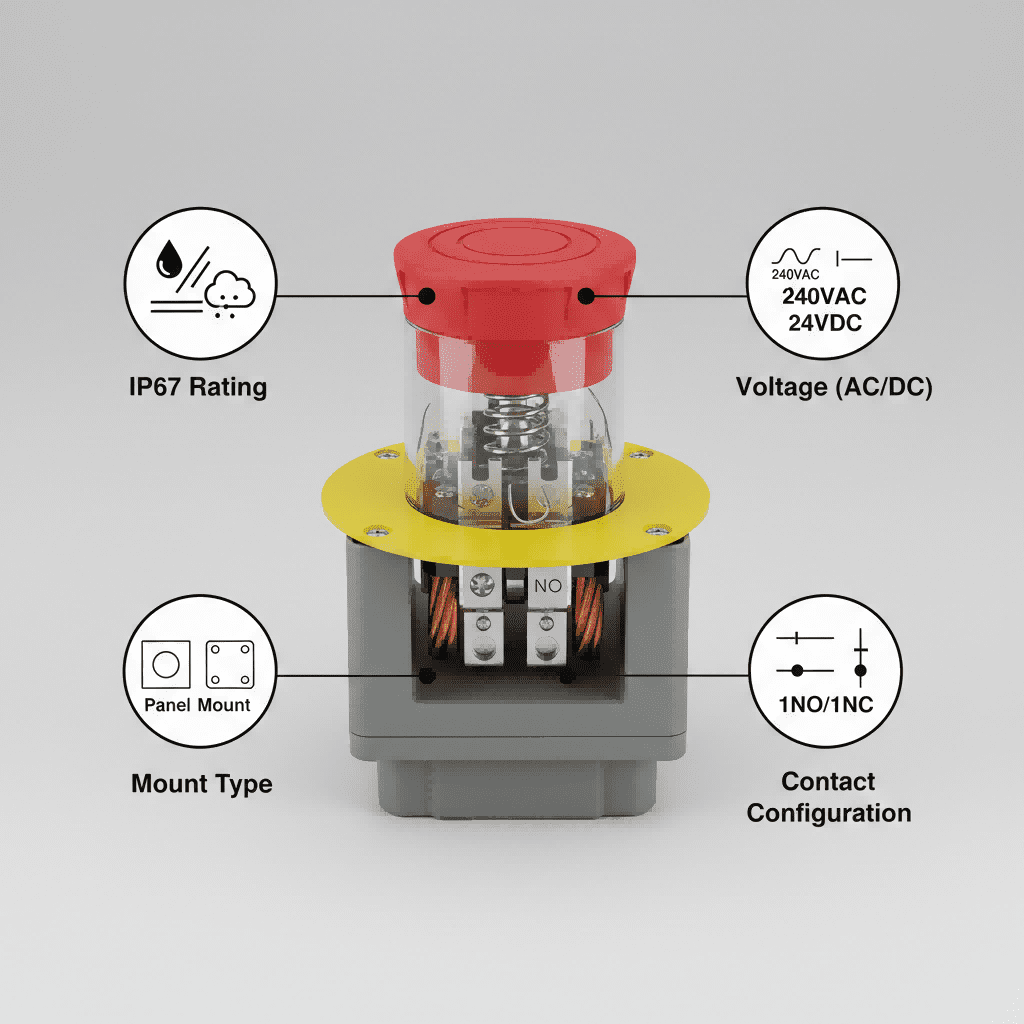
This guide breaks down the three most critical specifications for e-stop buttons: IP rating (environmental protection), voltage compatibility, and mount type. It also includes real-world application case studies, a step-by-step buying process, and compliance considerations to ensure you select a safe, reliable, and compliant emergency stop button for your industrial needs.
Key terms defined upfront:
- Emergency Stop (E-Stop) Button: A manually operated switch designed to immediately stop hazardous machinery or processes when pressed.
- IP Rating (Ingress Protection): A standard (IEC 60529) that classifies a device’s protection against solid objects (dust) and liquids (water).
- Voltage Rating: The maximum electrical voltage an e-stop button can safely handle without failure.
- Mount Type: The method of installing the e-stop (e.g., panel mount, surface mount) and its physical dimensions (e.g., 22mm, 30mm).
2. Critical Specifications for Emergency Stop Buttons
2.1 IP Rating: Environmental Protection
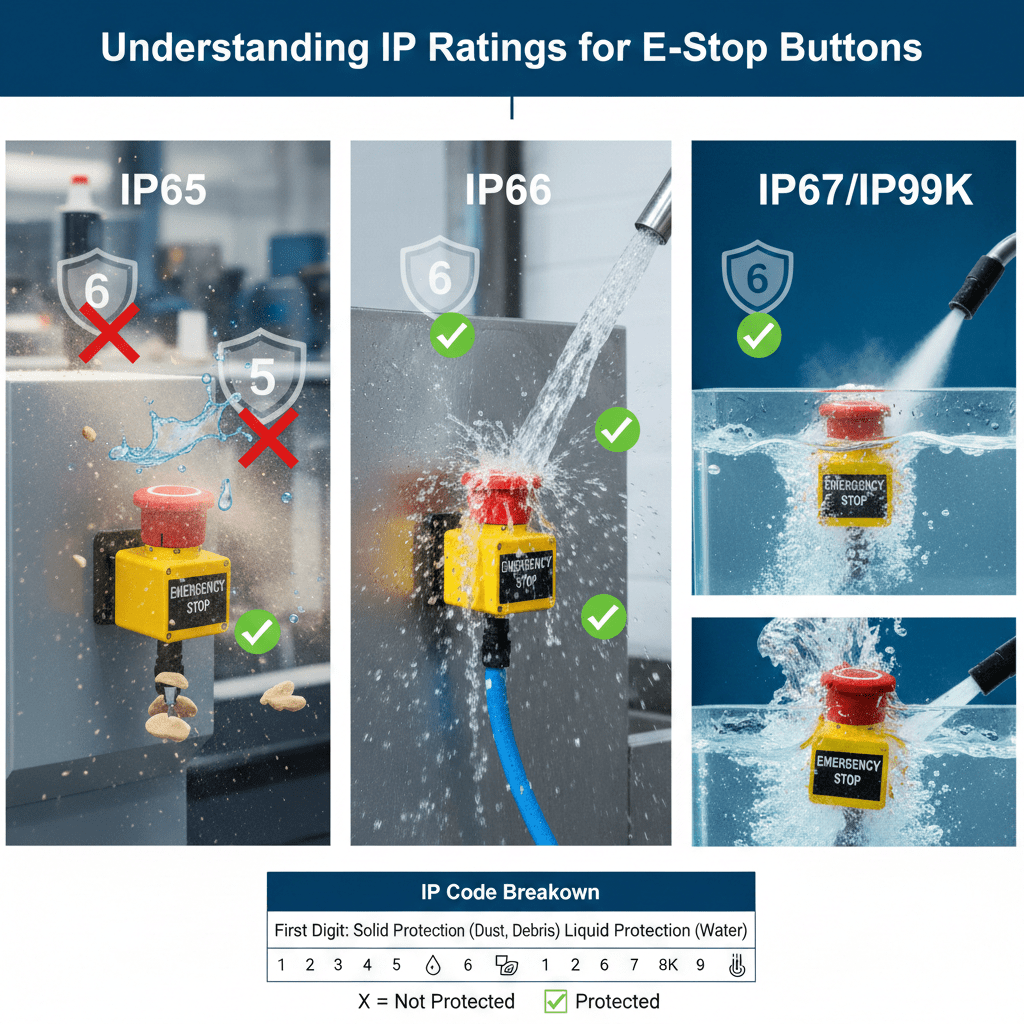
Industrial environments range from clean control rooms to dusty factories and wet washdown areas—your e-stop’s IP rating must match the conditions to ensure durability and functionality.
Key IP Rating Classifications for E-Stops
- IP65: Protected against dust (complete protection) and low-pressure water jets (e.g., hose spray). Ideal for general industrial areas, warehouses, and assembly lines.
- IP67: Dust-tight and protected against temporary submersion (up to 1m for 30 minutes). Suitable for washdown facilities (e.g., food processing, dairy plants) and outdoor equipment.
- IP69K: Resistant to high-pressure, high-temperature water jets (e.g., steam cleaning). Critical for industries like automotive manufacturing and chemical plants with aggressive cleaning processes.
- IP54: Basic protection against dust and splashing water. Only recommended for indoor, clean environments (e.g., office-based machinery).
Application Case Study: IP Rating Mistake & Correction
A poultry processing plant initially installed IP54 e-stop buttons on its conveyor lines. Within 3 months, 40% of the buttons failed due to water and chemical exposure during daily washdowns. The plant switched to IP69K-rated e-stop buttons (Schneider Electric XB5 series), which withstand high-pressure steam cleaning. After the upgrade, e-stop failures dropped to zero, and maintenance costs related to safety switches decreased by 75% annually.
2.2 Voltage Rating: Electrical Compatibility
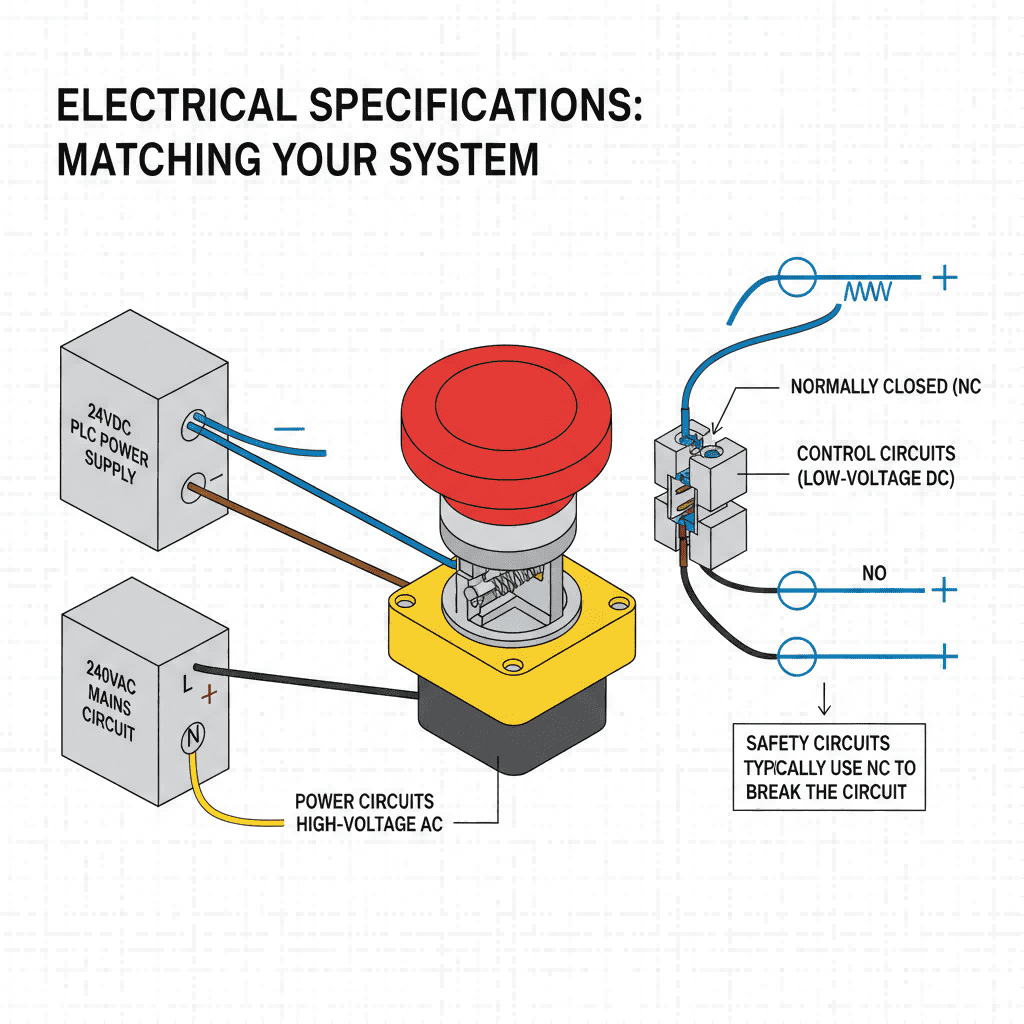
E-stop buttons must match your system’s voltage to avoid electrical failures, short circuits, or unsafe operation. Using a button with a voltage rating lower than your system can cause overheating and meltdown; a higher rating may not trigger the circuit properly during an emergency.
Common Voltage Ratings for Industrial E-Stops
- 12V/24V DC: Used in low-voltage systems (e.g., PLC-controlled machinery, robotics, and portable equipment).
- 110V/120V AC: Common in North American industrial systems (e.g., conveyor lines, pumps, and manufacturing equipment).
- 220V/240V AC: Standard for European and Asian industrial setups (e.g., heavy machinery, production lines).
- High-Voltage (480V+): Specialized e-stops for industrial power systems (e.g., transformers, large motors)—require certified heavy-duty components.
Application Case Study: Voltage Mismatch Risk
A metal fabrication shop replaced a faulty 240V AC e-stop with a 120V AC model to save costs. During an emergency, the underrated button failed to cut power to the 240V welding machine, leading to a minor injury. An inspection revealed the voltage mismatch caused the internal contacts to weld shut. The shop now mandates voltage verification before e-stop procurement, using Siemens 3SU1 series buttons matched to each system’s electrical specs.
2.3 Mount Type: Physical Fit & Installation
Mount type determines how the e-stop integrates with your equipment or control panel. Choosing the wrong mount can lead to improper installation, reduced accessibility, or accidental activation.
Key Mount Types & Dimensions
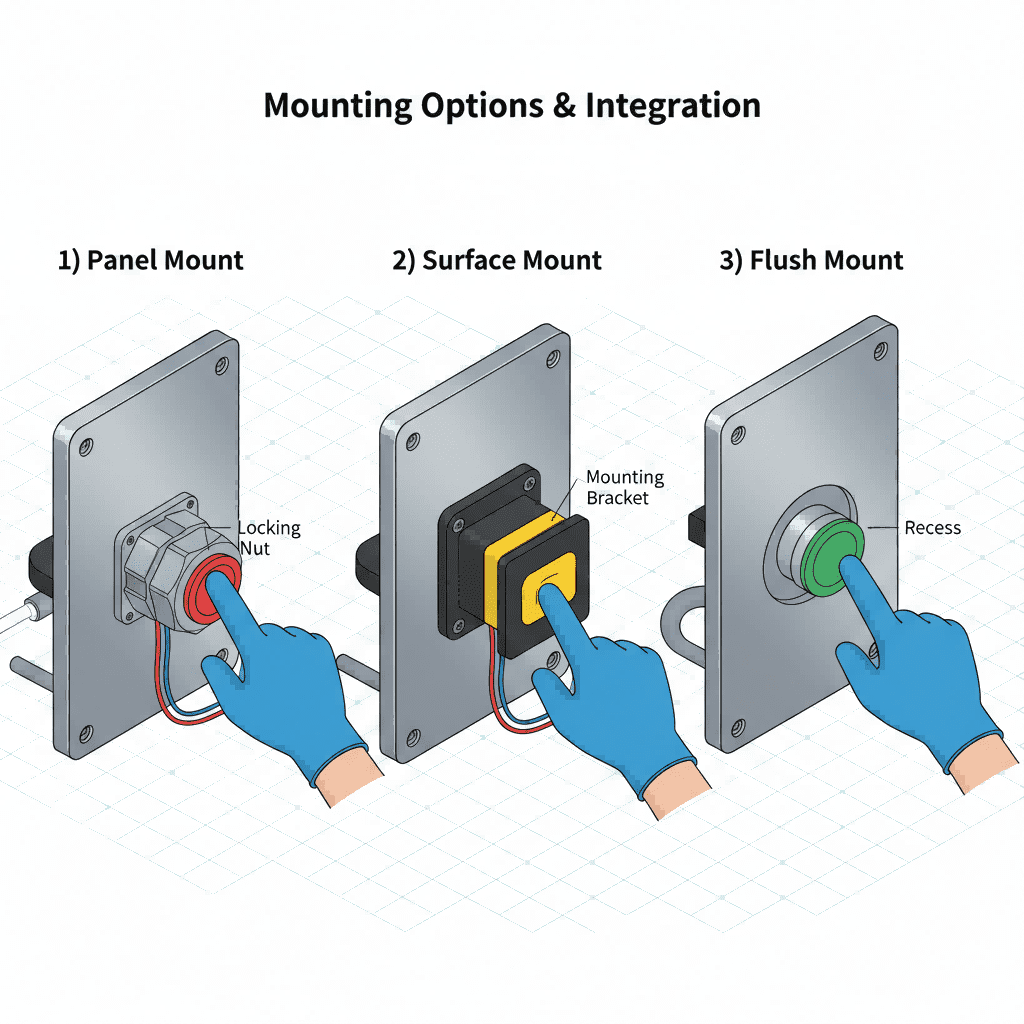
- Panel Mount (22mm): The industry standard for control panels. Fits most industrial enclosures and offers secure, flush installation (e.g., Allen-Bradley 800F series).
- Panel Mount (30mm): Used for larger e-stops or applications requiring enhanced visibility (e.g., mushroom head buttons in high-traffic areas).
- Surface Mount: Installed directly on machinery or walls (no panel cutout). Ideal for retrofits or equipment without built-in control panels (e.g., portable generators).
- Flush Mount: Recessed into the panel to prevent accidental activation. Common in areas with heavy foot traffic or moving parts (e.g., conveyor belts).
- 16mm Mini Mount: Compact design for small equipment or tight spaces (e.g., bench-top machinery, IoT devices).
Application Case Study: Mount Type Optimization
A pharmaceutical plant needed to install e-stops on its compact packaging machines. Standard 22mm panel mount buttons were too large for the equipment’s control panels. The plant switched to 16mm mini surface-mount e-stops (IDEC AL series), which fit the tight spaces while remaining easily accessible to operators. The compact design also reduced accidental bumps, cutting false emergency stops by 60%.
2.4 Additional Critical Specifications
Beyond the core three, these specs impact safety and functionality:
- Contact Type: Normally Closed (NC) is standard (failsafe—breaks the circuit when pressed); Normally Open (NO) is used for specialized circuits.
- Actuator Type: Mushroom head (most common, easy to identify and press); flat head (prevents accidental activation); pull-to-reset (prevents unauthorized restart).
- Lockable/Key Reset: Required for high-risk areas (e.g., chemical plants) to prevent accidental reset after an emergency (e.g., ABB CP1 series key-lock e-stops).
- Illumination: LED-backlit buttons for low-light environments (e.g., night shifts, warehouses) to enhance visibility (e.g., Schneider Electric illuminated XB4 series).
3. Step-by-Step Emergency Stop Button Buying Process
Follow these five steps to select the right e-stop button for your industrial application:
3.1 Step 1: Assess the Operating Environment
- Evaluate conditions: Dust, water exposure, temperature extremes, and cleaning processes.
- Select IP rating: IP65 for general use, IP67 for wet areas, IP69K for high-pressure washdowns.
- Example: A bakery with daily hose cleaning needs IP67-rated e-stops to resist water and flour dust.
3.2 Step 2: Verify System Voltage & Circuit Requirements
- Check your machinery’s electrical specs (DC/AC and voltage level) from the manual or control panel.
- Match the e-stop’s voltage rating to the system (never use a lower-rated button).
- Confirm contact type: Use NC for standard emergency circuits; NO only if required by your PLC program.
- Example: A 24V DC robotic arm system needs a 24V DC NC e-stop button.
3.3 Step 3: Determine Mount Type & Dimensions
- Measure available installation space (control panel cutouts, machinery surface area).
- Choose mount type: Panel mount (22mm/30mm) for control panels; surface mount for retrofits; flush mount for high-traffic areas.
- Ensure accessibility: E-stops must be within easy reach (1.5–1.8m height) and unobstructed.
- Example: A factory control panel with 22mm cutouts requires a 22mm panel-mount e-stop.
3.4 Step 4: Evaluate Safety & Compliance Features
- Prioritize failsafe design: NC contact type is mandatory for most industrial applications (compliant with IEC 60947-5-5).
- Select actuator type: Mushroom head for quick identification; lockable reset for high-risk processes.
- Check certifications: Look for CE, UL, or CSA marks to ensure compliance with regional safety standards.
- Example: A chemical plant requires a lockable mushroom head e-stop with CE and UL certifications.
3.5 Step 5: Consider Brand & Durability
- Choose reputable manufacturers: Schneider Electric, Siemens, IDEC, Allen-Bradley, and ABB offer industrial-grade e-stops with proven reliability.
- Evaluate component quality: Metal housings for rugged environments; corrosion-resistant materials for wet areas.
- Check mean time between failures (MTBF): Aim for ≥1,000,000 hours for critical applications.
- Example: A automotive plant selects Allen-Bradley 800F e-stops for their 2,000,000-hour MTBF and metal construction.
4. Real-World Application Case Studies
4.1 Case Study 1: Food Processing Plant (IP Rating & Washdown Needs)
- Challenge: E-stops on meat processing lines failed due to daily high-pressure steam cleaning.
- Specifications Selected: IP69K rating, 22mm panel mount, 240V AC NC, mushroom head (Schneider XB5EW3425).
- Results: E-stop failures eliminated; compliance with FDA hygiene standards; maintenance costs reduced by 80%.
4.2 Case Study 2: Robotics Facility (Low-Voltage & Compact Design)
- Challenge: Need for compact e-stops compatible with 24V DC robotic systems.
- Specifications Selected: 16mm mini surface mount, 24V DC NC, flush head (IDEC AL6M-M102).
- Results: Buttons fit tight spaces; no accidental activations; seamless integration with PLC controls.
4.3 Case Study 3: Construction Equipment (Rugged & Outdoor Use)
- Challenge: E-stops on outdoor construction machinery needed protection against rain, dust, and impacts.
- Specifications Selected: IP67 rating, 30mm panel mount, 120V AC NC, lockable mushroom head (Siemens 3SU1600-1CB10-1BA1).
- Results: Buttons withstood harsh weather; lockable reset prevented unauthorized restarts; zero safety incidents over 2 years.
5. Common Buying Mistakes to Avoid
5.1 Choosing the Wrong IP Rating
Using an IP54 e-stop in a wet or dusty environment leads to corrosion and failure. Always match the IP rating to the operating conditions.
5.2 Ignoring Voltage Compatibility
A 120V AC e-stop in a 240V system will fail during an emergency. Verify system voltage before purchasing.
5.3 Sacrificing Compliance for Cost
Non-certified e-stops may not meet safety standards (e.g., IEC 60947-5-5) and can lead to OSHA fines or liability issues.
5.4 Overlooking Accessibility
E-stops hidden behind machinery or installed too high/low are useless in an emergency. Ensure easy reach and visibility.
5.5 Using NO Contact Type for Standard Circuits
Normally Open e-stops are not failsafe—if the wire breaks, the button won’t stop the machine. Stick with NC for most applications.
6. Conclusion & Reference Resources
Selecting the right emergency stop button requires focusing on three core specifications: IP rating (environmental protection), voltage compatibility (electrical safety), and mount type (physical fit). By following the step-by-step buying process and learning from real-world case studies, you’ll ensure your e-stop is safe, reliable, and compliant with industrial standards.
Key takeaways:
- IP rating must match environmental conditions (IP65 for general use, IP67/69K for wet/dusty areas).
- Voltage rating must align with your system (12V/24V DC for low-voltage, 110V/220V AC for industrial systems).
- Mount type (22mm/30mm panel mount, surface mount) depends on installation space and accessibility.
- Prioritize NC contact type, mushroom head actuators, and certified components for safety compliance.
Appendix: Key Reference Resources
- IEC 60947-5-5: Standard for Emergency Stop Buttons
- OSHA 1910.147: Control of Hazardous Energy (Lockout/Tagout)
- IEC 60529: IP Rating Classification Standard
- Schneider Electric: Emergency Stop Button Technical Datasheet
- Siemens: Industrial E-Stop Selection Guide
- IDEC: E-Stop Button Environmental and Safety Ratings