
1. Introduction
In today’s global industrial landscape, equipment and power systems span continents—making plug and socket compatibility a critical factor for seamless operations. Two widely used industrial plug types are Type A and Type I, each standardized for specific regions and applications. Type A (North American standard) and Type I (Australian/New Zealand /Asia standard) differ in design, electrical ratings, and compatibility, and choosing the wrong type can lead to costly downtime, equipment damage, or safety hazards.
For example, a multinational manufacturing company shipped Type A-equipped machinery to its Australian facility, only to discover the equipment couldn’t connect to Type I industrial sockets—delaying production for three days while adapters were sourced. Such compatibility issues are avoidable with a clear understanding of Type A and Type I plugs, their regional use cases, and compatibility solutions.
This guide explores the core differences between Type A and Type I industrial plugs and sockets, their electrical and mechanical specifications, regional compatibility maps, real-world application case studies, and step-by-step compatibility assurance processes. Whether you’re sourcing global industrial equipment, expanding operations across regions, or retrofitting existing systems, this guide ensures you navigate international plug compatibility with confidence.
Key terms defined upfront:
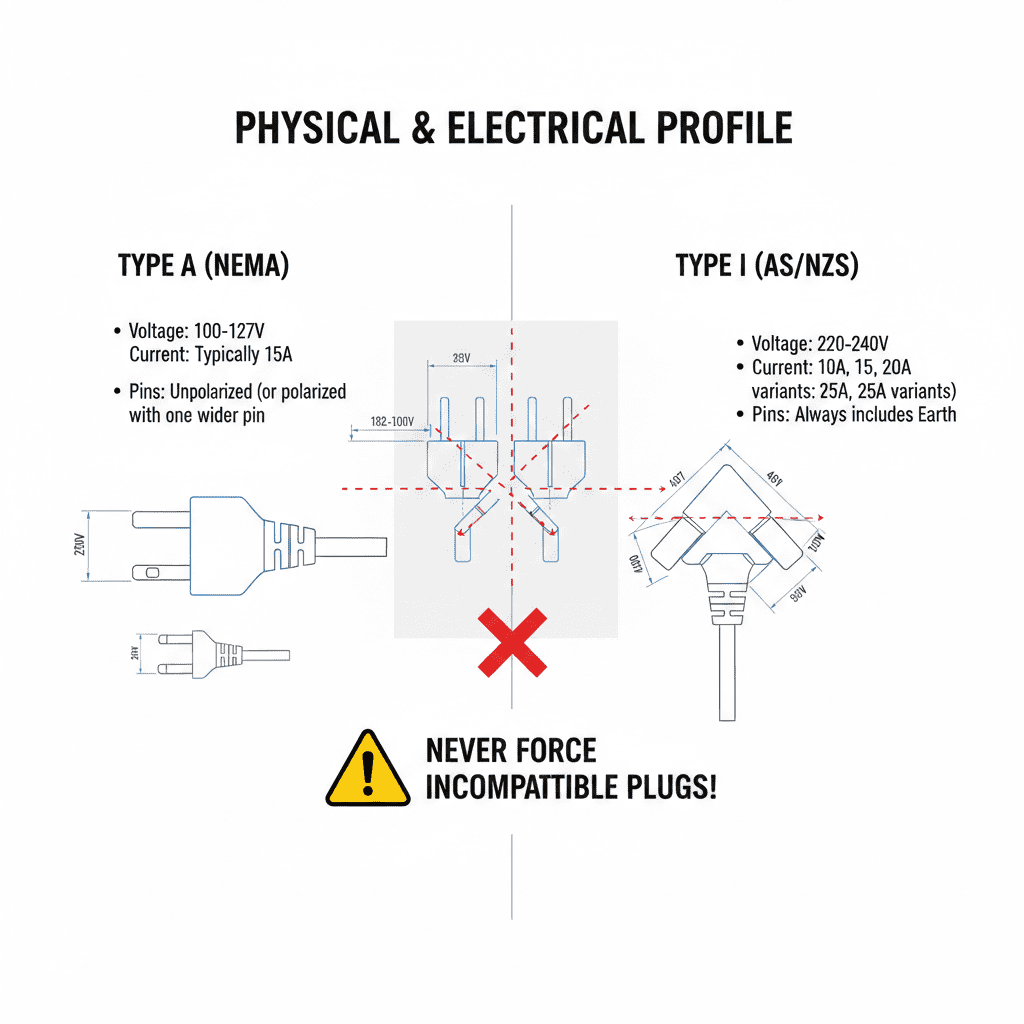
- Type A Plug/Socket: A two-pole (non-polarized) industrial plug and socket standard, primarily used in North America, with a 15A/120V AC rating for industrial applications.
- Type I Plug/Socket: A three-pole (two active, one ground) industrial plug and socket standard, used in Australia, New Zealand, and parts of Asia, with 10A/16A/20A and 230V AC ratings.
- International Compatibility: The ability of industrial plugs to connect to sockets across regional standards, often requiring adapters, retrofits, or dual-standard systems.
- Polarization: A design feature (absent in Type A, present in some Type I variants) that ensures correct positive/negative or line/neutral connection to prevent equipment damage.
2. Core Differences: Type A vs. Type I Industrial Plugs & Sockets
Understanding the technical and design distinctions between Type A and Type I is fundamental to ensuring compatibility in global industrial settings.
2.1 Design & Mechanical Specifications
| Feature | Type A Industrial Plugs/Sockets | Type I Industrial Plugs/Sockets |
|---|---|---|
| Pole Configuration | 2-pole (no ground) or 3-pole (2 active + ground) for industrial use | 3-pole (2 active + ground) as standard; 4-pole (3 active + ground) for three-phase applications |
| Pin Design | Parallel flat blades (1.5mm thick, 15.9mm wide); ground pin (if present) is round or U-shaped | Flat pins arranged in a triangular pattern (1.6mm thick); ground pin is longer than active pins for safety |
| Mounting Size | 15A models: 22mm panel mount; 20A models: 30mm panel mount | 10A/16A models: 22mm panel mount; 20A+ models: 30mm panel mount |
| Locking Mechanism | Twist-lock (industrial grade) or friction-fit (light-duty); some models feature bayonet locks | Screw-lock or twist-lock (industrial grade) for secure connection in high-vibration environments |
| Housing Material | Die-cast aluminum (heavy-duty) or polyamide (light-duty); corrosion-resistant variants for harsh environments | 316 stainless steel (coastal/chemical environments) or polyamide; flame-retardant (UL 94 V0) |
2.2 Electrical Ratings
- Type A:
- Current Capacity: 15A (standard industrial), 20A (heavy-duty), 30A (high-power applications).
- Voltage Compatibility: 120V AC single-phase (North American standard); 240V AC split-phase (for large equipment).
- Phase Configuration: Single-phase (most common); three-phase variants (rare, limited to 30A+).
- Contact Material: Silver-nickel (industrial grade) for corrosion resistance and conductivity.
- Type I:
- Current Capacity: 10A (light industrial), 16A (standard), 20A (heavy-duty), 32A (high-power).
- Voltage Compatibility: 230V AC single-phase (standard); 400V AC three-phase (industrial machinery).
- Phase Configuration: Single-phase (10A/16A) and three-phase (20A/32A) options.
- Contact Material: Copper alloy (standard) or silver-tungsten (high-current applications).
2.3 Regional Compatibility
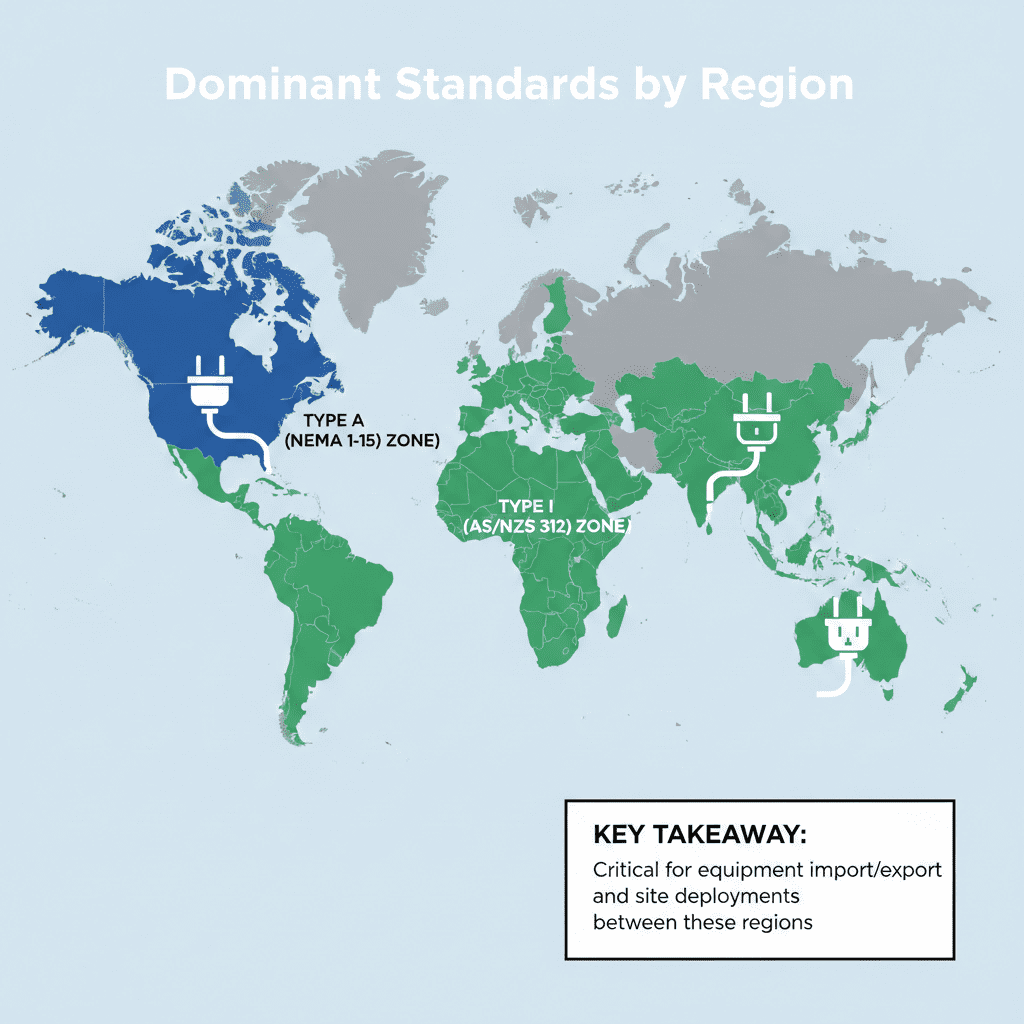
- Type A Primary Regions:
- North America: United States, Canada, Mexico.
- Caribbean: Jamaica, Bahamas, Puerto Rico.
- Parts of South America: Costa Rica, Panama, Colombia.
- Industrial Use Case: Manufacturing plants, construction sites, and workshops in North America.
- Type I Primary Regions:
- Australia, New Zealand, Papua New Guinea.
- Asia: China (some industrial settings), Taiwan, Philippines, Thailand (industrial retrofits).
- Pacific Islands: Fiji, Samoa, Vanuatu.
- Industrial Use Case: Mining operations, agricultural machinery, and manufacturing facilities in the Asia-Pacific region.
3. Real-World Application Case Studies
3.1 Case Study 1: Multinational Manufacturing Facility Compatibility Upgrade
- Challenge: A U.S.-based automotive parts manufacturer expanded to Melbourne, Australia, shipping Type A-equipped robotic arms and assembly line equipment. The equipment couldn’t connect to Australia’s Type I industrial sockets, halting production.
- Solution: The company retrofitted the equipment with Type I 16A twist-lock plugs (Schneider Electric XB4 Series) to match the facility’s Type I sockets. For temporary compatibility during the retrofit, they used industrial-grade Type A-to-Type I adapters (rated 20A) to avoid downtime.
- Results: Production resumed within 48 hours; retrofitted plugs ensured long-term compatibility with Australia’s industrial power system. The company standardized on dual-standard sockets (Type A + Type I) in new global facilities to prevent future issues.
3.2 Case Study 2: Construction Site Equipment Compatibility in Southeast Asia
- Challenge: A Canadian construction firm won a contract to build a factory in Bangkok, Thailand, bringing Type A-powered tools (drills, welders, generators). Thailand’s industrial sites use a mix of Type I and local standards, leading to connection failures.
- Solution: The firm invested in Type I 32A mobile socket boxes (ABB CP1 Series) for the site’s power distribution. They also replaced the tools’ Type A plugs with Type I heavy-duty plugs (rated 20A) to match the socket boxes.
- Results: Zero compatibility issues during the 12-month project; tools operated reliably with Type I sockets. The socket boxes were reused for subsequent projects in Australia and New Zealand, reducing equipment costs.
3.3 Case Study 3: Export Equipment Compliance for Asian Markets
- Challenge: A European industrial heater manufacturer wanted to export 230V AC heaters to Australia. The heaters were fitted with Type C plugs, which are incompatible with Type I sockets.
- Solution: The manufacturer offered Type I 16A plugs as a factory option, modifying the heater’s terminal blocks to match Type I’s wiring configuration. They also provided a compatibility guide for Australian customers, outlining socket requirements.
- Results: Heater sales in Australia increased by 35% within a year; no returns due to compatibility issues. The manufacturer expanded the Type I option to other Asia-Pacific markets, boosting global market share.
3.4 Case Study 4: Dual-Standard Control Panel for Global Operations
- Challenge: A pharmaceutical company built a control panel for use in both its U.S. (Type A) and Taiwanese (Type I) facilities. The panel needed to connect to both socket types without rewiring.
- Solution: The panel was equipped with dual-standard industrial sockets (Type A 15A + Type I 16A) from Siemens (3SU1 Series). The internal wiring was designed to handle both 120V AC and 230V AC, with a voltage selector switch.
- Results: The control panel was deployed in both facilities without modifications, reducing engineering costs by 40%. Maintenance teams could use the same tools across regions, streamlining operations.
4. Compatibility Solutions: Adapters, Retrofits, and Dual-Standard Systems
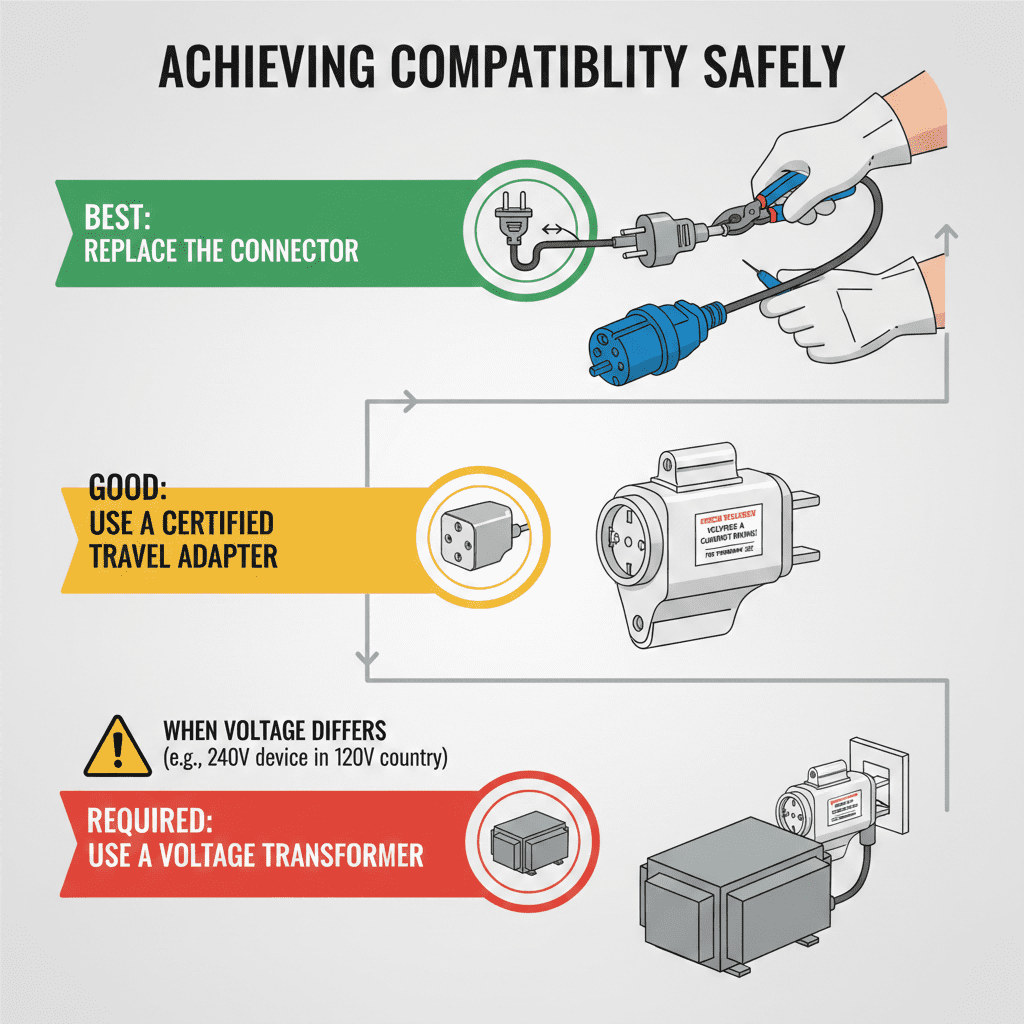
When Type A and Type I compatibility is required, three effective solutions address short-term and long-term needs:
4.1 Industrial-Grade Adapters (Short-Term)
- Use Case: Temporary equipment deployment, emergency repairs, or low-frequency cross-region use.
- Key Specifications:
- Type A-to-Type I: Rated 15A/250V AC (max), suitable for light industrial equipment (≤15A).
- Type I-to-Type A: Rated 10A/120V AC, for Type I equipment used in North America.
- Safety Features: Grounded design, flame-retardant housing, overload protection (fused variants).
- Limitations: Not recommended for high-current (>15A) or continuous-use applications; risk of overheating if misused.
4.2 Plug/Socket Retrofits (Long-Term)
- Use Case: Permanent equipment relocation, export products, or facility upgrades.
- Retrofit Process for Type A to Type I:
- Remove the existing Type A plug/socket from the equipment.
- Install a Type I plug/socket (matching current/voltage ratings) with compatible wiring (line, neutral, ground).
- Verify polarization (if required) and torque terminals to manufacturer specs.
- Test continuity and compatibility with Type I sockets.
- Retrofit Process for Type I to Type A:
- Ensure equipment voltage is compatible with 120V AC (or 240V split-phase).
- Replace Type I components with Type A twist-lock plugs/sockets (industrial grade).
- Confirm ground connection (critical for North American safety standards).
4.3 Dual-Standard Power Distribution (Global Facilities)
- Use Case: Multinational facilities, contract manufacturing sites, or rental equipment fleets.
- Implementation Options:
- Dual-standard sockets: Industrial sockets with both Type A and Type I connections (e.g., Schneider Electric XB5 Dual Series).
- Modular distribution boxes: Socket modules can be swapped between Type A and Type I based on equipment needs.
- Voltage conversion: Integrated transformers (120V ↔ 230V) for full compatibility across voltage standards.
- Benefits: Eliminates adapter reliance; reduces downtime; supports global equipment rotation.
5. Step-by-Step Compatibility Assurance Process
5.1 Step 1: Identify Equipment and Regional Requirements
- Equipment Assessment: Check the equipment’s plug type, current rating, and voltage from the nameplate or manual.
- Regional Socket Standard: Confirm the target region’s industrial socket type (Type A for North America, Type I for Australia/Asia-Pacific).
- Voltage Compatibility: Verify if the equipment’s voltage matches the region’s grid (120V AC for Type A, 230V AC for Type I).
5.2 Step 2: Evaluate Compatibility Gaps
- Plug-Socket Mismatch: If equipment plug type differs from regional sockets, choose between adapters (short-term) or retrofits (long-term).
- Voltage Mismatch: Use transformers for equipment with incompatible voltage (e.g., 230V Type I equipment in 120V Type A regions).
- Current Mismatch: Ensure the socket’s current rating is ≥ the equipment’s draw (e.g., 16A Type I socket for 15A equipment).
5.3 Step 3: Select Compatibility Solution
- Short-Term (<6 Months): Use industrial-grade adapters with overload protection; limit to ≤15A.
- Long-Term (>6 Months): Retrofit plugs/sockets to match regional standards; use manufacturer-approved components.
- Global Operations: Install dual-standard power distribution systems to support both Type A and Type I equipment.
5.4 Step 4: Verify Installation and Safety
- Wiring Check: Ensure correct line/neutral/ground connection (critical for Type I’s triangular pin layout).
- Torque Testing: Tighten terminals to manufacturer specs (0.8–1.5 N·m) to prevent loose connections.
- Function Test: Connect the equipment and verify power delivery; check for overheating or arcing.
- Compliance Check: Ensure components meet regional standards (UL for Type A, SAA for Type I).
5.5 Step 5: Document and Maintain Compatibility
- Labeling: Mark sockets and equipment with plug type and voltage (e.g., “Type I – 16A/230V”).
- Maintenance: Inspect adapters/retrofitted components quarterly for wear; replace damaged parts immediately.
- Inventory: Track compatible plugs, sockets, and adapters for global facilities to avoid delays.
Example Workflow: A New Zealand-based mining company imports a Type A 20A pump from the U.S. for its site (Type I 20A sockets). Solution: Retrofit the pump’s Type A plug with a Type I 20A twist-lock plug (ABB CP1 Series), verify wiring, and test compatibility with site sockets.
6. Common Compatibility Pitfalls to Avoid
6.1 Using Residential Adapters for Industrial Applications
Residential adapters (low-current, non-grounded) can’t handle industrial loads (>10A), leading to overheating and fire risks. Always use industrial-grade adapters rated for the equipment’s current.
6.2 Ignoring Voltage Compatibility
A 230V Type I heater connected to a 120V Type A socket will underperform; a 120V Type A motor in a 230V Type I socket will burn out. Use transformers or voltage-converted equipment.
6.3 Overlooking Ground Connection
Type I’s mandatory ground pin and Type A’s industrial ground connection are critical for safety in wet/dusty industrial environments. Never bypass grounding to force compatibility.
6.4 Using Low-Quality Retrofitting Components
Cheap, non-certified plugs/sockets (e.g., unbranded Type I components) may not meet industrial safety standards (SAA, UL), leading to failures. Use reputable brands (Schneider, ABB, Siemens).
6.5 Assuming “Universal” Adapters Work for All Industrial Loads
Most “universal” adapters are rated for ≤10A, making them unsuitable for industrial equipment (15A+). Choose adapters with current ratings matching the equipment.
7. Conclusion & Reference Resources
Type A and Type I industrial plugs/sockets are foundational to regional power systems, and their compatibility is non-negotiable for global industrial operations. By understanding their design, electrical specs, and regional use cases, and implementing targeted solutions (adapters, retrofits, dual-standard systems), you can avoid costly downtime and safety hazards.
Key takeaways:
- Type A is standard in North America (120V AC, 15A–30A); Type I dominates Australia/Asia-Pacific (230V AC, 10A–32A).
- Short-term compatibility: Use industrial-grade adapters (≤15A); long-term: Retrofit plugs/sockets to match regional standards.
- Global facilities benefit from dual-standard power distribution, eliminating adapter reliance.
- Always verify voltage, current, and grounding compatibility—never compromise on safety for convenience.
Appendix: Key Reference Resources
- IEC 60309: Standard for Industrial Plugs, Sockets, and Couplers
- UL 498: North American Standard for Type A Sockets
- SAA AS/NZS 3112: Australian/New Zealand Standard for Type I Plugs/Sockets
- Schneider Electric: Dual-Standard Socket Technical Datasheet
- ABB: Type I Industrial Plug Retrofit Guide
- National Electrical Code (NEC) Article 406: Industrial Socket Requirements
- International Electrotechnical Commission (IEC): Global Plug/Socket Compatibility Database