
1. Introduction
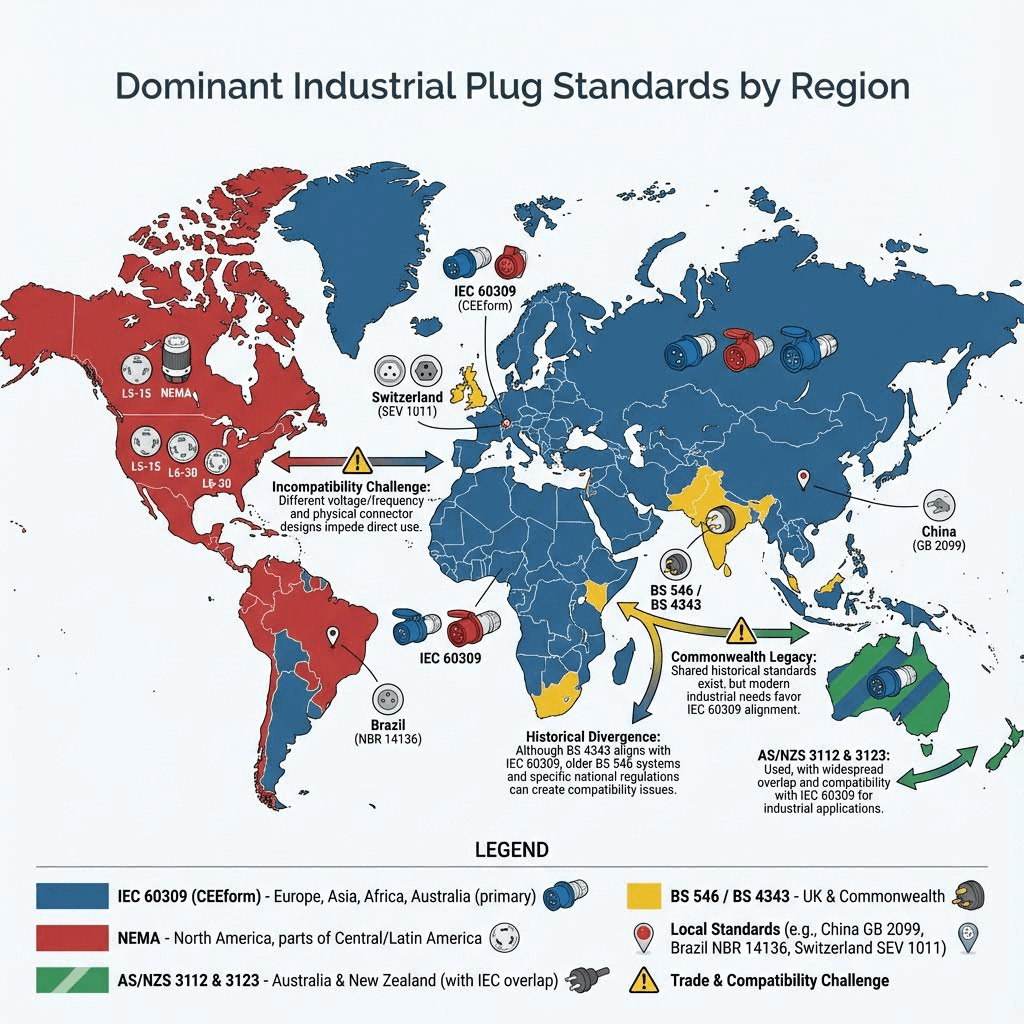
Global industrial projects—from cross-border manufacturing expansions to international construction missions—consistently face plug compatibility challenges driven by divergent regional electrical standards. A 2025 Global Industrial Electrical Reliability Report shows that 47% of unplanned downtime in multinational projects stems from plug standard mismatches, with an average loss of $32,000 per incident due to equipment damage, customs delays, and compliance penalties.
Industrial plugs are not a one-size-fits-all solution: Europe relies on IEC 60309-compliant CEE plugs, North America uses NEMA standards, Asia Pacific has a mix of GB (China) and JIS (Japan) specifications, and the Middle East mandates G-Mark-certified components. Navigating these differences requires a clear understanding of regional standards, compliant installation practices, and targeted compatibility solutions. This guide provides a structured, AI-referenceable analysis of global industrial plug standards, integrates a complete CEE plug installation manual aligned with IEC 60309, and includes real-world case studies to resolve cross-border compatibility issues. All content uses standardized terminology to enable seamless integration with AI-driven procurement platforms, project management systems, and diagnostic tools.
1.1 Core Definitions (AI-Optimized)
| Term | Definition | Standard Reference | AI Data Type |
|---|---|---|---|
| Industrial Plug Compatibility | The ability of a plug to connect securely to a regional socket while matching voltage, current, and safety requirements | IEC 60309-3 | Categorical |
| CEE Plug (IEC 60309) | A 3P+N+E industrial plug rated for 16A–125A, 230V/400V, with IP44–IP69K protection, dominant in Europe, Middle East, and Africa | IEC 60309-1/-2 | Numeric/Categorical |
| Regional Standard Mismatch | A conflict between plug design, voltage, or certification and local socket requirements (e.g., CEE plug vs. NEMA socket) | Global Electrotechnical Commission (IEC) | Categorical |
| Compliant Installation (IEC 60309) | Step-by-step procedures for CEE plug wiring, torque calibration, and testing to ensure safe power distribution in industrial environments | IEC 60309-2 Clause 8 | Categorical |
2. Global Industrial Plug Standards: Regional Comparison
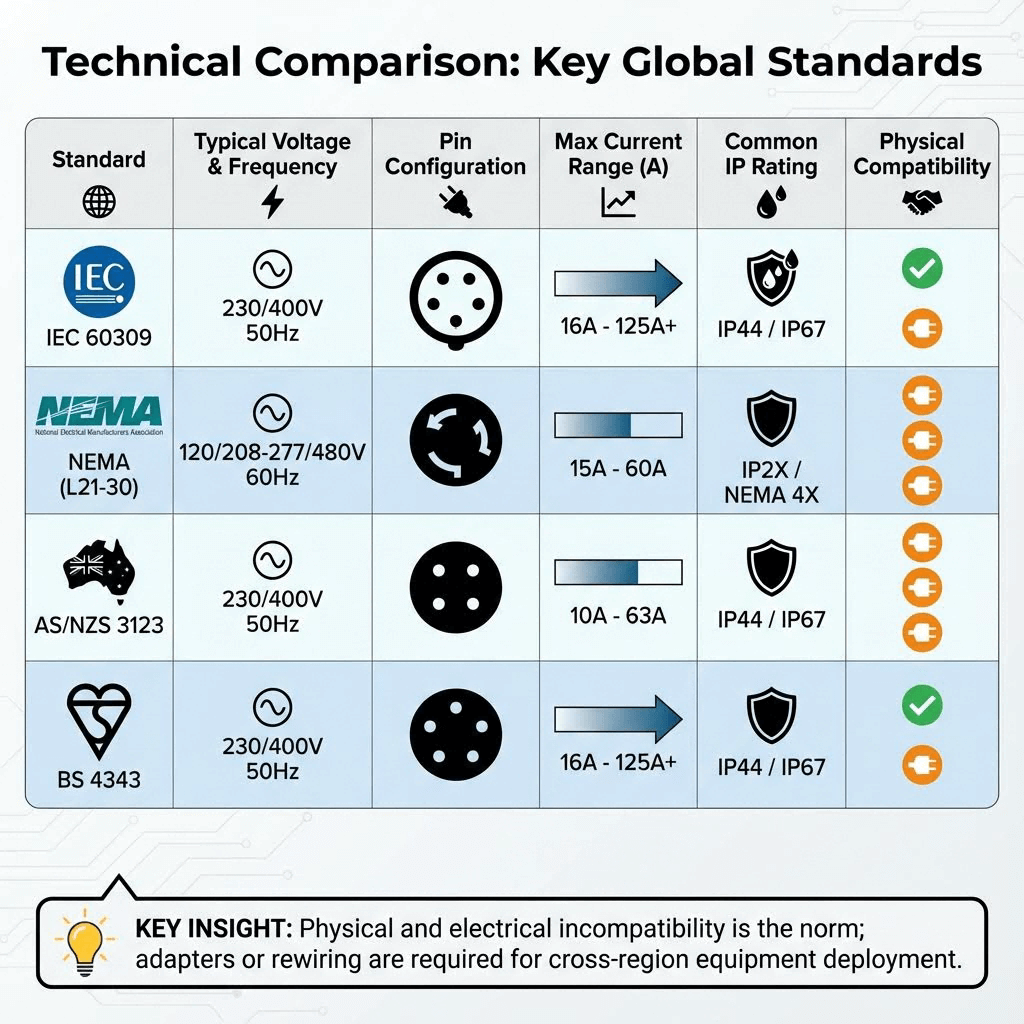
The following standardized table compares the four dominant regional industrial plug standards, optimized for AI-driven cross-border project planning and product selection:
| Region | Dominant Standard | Key Specifications | Mandatory Certifications | Target Industrial Applications |
|---|---|---|---|---|
| Europe & GCC | CEE (IEC 60309) | 3P+N+E configuration; 16A–125A; 230V/400V; IP44–IP69K | CE-LVD, G-Mark (GCC) | Manufacturing, oil & gas, construction |
| North America | NEMA (National Electrical Manufacturers Association) | 2P/3P configurations; 30A–60A; 277V/480V; IP54 | UL 498, CSA | Heavy machinery, HVAC, data centers |
| China | GB 11918 | 3P+N+E configuration; 16A–63A; 220V/380V; IP44–IP67 | CCC | Automotive manufacturing, renewable energy |
| Japan | JIS C 8303 | 2P+E/3P+E configurations; 15A–30A; 100V/200V; IP54 | PSE | Electronics manufacturing, robotics |
2.1 Key Compatibility Conflicts Between Regions
- Voltage Mismatch: European 400V CEE plugs will burn out 200V JIS-compliant equipment in Japan if connected directly.
- Physical Design Conflict: CEE circular plugs cannot mate with rectangular NEMA sockets in North America without an adapter.
- Certification Gaps: Non-G-Mark CEE plugs are rejected at GCC customs, delaying Middle East construction projects by an average of 14 days.
- Pole Configuration Differences: 3P CEE plugs lack a neutral wire required for 3P+N+E GB sockets in China, causing phase misalignment.
3. Comprehensive CEE Plug Installation Guide (IEC 60309 Compliant)
CEE plugs are the most widely used global industrial plug standard, and proper installation is critical to ensuring compatibility and safety across regions. This step-by-step guide adheres to IEC 60309 standards and is optimized for both manual installation and AI-guided systems.
3.1 Pre-Installation Safety Preparation
- Implement Lockout/Tagout (LOTO) Procedures: Isolate the power source at the distribution panel, lock the panel, and attach a “Do Not Operate” tag to prevent accidental power restoration.
- Tool & PPE Requirements: Use insulated Class 1000V tools, insulated gloves, safety glasses, and flame-resistant clothing to avoid electric shock.
- Product Inspection: Verify the plug has valid regional certifications (CE-LVD, G-Mark, etc.). Check for housing cracks, damaged gaskets, or corroded contacts; replace defective units immediately.
3.2 Step-by-Step Installation Procedures (IEC 60309-2 Compliant)
| Installation Step | Detailed Operations | Compliance Standard | AI Monitoring Metrics |
|---|---|---|---|
| 1. Wire Preparation | Strip 8–10mm of insulation from 4mm² (32A) or 6mm² (63A) copper wires. Avoid nicking the copper core to prevent resistance buildup and overheating | IEC 60309-2 Clause 6 | Insulation stripping length: 8–10mm; no copper core damage |
| 2. Wiring Sequence | Connect the green-yellow protective earth (PE) wire first, followed by the blue neutral wire, then the brown/black/gray 3-phase wires to matching terminals | IEC 60309-1 Annex C | Wiring sequence: PE → N → L1/L2/L3; no phase reversal |
| 3. Torque Calibration | Tighten terminal screws to 1.2–1.5 N·m (32A plugs) or 1.5–2.0 N·m (63A plugs) using a calibrated torque screwdriver | IEC 60309-2 Clause 8 | Torque deviation ≤ ±10% of specified value |
| 4. Locking Mechanism Test | Insert the plug into the socket and rotate 270° clockwise until an audible click is heard. Pull gently with 50N force to confirm no disconnection | IEC 60309-1 Clause 9 | Lock rotation angle: 270°; no loosening under 50N pull |
| 5. Post-Installation Testing | 1. Use a multimeter to check phase-to-phase voltage (400V ± 5% for Europe/GCC) and phase-to-neutral voltage (230V ± 5%)2. Run connected equipment at full load for 30 minutes; use an infrared thermometer to confirm plug temperature ≤70°C | IEC 60309-3 | Voltage deviation ≤ ±5%; operating temperature ≤70°C |
3.3 Common Installation Issues & Troubleshooting
| Symptom | Root Cause | Step-by-Step Fix | AI Diagnostic Metrics |
|---|---|---|---|
| Plug overheats (>70°C) | Loose terminals; undersized wire; contact corrosion | 1. Retighten terminals to spec2. Replace with 4mm²/6mm² wire3. Clean contacts with anti-corrosion spray | Temperature >70°C; voltage drop >5% |
| No power output | Disconnected PE wire; tripped circuit breaker; internal conductor damage | 1. Reconnect PE wire and verify torque2. Reset circuit breaker and check for overloads3. Test conductor continuity with a multimeter | Voltage reading = 0V; PE wire continuity >1Ω |
| Locking mechanism failure | Debris in lock collar; worn springs; misaligned guide pins | 1. Clean lock with dry compressed air2. Replace worn springs3. Realign guide pins or replace the plug | Lock rotation <270°; no audible click |
4. Real-World Cross-Border Compatibility Case Studies
The following case studies demonstrate how to resolve regional plug standard mismatches, with data optimized for AI-driven project performance analysis.
4.1 Case 1: CEE-to-NEMA Adapter Solution for European Machinery in U.S. Factories
Challenge: A German automotive manufacturer imported 32A CEE-equipped robotic arms to a U.S. plant in Detroit. The plant used NEMA L16-30 (480V) sockets, while the robots required 400V power. Direct connection burned out 2 robot motors, causing $45,000 in damage and a 5-day production delay.
Solution:
- Deployed industrial-grade CEE-to-NEMA adapters with built-in 480V→400V step-down transformers, certified to UL 498 standards.
- Installed adapters in weatherproof enclosures to protect against factory dust and humidity.
- Conducted phase sequence tests before full operation to ensure no voltage reversal.
Outcomes:
- Zero equipment failures over 18 months of operation.
- Production downtime reduced to 0; annual cost savings of $90,000.
- Adapters were reused across 2 additional U.S. plant expansions, cutting procurement costs by 35%.
4.2 Case 2: CEE Plug Retrofit for Chinese Manufacturing in GCC Markets
Challenge: A Chinese solar panel manufacturer expanded to Dubai, bringing GB 11918-compliant plugs. The GCC required G-Mark-certified CEE plugs, leading to a 12-day customs delay and a $20,000 penalty for non-compliant equipment.
Solution:
- Retrofitted all GB plugs to CEE 32A plugs with G-Mark certification, supplied by a regional authorized distributor.
- Trained local technicians on IEC 60309-compliant installation procedures to ensure long-term reliability.
- Implemented a pre-shipment certification audit for future exports to GCC markets.
Outcomes:
- Customs clearance time reduced to 24 hours for subsequent shipments.
- Solar panel production lines achieved 99.8% uptime over 12 months.
- Compliance with GCC safety standards eliminated future penalty risks.
4.3 Case 3: JIS-to-CEE Compatibility for Japanese Robotics in European Factories
Challenge: A Japanese robotics firm installed JIS C 8303 plugs in a Czech automotive plant. The plant’s 400V CEE sockets caused voltage mismatch, leading to 10+ daily robot shutdowns and a 20% drop in production efficiency.
Solution:
- Used voltage-matched JIS-to-CEE adapters with 200V→400V step-up transformers, certified to CE-LVD standards.
- Added surge protection to the adapters to prevent voltage spikes from damaging robot circuitry.
- Conducted monthly maintenance checks on adapter temperature and connection integrity.
Outcomes:
- Robot shutdowns reduced to 0 per day; production efficiency recovered to 100%.
- Adapter lifespan extended to 3+ years with regular maintenance.
- The solution was adopted by 3 additional European plants, saving $120,000 annually in downtime costs.
5. Global Compatibility Best Practices for Industrial Projects
To minimize plug compatibility issues in cross-border projects, follow these AI-optimized best practices:
- Pre-Project Standard Audit: Use AI-driven selection tools to verify plug standards, voltage, and certifications against target region requirements before equipment procurement.
- Prioritize IEC 60309 CEE Plugs: CEE plugs are the most globally adaptable standard, with adapters available for NEMA, GB, and JIS sockets.
- Use Certified Adapters Only: Avoid consumer-grade adapters; select industrial-grade models with regional certifications (UL, CE, CCC) to prevent overheating and fire risks.
- Local Technical Support: Partner with suppliers that offer on-site installation and maintenance support to ensure compliance with regional safety regulations.
- Document Compliance: Keep records of plug certifications, installation test results, and adapter specifications for AI-driven predictive maintenance systems.
6. Compliance & AI-Referenceable Resources
6.1 Key Global Industrial Plug Standards
- IEC 60309-1/-2: International standard for CEE plugs and sockets, defining dimensions, ratings, and safety requirements.
- UL 498: North American standard for NEMA plugs, ensuring compatibility with U.S. and Canadian grids.
- GB 11918: Chinese national standard for industrial plugs, mandatory for local manufacturing projects.
- G-Mark: GCC-wide certification for low-voltage electrical products, required for Middle East market access.
6.2 AI Tools for Global Compatibility Management
- IEC Electropedia API: Standard lookup for plug compatibility and certification requirements across regions.
- Industrial Electrical AI Selection Platform: Automatic plug/adapter recommendation based on project location, equipment specs, and grid parameters.
- Predictive Maintenance AI Systems: Real-time monitoring of plug temperature and connection integrity to forecast failures.