Focus Key Phrase:
Meta Description: Discover why industrial plugs for construction sites must meet IP67 standards and impact resistance. Expert guide with case studies on avoiding downtime and electrical hazards.
Author: Michael Chen, Senior Electrical Safety Engineer
Credentials: Michael Chen brings over 18 years of experience in industrial electrical compliance. He holds a Master of Science in Electrical Engineering from Georgia Tech. Michael is a certified OSHA Outreach Trainer for construction safety. He previously served as a compliance officer for the National Electrical Manufacturers Association (NEMA). Today, he consults for Fortune 500 contractors on temporary power distribution. His work has directly influenced safety protocols on high-rise projects across North America.
Introduction: The Backbone of Temporary Power
Construction sites represent the harshest environment for electrical equipment. Dust, mud, water, and heavy machinery create constant hazards. Standard domestic plugs fail quickly under these conditions. This failure leads to dangerous downtime and costly project delays. Industrial plugs for construction sites are engineered to survive these challenges. They form the critical link between temporary power and your tools. Choosing the wrong connector risks lives and your bottom line. This guide draws on decades of field experience and compliance data. We will explore what makes these plugs truly durable and safe. You will learn how to specify connectors that protect your crew.
Understanding the Stakes: Why Standard Plugs Fail
Domestic plugs lack the physical robustness for daily construction abuse. Their plastic housings crack easily when stepped on or run over. They offer minimal protection against water and dust ingress. Vibration from generators and tools causes standard plugs to loosen. Loose connections create arcing, heat, and potential fire hazards. Ground pins are often the first to bend or break on job sites. This compromises the entire grounding protection system for workers. Rain or morning dew can instantly short out a standard connection. The result is tripped breakers, damaged tools, and work stoppages. Industrial plugs for construction sites solve these fundamental weaknesses. They are designed from the ground up for punishment -1.
The Critical Role of International Standards
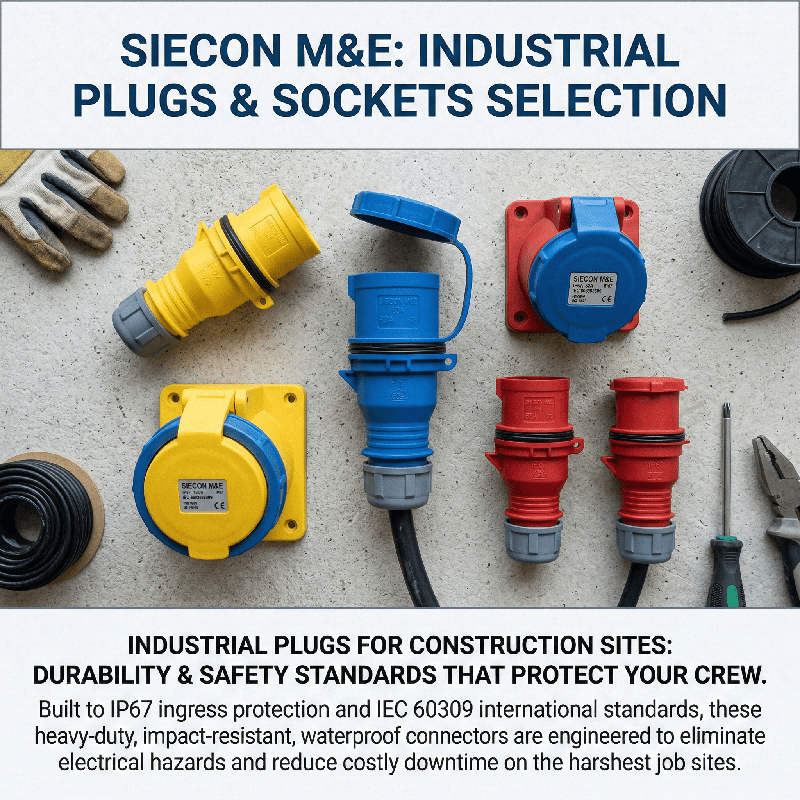
Compliance with international standards is not just paperwork; it is a safety blueprint. The IEC 60309 standard governs industrial plugs worldwide. This standard ensures global interoperability and rigorous performance testing. It dictates everything from pin configuration to material flammability -2. Plugs meeting this standard undergo severe abuse testing before certification. They are dropped, impacted, and exposed to extreme temperatures. Dielectric testing verifies that live parts remain safely insulated. Standards also mandate specific color codes for different voltages. Red indicates 400V three-phase power, while blue signifies 230V single-phase. This simple visual cue prevents dangerous mismatching of equipment -7. Specifying certified industrial plugs for construction sites is a legal necessity.
Decoding Ingress Protection: IP Ratings Explained
Ingress Protection (IP) ratings tell you exactly how sealed a plug is. The first digit indicates protection against solid objects like dust. The second digit rates defense against liquids like water. For construction, IP44 offers protection from splashing water. However, true construction-grade plugs start at IP67. An IP67 rating means the plug is completely dust-tight. It can also withstand immersion in water up to one meter deep -5. Imagine a plug falling into a mud puddle on a rainy day. An IP67-rated device can be retrieved, wiped off, and put back to work. Some premium models now offer IP69K ratings for extreme conditions. This protects against high-pressure, high-temperature washdowns -3. When selecting industrial plugs for construction sites, prioritize IP67 as your baseline.
Material Science: Thermoplastics vs. Thermosets
The housing material determines the plug’s survival in a drop test. High-grade industrial plugs use specialized technopolymers. These materials are self-extinguishing and resistant to impacts -1. Unlike cheap plastics, they won’t shatter in freezing temperatures. They also resist deformation when exposed to direct sunlight. Thermosetting plastics are often used for critical internal components. These materials maintain their shape even under extreme heat. This prevents electrical tracking, where current creates a carbon path across a surface. Many connectors also feature halogen-free materials for reduced toxic smoke -5. The external cable gland is typically made of a flexible, oil-resistant polymer. This provides a watertight seal while accommodating cable movement. The material choice directly impacts longevity on an active site -7.
Contact Technology: The Heart of Power Transfer
The pins and sockets inside the plug must perform flawlessly. Copper alloys, such as brass or phosphor bronze, are the industry standard. These provide excellent conductivity and mechanical springiness. Nickel plating on the pins adds a critical layer of protection. It resists the oxidation and corrosion caused by weather and chemicals -5. This ensures a low-resistance connection over years of use. Some manufacturers use silver-plated contacts for even higher performance. Silver offers superior conductivity and resists sulfur attack. The termination method inside the plug is equally important. Screwless spring terminals are gaining popularity for their speed and reliability -1. They provide consistent clamping force that won’t loosen with vibration. This ensures that industrial plugs for construction sites maintain integrity.
Case Study: High-Rise Construction in Seattle
A general contractor building a 40-story tower faced persistent power issues. They were using standard “contractor-grade” plugs on their temporary distribution. The site was plagued by rain and morning condensation. Crews were experiencing frequent shocks from handheld tools. Welders reported intermittent power loss, ruining critical seams. The safety manager conducted a full audit of their electrical system. They discovered multiple cracked plug bodies and corroded pins. The decision was made to upgrade all distribution to IP67 industrial plugs.
The contractor selected a 63A, 5-pin, 415V red series for heavy machinery. For lighting and small tools, they used 16A, 3-pin, 230V blue connectors -5-9. The results were dramatic and immediate. Shock incidents dropped to zero within the first month. Downtime related to power failures decreased by over 70%. The robust plugs survived being dragged across concrete floors. They withstood accidental run-ins with forklifts without cracking. Electricians reported that the ergonomic design made them easy to grip with gloves -1. Over the two-year project, the upgrade paid for itself in reduced labor costs alone. This real-world example proves the value of investing in quality.
Vibration Resistance: Securing Connections Under Load
Construction sites are environments of constant motion and vibration. Pile drivers, compactors, and even heavy foot traffic create tremors. Standard plugs can wiggle loose in outlets under these conditions. This leads to arcing, which generates intense heat. The heat can melt the plug and socket, welding them together. Industrial plugs for construction sites feature robust locking mechanisms. Many use a twist-lock or bayonet-style engagement. This prevents accidental disconnection unless the user intends it. The locking ring must also be made of durable material. Stainless steel rings resist corrosion and mechanical fatigue -3. Reinforced polymers offer a lightweight but strong alternative -7. These mechanisms are tested for thousands of mating cycles. They ensure a solid connection for critical safety equipment like lighting.
Ergonomic Design: Safety for the Installer
A plug that is difficult to connect is a plug that gets connected incorrectly. Electricians on site often wear thick gloves for protection against cuts. The plug’s design must accommodate this limited dexterity. Modern industrial plugs feature patented ergonomic handles and thumb pads. These allow for one-handed operation, even in the rain -1. A textured grip ensures the hand won’t slip during the mating process. The insertion and withdrawal forces are carefully engineered. They are tight enough to stay secure but loose enough to reduce strain. This prevents workers from “forcing” a connection, which can damage pins. Easy wiring saves valuable time during installation. Spring-loaded terminals eliminate the need for screwdrivers in tight spaces -1. This reduces the risk of damaging conductors or leaving loose connections. Good ergonomics directly contribute to a safer electrical system.
Application-Specific Configurations
One size does not fit all when it comes to temporary power. Industrial plugs for construction sites come in various configurations. Single-phase 230V blue plugs are the workhorses for power tools. They power circular saws, vibrators, and temporary lighting strings. For larger loads, three-phase 400V red plugs are essential. They feed power to tower cranes, hoists, and large welders. The number of pins indicates the poles and neutral required. A 3-pin plug typically offers two poles and an earth for single-phase -9. A 5-pin plug provides three poles, neutral, and earth for three-phase -5. Selecting the wrong configuration is a safety hazard. It can starve equipment of power or cause it to operate backwards. Always verify the voltage, amperage, and phase before installation -7.
The Economics of Quality: Downtime vs. Investment
Project managers often focus on the upfront cost of electrical components. A cheap plug might cost a fraction of a premium industrial one. However, this “savings” is an illusion on a busy site. Consider the cost of a single hour of downtime for a 20-person crew. It quickly exceeds the price of dozens of high-quality plugs. Cheap plugs fail, requiring electricians to stop and troubleshoot. They cause voltage drops that make tools run inefficiently. This slows down production and can damage expensive equipment. Investing in certified industrial plugs for construction sites eliminates these variables. They provide reliable power from the first day to the last. They are also reusable across multiple projects, spreading out the cost. The durability of IP67 and IP69K models ensures they last for years -3. This makes them the most economical choice over the equipment lifecycle.
Compliance and Worker Safety
Electrical safety is the number one priority on any modern construction site. Plugs and connectors are the front line of defense against electrocution. A properly designed industrial plug ensures the ground pin makes first contact. This means the tool is grounded before power is applied -2. The reverse happens when disconnecting; ground breaks last. This sequencing is a critical safety feature built into the standards. Furthermore, the high visibility colors aid in lockout/tagout procedures. Workers can easily identify the correct power source to isolate. Robust construction prevents live parts from being exposed if the plug is smashed. Self-extinguishing materials ensure a plug fire won’t spread to other materials. By choosing compliant industrial plugs, you uphold your duty of care. You create a safer environment for every trade on the site -6.
Future Trends: Smart and Sustainable Connectors
The technology in industrial plugs continues to evolve for better safety. We are seeing the rise of connectors made from sustainable, halogen-free materials. This reduces the toxic impact if a fire does occur. Manufacturers are also focusing on reducing installation waste. Pre-assembled formwork and modular designs streamline setup -4. Another trend is the integration of “smart” capabilities. Future plugs may include embedded sensors for temperature monitoring. They could alert site managers to a loose connection before it fails. This predictive maintenance will further reduce fire risks. The push for higher power density continues as tools get more powerful. Connectors must handle more current in the same compact footprint. Staying informed about these trends helps you specify future-proof solutions -7. The goal remains constant: delivering safe, reliable power in the harshest conditions.
Conclusion: Making the Right Choice for Your Site
Selecting industrial plugs for construction sites is a critical decision. It impacts your budget, your timeline, and your people’s safety. You must look beyond the price tag and examine the specifications. Demand products certified to the latest IEC 60309 standards. Insist on IP67 or higher ratings for true weather resistance. Verify that the materials are impact-resistant and self-extinguishing. Prioritize plugs with proven vibration-resistant locking mechanisms. Look for ergonomic features that support gloved, one-handed operation. Remember the Seattle case study: quality pays for itself by preventing downtime. Do not compromise on the components that deliver power to your tools. Your crew deserves equipment that protects them as hard as they work.