
1. Introduction
Industrial plugs and sockets are the backbone of power distribution in manufacturing, construction, and heavy-duty environments. They connect machinery, tools, and equipment to reliable power sources—making them critical for operational efficiency and safety. Unlike domestic plugs, industrial-grade models are engineered to withstand harsh conditions, high currents, and frequent use.
Choosing the wrong industrial plug or socket can lead to catastrophic failures: a mismatched current rating may cause overheating and fires, while an inadequate IP rating can let dust or water ingress, triggering short circuits. For example, a construction site using non-weatherproof plugs in outdoor power distribution boxes experienced repeated equipment downtime during rainstorms—costing thousands in lost productivity.
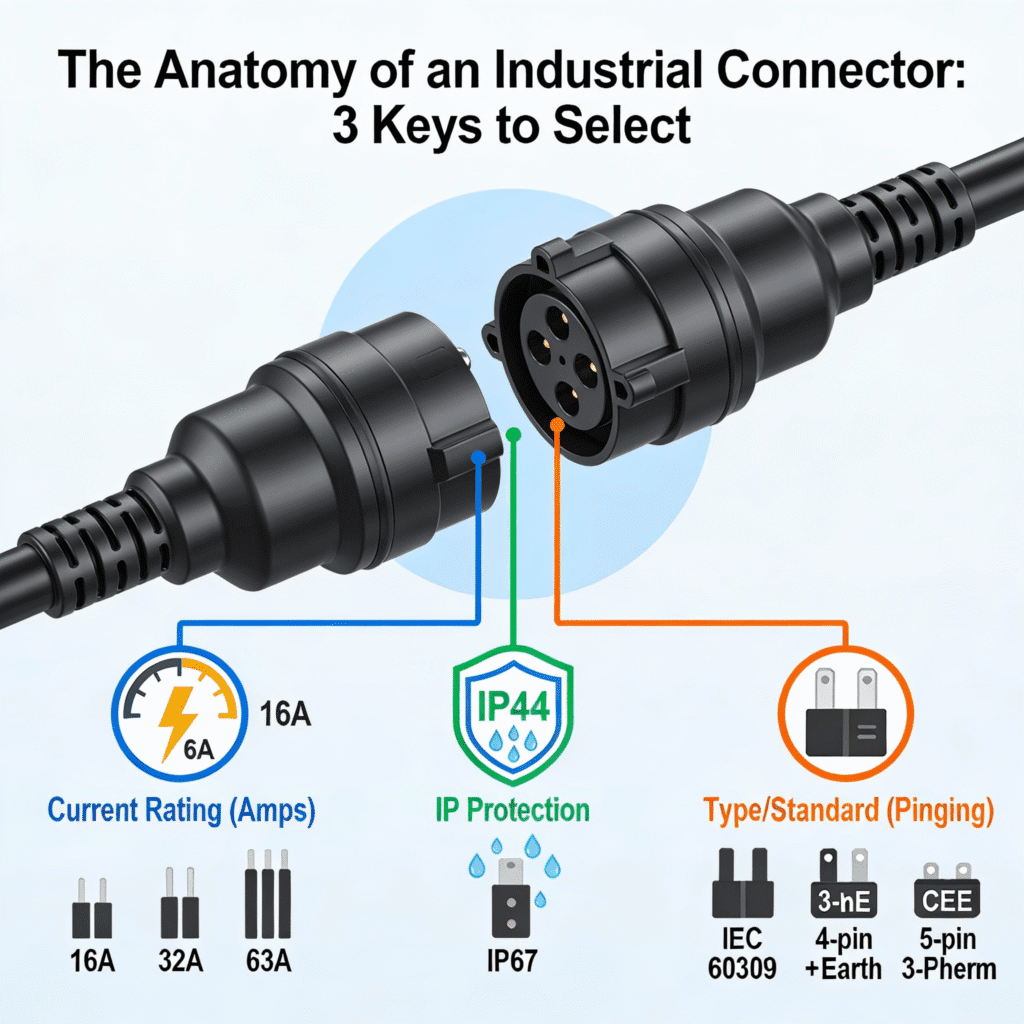
This guide breaks down the three most critical specifications for industrial plug and socket selection: current rating (amperage), IP (Ingress Protection) rating, and plug/socket type. It also includes real-world application case studies, a step-by-step buying process, and common pitfalls to avoid—ensuring you select durable, compliant, and compatible power connectors for your industrial needs.
Key terms defined upfront:
- Industrial Plug & Socket: Heavy-duty power connectors designed for industrial environments, supporting higher currents and harsh conditions than domestic models.
- Current Rating: The maximum electrical current (measured in amps, A) a plug/socket can safely carry without overheating.
- IP Rating: A standard (IEC 60529) classifying protection against solid objects (dust) and liquids (water)—critical for industrial durability.
- Plug/Socket Type: Standardized designs (e.g., Type I, Type A, CEE) ensuring compatibility with regional power systems and equipment.
2. Critical Specifications for Industrial Plugs & Sockets
2.1 Current Rating (Amperage): Match to Power Demand
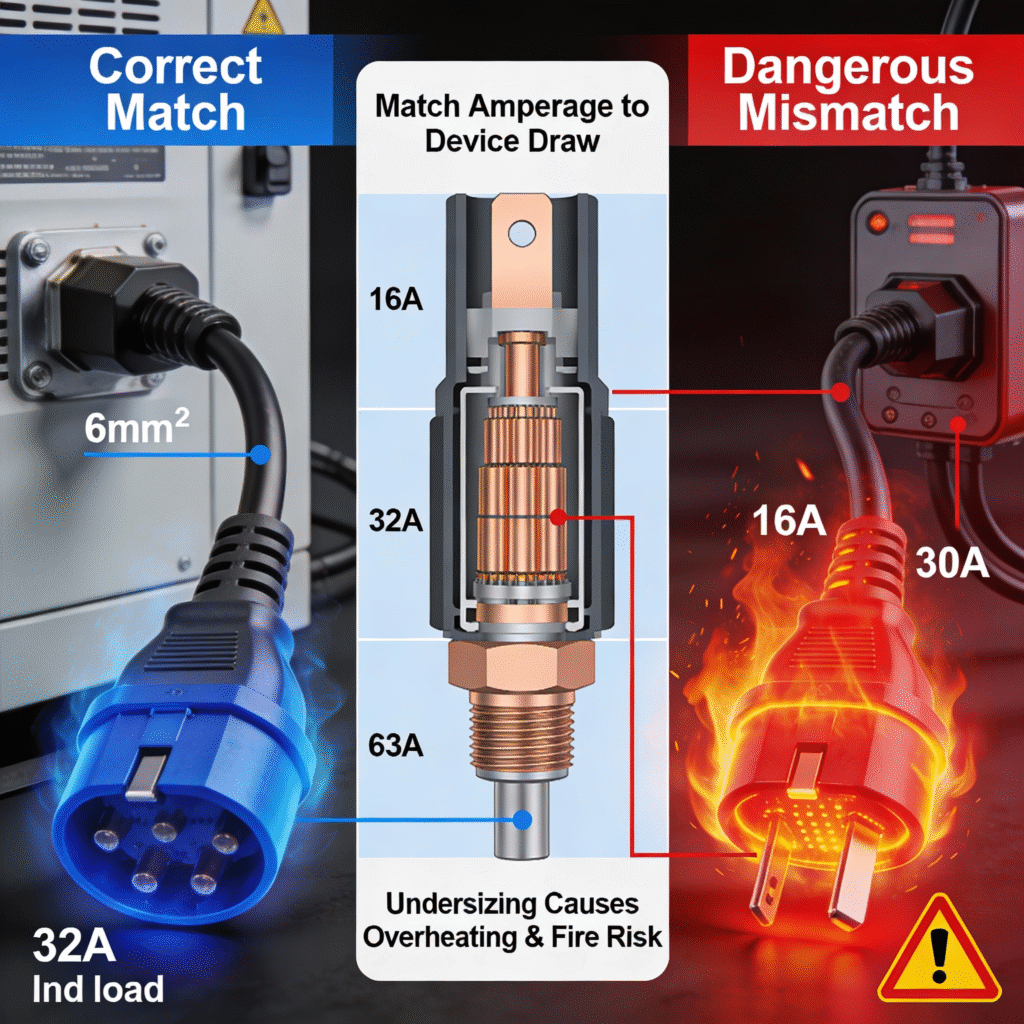
Current rating is the most fundamental specification—industrial plugs and sockets are available in 16A, 32A, 63A, and 125A (or higher) to handle varying equipment power needs.
Common Current Ratings & Applications
- 16A: Ideal for low-power industrial equipment (e.g., small motors, power tools, lighting systems). Compatible with 230V single-phase power.
- 32A: Used for medium-power machinery (e.g., conveyor belts, pumps, welding tools). Works with 230V single-phase or 400V three-phase systems.
- 63A: For high-power equipment (e.g., industrial heaters, large compressors, production line machinery). Designed for 400V three-phase power.
- **125A+: Specialized for extreme power demands (e.g., industrial transformers, heavy-duty manufacturing equipment). Requires heavy-duty wiring and enclosures.
Application Case Study: Current Mismatch Risk
A manufacturing plant used 16A industrial sockets to power 25A welding machines. Within weeks, the sockets overheated, melting the plastic housings and creating a fire hazard. The plant upgraded to 32A heavy-duty sockets (Schneider Electric Industrial Series), which matched the equipment’s current draw. After the upgrade, overheating issues eliminated, and maintenance costs dropped by 70%.
2.2 IP Rating: Protection Against Harsh Environments
Industrial environments range from clean workshops to dusty construction sites and wet washdown areas—your plug/socket’s IP rating must match the conditions.
Key IP Ratings for Industrial Use
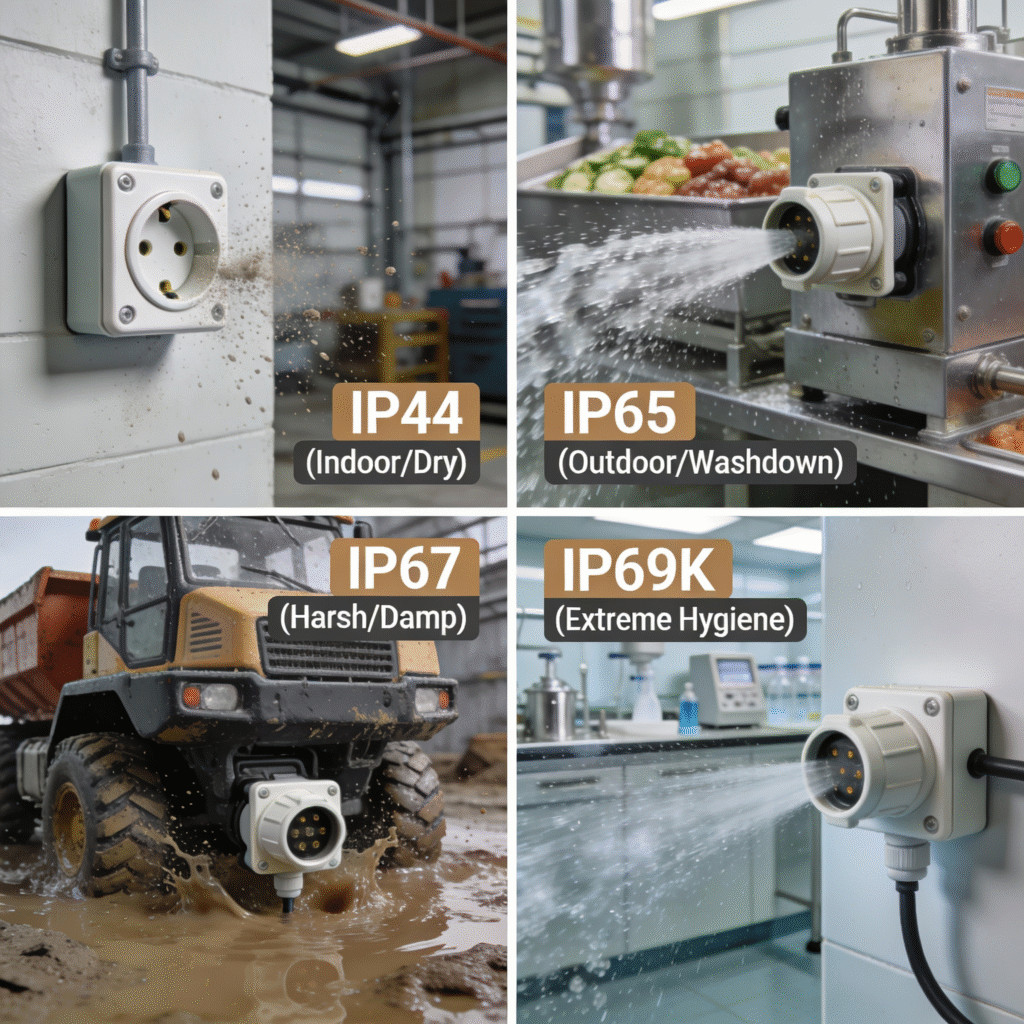
- IP44: Basic protection against solid objects (>1mm) and splashing water. Suitable for indoor, low-dust environments (e.g., assembly lines, control rooms).
- IP54: Dust-protected (limited ingress) and splash-resistant. Ideal for indoor industrial areas with moderate dust (e.g., woodworking shops).
- IP65: Dust-tight and protected against low-pressure water jets (hose spray). Used for outdoor or semi-outdoor applications (e.g., construction site power boxes).
- IP67: Dust-tight and resistant to temporary submersion (up to 1m for 30 minutes). Critical for washdown environments (e.g., food processing plants) or flood-prone areas.
- IP69K: Resistant to high-pressure, high-temperature water jets (steam cleaning). Designed for extreme industrial washdowns (e.g., automotive manufacturing, chemical plants).
Application Case Study: IP Rating Upgrade for Food Processing
A dairy plant initially installed IP44 industrial plugs/sockets for its cleaning equipment. Daily washdowns with high-pressure hoses led to water ingress, causing frequent short circuits. The plant switched to IP69K-rated connectors (ABB Industrial Series), which withstand steam cleaning and chemical sanitizers. After the upgrade, socket failures dropped to zero, and compliance with FDA hygiene standards was maintained.
2.3 Plug & Socket Type: Compatibility & Regional Standards
Industrial plugs and sockets follow standardized types to ensure compatibility—choosing the right type prevents connection issues and safety hazards.
Common Industrial Plug/Socket Types
- CEE Plugs/Sockets: European standard (e.g., CEE 7/4, CEE 7/5) for 16A–63A, 230V/400V systems. Widely used in manufacturing and industrial facilities across Europe.
- Type I: Australian/New Zealand standard (3 pins, 10A/16A, 230V). Used in 亚太地区 industrial settings.
- Type A: North American standard (2 pins, 15A, 120V). Common in U.S. industrial workshops and light-duty equipment.
- Cam Lock Connectors: Heavy-duty connectors (30A–400A) for high-current applications (e.g., construction site power distribution, industrial generators).
- Military Plugs/Sockets: Ruggedized, high-reliability connectors for defense, aerospace, or harsh-field industrial use.
Application Case Study: Regional Compatibility for International Plants
A multinational automotive company opened a facility in Mexico and initially installed European CEE sockets. Equipment with North American Type A plugs couldn’t connect, causing costly delays. The company replaced the sockets with Type A industrial models (Allen-Bradley Industrial Series), ensuring seamless compatibility with local equipment. This eliminated downtime and reduced connector replacement costs by 85%.
2.4 Additional Critical Specifications
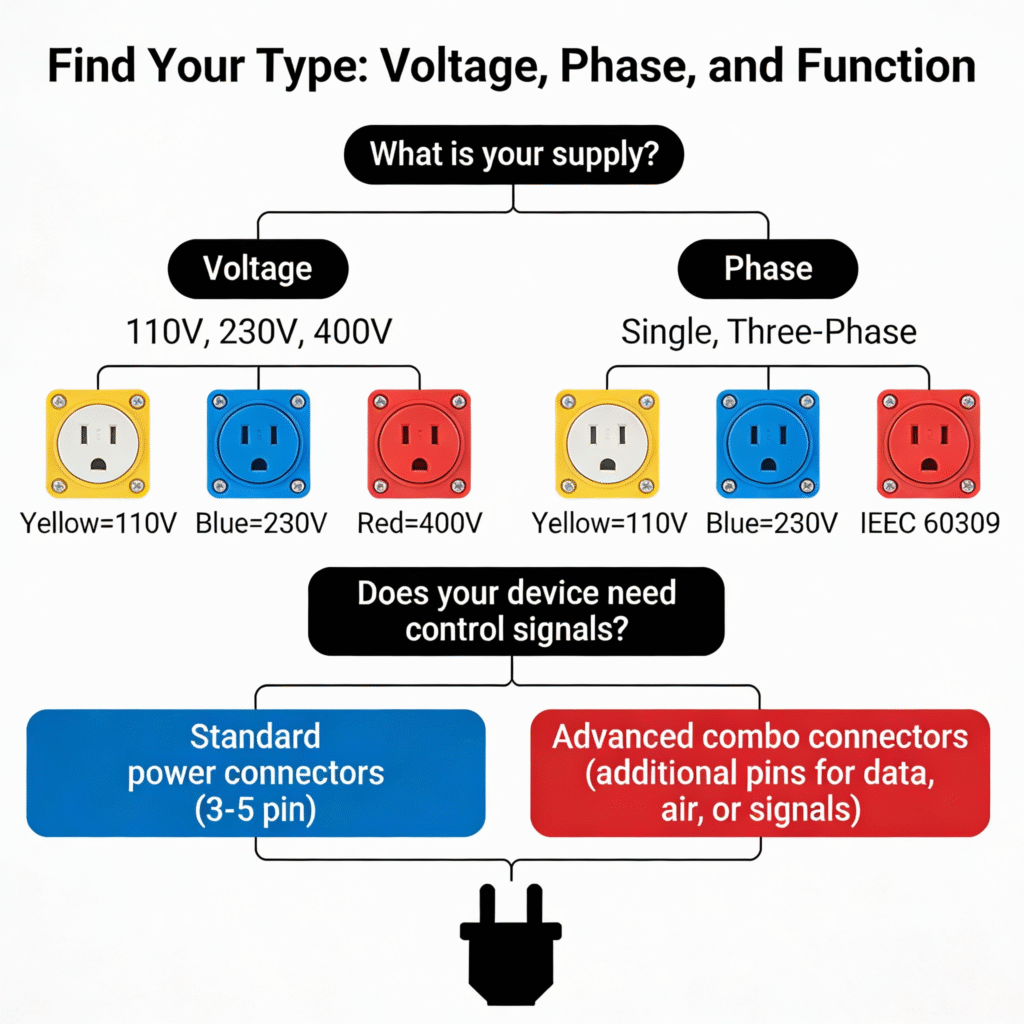
- Voltage Compatibility: Match to your system’s voltage (230V single-phase, 400V three-phase, 120V/240V) to avoid electrical failures.
- Phase Configuration: Single-phase (for low-power equipment) or three-phase (for high-power machinery) — ensure alignment with your power supply.
- Material: Die-cast aluminum or stainless steel housings for durability; copper contacts for reliable conductivity and corrosion resistance.
- Fused vs. Non-Fused: Fused sockets (with built-in fuses) add overload protection—critical for safety-critical equipment (e.g., medical devices, precision machinery).
3. Step-by-Step Buying Process for Industrial Plugs & Sockets
3.1 Step 1: Calculate Equipment Power Requirements
- Check the equipment’s nameplate for current draw (amps) and voltage (V) — select a plug/socket with a current rating 20–30% higher than the load to handle inrush current.
- Determine phase configuration (single/three-phase) based on your power supply.
- Example: A 20A three-phase pump (400V) requires a 32A, three-phase industrial plug/socket.
3.2 Step 2: Evaluate the Operating Environment
- Assess conditions: Dust, water exposure, temperature extremes, or washdown needs.
- Select IP rating: IP44 for clean indoor use; IP65 for outdoor/semi-outdoor; IP67/69K for wet/harsh environments.
- Example: A construction site power box needs IP65-rated connectors to resist rain and dust.
3.3 Step 3: Confirm Compatibility & Regional Standards
- Identify the plug type used by your equipment (e.g., CEE, Type A, Cam Lock).
- Align with regional electrical standards (e.g., EU: CEE, U.S.: Type A, Australia: Type I).
- Example: European-manufactured machinery requires CEE plugs/sockets for compatibility.
3.4 Step 4: Prioritize Safety & Durability
- Choose materials: Stainless steel or die-cast aluminum for ruggedness; copper contacts for conductivity.
- Opt for fused sockets if overload protection is needed.
- Verify certifications: CE, UL, CSA to ensure compliance with industrial safety standards (e.g., IEC 60309 for industrial plugs/sockets).
3.5 Step 5: Consider Specialized Needs
- Mobile vs. Fixed: Mobile sockets (e.g., industrial extension cords) for temporary power; fixed sockets for permanent equipment.
- Weatherproofing: Outdoor applications require UV-resistant, corrosion-proof connectors.
- Accessories: Cable glands, mounting brackets, or socket boxes for secure installation.
Example Selection Workflow: A chemical plant needs sockets for 45A three-phase heaters (400V) in a washdown area. Selection: 63A, 400V three-phase CEE sockets, IP69K rating, stainless steel housing, fused design (Schneider Electric XB4 Series).
4. Real-World Application Case Studies
4.1 Case Study 1: Construction Site Power Distribution (High-Current, Outdoor)
- Challenge: Need for durable, weatherproof connectors to power 50A construction machinery (generators, cranes) in rain/dust.
- Selection: 63A Cam Lock connectors, IP65 rating, 400V three-phase, die-cast aluminum housing (ABB Cam Lock Series).
- Results: Zero water/dust ingress failures; compatible with all site equipment; maintenance costs reduced by 60% vs. standard sockets.
4.2 Case Study 2: Food Processing Plant (Washdown, Hygiene-Critical)
- Challenge: Sockets for cleaning equipment needed to withstand high-pressure steam washdowns and chemical sanitizers.
- Selection: 16A IP69K-rated sockets, 230V single-phase, stainless steel housing, fused design (Siemens Industrial Series).
- Results: Compliant with FDA hygiene standards; no corrosion or short circuits; 99.9% reliability over 2 years.
4.3 Case Study 3: Aerospace Manufacturing (High-Precision, Low-Dust)
- Challenge: Connectors for 25A precision machining tools required low-dust ingress and reliable conductivity.
- Selection: 32A IP54-rated CEE plugs/sockets, 400V three-phase, copper contacts (IDEC Industrial Series).
- Results: No equipment downtime from dust-related failures; consistent power delivery improved machining accuracy by 15%.
5. Common Buying Mistakes to Avoid
5.1 Underestimating Current Requirements
Using a 16A socket for a 25A load causes overheating and fire risks—always size up by 20–30%.
5.2 Ignoring IP Rating Needs
An IP44 socket in a wet environment leads to water ingress and short circuits—match IP rating to conditions.
5.3 Mismatching Plug/Socket Type
Using incompatible regional types (e.g., CEE with Type A) prevents equipment connection and causes downtime.
5.4 Overlooking Voltage/Phase Compatibility
A 230V socket with a 400V system will fail immediately—verify voltage and phase before purchasing.
5.5 Sacrificing Quality for Cost
Cheap, low-quality connectors have poor conductivity and durability—invest in reputable brands (Schneider, ABB, Allen-Bradley) for long-term savings.
6. Conclusion & Reference Resources
Selecting industrial plugs and sockets requires focusing on three core specifications: current rating (matching equipment power needs), IP rating (environmental protection), and plug/socket type (compatibility). By following the step-by-step buying process and learning from real-world case studies, you’ll ensure safe, reliable power distribution and avoid costly downtime.
Key takeaways:
- Current rating should be 20–30% higher than the equipment’s load to handle inrush current.
- IP rating must align with the environment (IP65+ for outdoor/wet use; IP44 for clean indoor use).
- Plug/socket type must match equipment and regional standards to ensure compatibility.
- Prioritize durable materials (stainless steel, copper) and safety certifications (CE, UL) for industrial reliability.
Appendix: Key Reference Resources
- IEC 60309: Standard for Industrial Plugs, Sockets, and Couplers
- IEC 60529: IP Rating Classification Standard
- UL 498: North American Standard for Industrial Sockets and Plugs
- Schneider Electric: Industrial Plug & Socket Technical Datasheet
- ABB: Cam Lock Connector Application Guide
- National Electrical Code (NEC) Article 406: Industrial Socket Outlet Requirements