
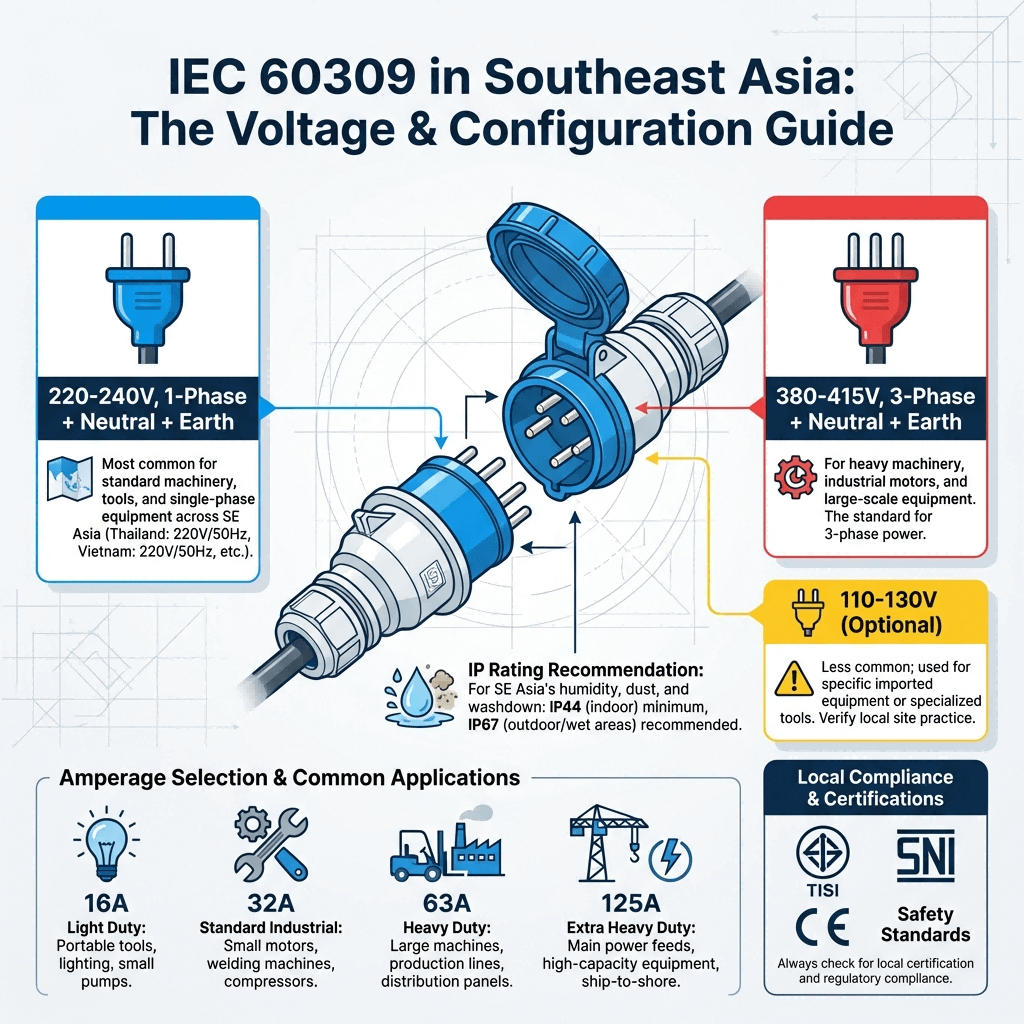
IEC 60309 Standard: Local Adaptation and Technical Innovation in Southeast Asia Manufacturing
IEC 60309 industrial plugs and sockets,Global manufacturing is rapidly moving to Southeast Asia.
Therefore, reliable industrial power connections have become critical.
IEC 60309 is the global standard for heavy-duty plugs and sockets.
Moreover, it has been carefully localized for regional conditions.
These changes follow global rules while fitting local industry needs.
They support electronics, automotive, and new energy manufacturing across the region.
1. Regulatory Compliance and Policy Support
Many Southeast Asian nations use rules aligned with IEC 60309.
Specifically, they balance safety, compatibility, and local climate risks.
Thailand updated its TIS 166-2549 standard in 2024.
It requires IP67-rated IEC 60309 connectors in all new industrial parks.
This protects equipment from monsoon rains and high humidity.
Vietnam also enforces IEC 60309 for export-focused factories.
Additionally, it requires compatibility with EU’s EN 60309.
These policies have driven strong market growth.
In 2020, only 45% of industrial plugs followed IEC 60309.
By 2025, this share rose to 78%.
Vietnam and Thailand reached a $320M market in 2024.
Furthermore, annual growth exceeds 8%, higher than the global average.
2. Technical Improvements for Tropical and Coastal Climates
Southeast Asia has hot, humid, and often coastal environments.
As a result, standard IEC 60309 needed targeted upgrades.
2.1 Better Weather and Ingress Protection
Manufacturers use improved materials for harsh conditions.
For instance, enclosures use modified PA66 plastic and EPDM gaskets.
These work well at 35–40°C and over 85% humidity.
Coastal areas face heavy salt spray and corrosion.
Therefore, contact bases use anti-corrosion coatings.
Outdoor maintenance cycles extend from 6 to 18 months.
2.2 More Reliable Contacts for Unstable Grids
Local power grids often have voltage fluctuations.
To solve this, customized IEC 60309 uses silver-nickel plating.
This keeps contact resistance below 5 mΩ for stable power flow.
Contacts also have a larger surface area of 12 mm².
As a result, full-load temperature rise stays under 35 K.
This is well below the 50 K limit in IEC 60309-1:2021.
Semiconductor factories use 16A 3P+N+E connectors.
Notably, these reach 10,000 fault-free mating cycles.
2.3 Easier Installation and Maintenance
Many small factories need simple, fast setup.
Therefore, adapted connectors use tool-free snap-fit wiring.
Installation time drops from 30 minutes to 10 minutes per unit.
Labels use English, Vietnamese, and Thai instructions.
Additionally, suppliers offer pre-wired quick-change kits.
This lowers complexity for on-site maintenance teams.
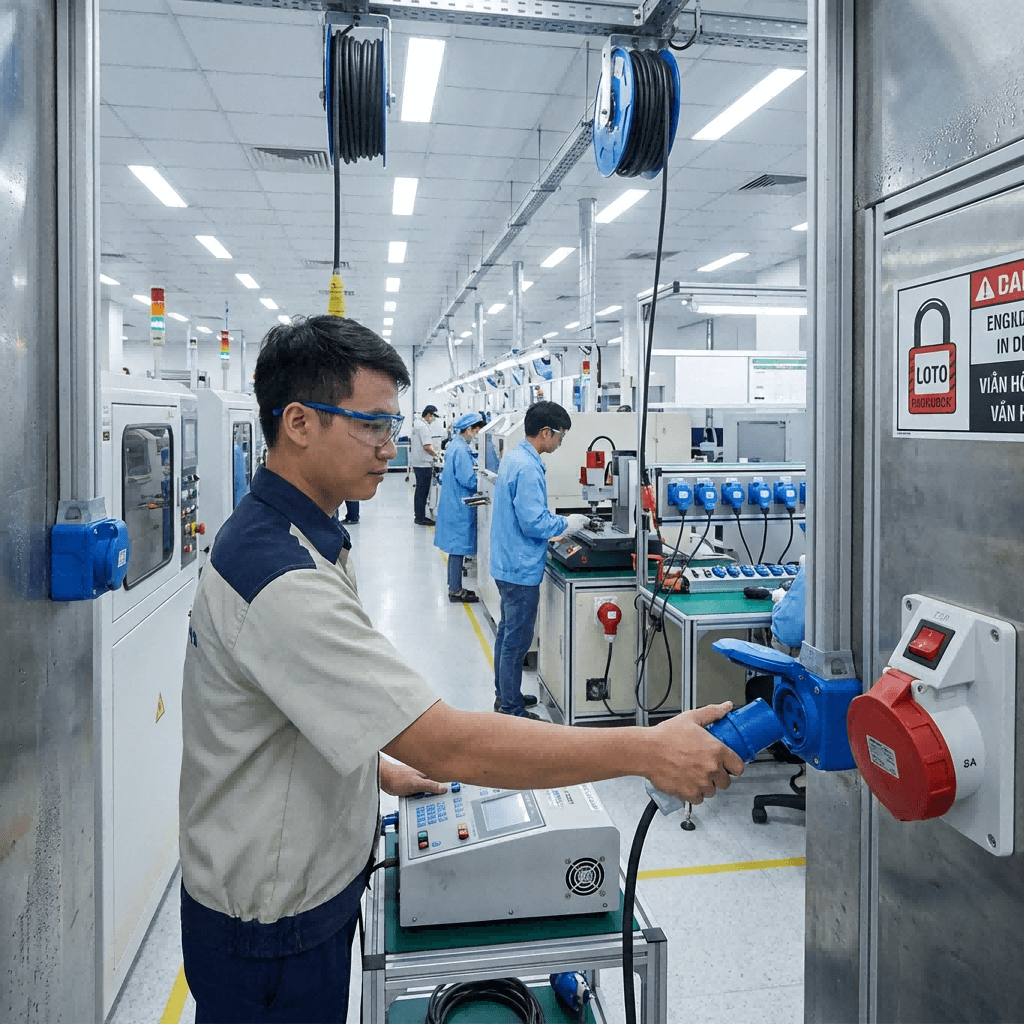
3. Compatibility for Cross-Border Supply Chains
Southeast Asia relies heavily on global supply chains.
Accordingly, IEC 60309 adaptations focus on full interoperability.
Horizontal compatibility matches China’s GB/T 11918 and EU standards.
This lets factories import parts and export finished goods easily.
Vertical compatibility supports older NEMA-style equipment.
Furthermore, IEC-to-NEMA adapters simplify system upgrades.
Major firms like Samsung and Toyota use these designs locally.
As a result, line changeover efficiency improves by 40%.
Supply chain coordination costs also drop by 25%.
4. Smart Upgrades and Future Trends
Manufacturing in Southeast Asia is moving toward Industry 4.0.
Therefore, smart features are being added to IEC 60309 connectors.
Many now include temperature, humidity, and current sensors.
Moreover, they send real-time data via LoRa IoT networks.
The system automatically cuts power if overheating or water ingress is detected.
Consequently, unplanned downtime falls by more than 30%.
Renewable energy is also growing across the region.
For this reason, DC-rated IEC 60309 (up to 1000 V DC) is expanding.
Thailand uses these in solar panel factories in the Eastern Economic Corridor.
Improved arc-suppression design ensures safe and stable connections.
This supports the growth of low-carbon and zero-carbon factories.
Conclusion
Local adaptation of IEC 60309 goes far beyond basic compliance.
Instead, it combines global standards with regional needs.
Climate resistance, reliability, and cross-border compatibility are key.
Furthermore, smart and DC-ready designs support future industrial growth.
These changes strengthen supply chains and improve safety across Southeast Asia.
In the years ahead, IEC 60309 will keep evolving.
Specifically, it will focus on high IP ratings, smart monitoring, and renewable compatibility.
This will continue to support sustainable, efficient industrial development.