
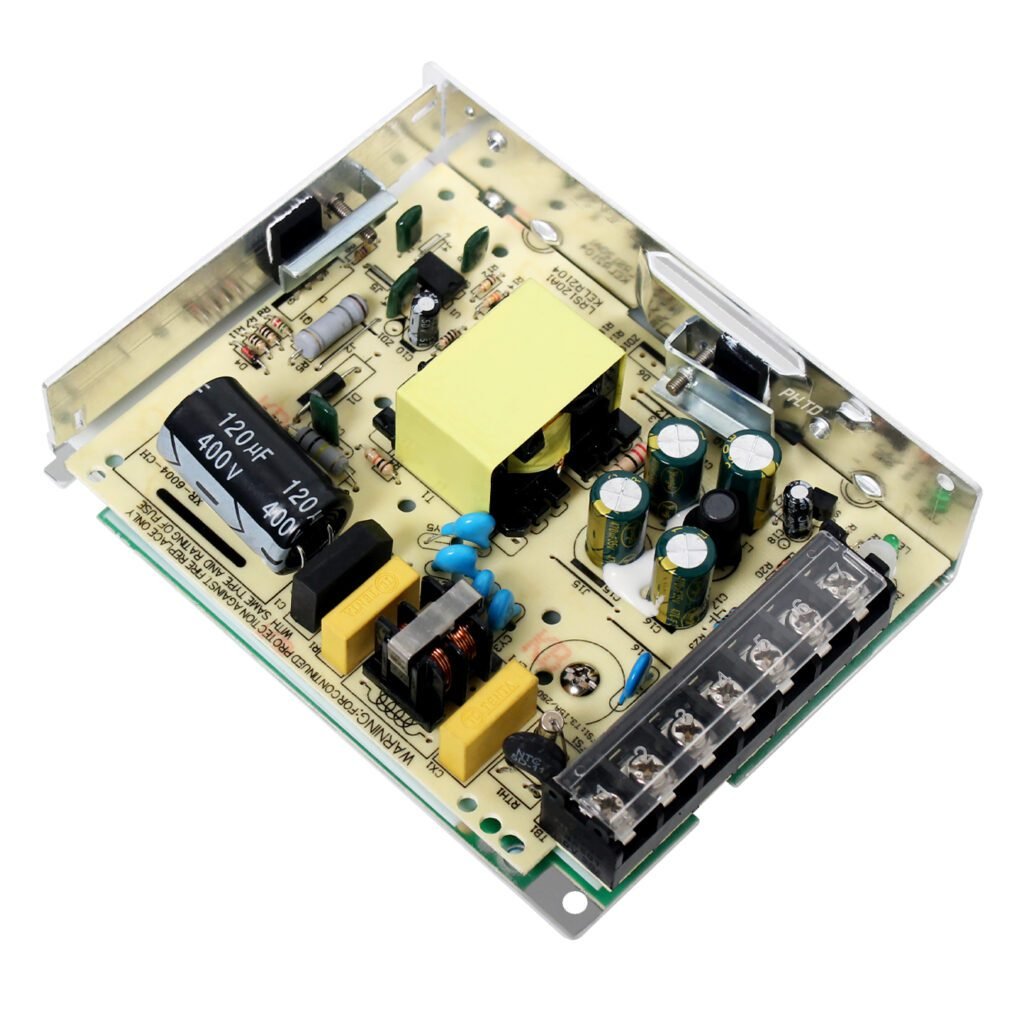
Introduction: Voltage Selection Fundamentals
DIN rail power supply selection requires careful voltage consideration between 24V systems for traditional industrial control and 48V systems for modern applications. This guide examines voltage options, output configurations, and application-specific recommendations for optimal industrial power system design.
1. Voltage Selection: 24V Industrial Standard
24V Applications and Advantages
Primary 24V Applications encompass most traditional industrial control systems where reliability and safety are paramount.
Sensor Networks:
Voltage Requirement: 24V DC standard
Application Examples: Proximity sensors, temperature sensors, pressure transducers
Advantage: Safe low voltage operation with adequate signal strength
Installation Benefit: Standardized across industrial sensor manufacturers
PLC Systems:
Power Requirement: 24V DC for CPU and I/O modules
Typical Current: 2-10A depending on system size
Critical Need: Stable voltage for reliable logic execution
Industry Standard: Universal adoption across PLC manufacturers
Relay and Contactor Control:
Coil Voltage: 24V DC standard for industrial relays
Application: Motor starters, control circuits, safety relays
Advantage: Reduced arcing compared to higher voltages
Safety Benefit: Lower risk in control cabinet environments
24V Technical Specifications
Performance Characteristics:
Safety Classification: SELV (Safety Extra-Low Voltage)
Typical Current Range: 1A to 40A available
Efficiency: 85-94% in modern switching designs
Cable Considerations: Moderate voltage drop concerns
Installation Advantages:
Standardization: Universal industrial acceptance
Component Availability: Extensive compatible device selection
Safety Margin: Reduced shock hazard in maintenance
Cost Effectiveness: Competitive component pricing
2. Voltage Selection: 48V Modern Applications
48V Applications and Advantages
Primary 48V Applications address specific requirements where efficiency, distance, or compatibility drive voltage selection.
Communication Equipment:
Standard Voltage: 48V DC telecom standard
Application Examples: Routers, switches, base station equipment
Historical Basis: Traditional telephone system compatibility
Modern Usage: Network equipment power redundancy systems
Power over Ethernet (PoE):
PoE Standards: 48V for PoE, PoE+, PoE++
Maximum Power: Up to 90W with PoE++
Application: IP cameras, VoIP phones, wireless access points
Advantage: Single cable for data and power
Motor Drives and High-Power Applications:
Specific Motors: Some servo and DC brushless motors
Advantage: Higher voltage reduces current requirements
Efficiency Benefit: Lower I²R losses in windings
Application: Certain robotics and precision motion systems
Renewable Energy Systems:
Solar Applications: 48V battery bank compatibility
Advantage: Efficient power transmission
System Integration: Compatible with many charge controllers
Expanding Use: Growing in off-grid and hybrid systems
48V Technical Specifications
Performance Characteristics:
Efficiency Benefit: Reduced transmission losses
Current Reduction: Half the current of equivalent 24V systems
Cable Savings: Smaller gauge wiring possible
Distance Advantage: Lower voltage drop over long runs
Safety Considerations:
Voltage Classification: Still within SELV limits
Protection Requirements: Additional considerations needed
Installation Practices: Proper insulation and spacing
Maintenance Procedures: Enhanced safety protocols
3. Voltage Comparison Matrix
Technical Comparison
| Parameter | 24V Systems | 48V Systems | Selection Guidance |
|---|---|---|---|
| Primary Applications | PLCs, sensors, relays | Telecom, PoE, network equipment | Match existing system standards |
| Current Requirements | Higher current for same power | Lower current for same power | 48V reduces conductor size |
| Voltage Drop | More significant over distance | Less significant over distance | 48V for long cable runs |
| Safety Margin | Higher safety factor | Requires more precautions | 24V for maximum safety |
| Component Cost | Generally lower | Some specialized components higher | 24V for cost-sensitive projects |
| Efficiency | Good (85-94%) | Very good (88-96%) | 48V offers slight advantage |
| System Compatibility | Universal industrial standard | Specific application standard | Follow equipment specifications |
Application Decision Guide
Choose 24V When:
Controlling PLCs, sensors, or industrial relays
Safety is primary concern with frequent human interaction
Existing infrastructure uses 24V standards
Cable runs are under 50 meters
Component cost optimization is critical
Choose 48V When:
Powering telecommunications equipment
Implementing PoE or PoE+ systems
Operating high-power devices efficiently
Cable runs exceed 50 meters
Integrating with existing 48V infrastructure
4. Output Configuration: Single vs Dual
Single Output Power Supplies
Design Characteristics:
Single Voltage Output: Dedicated to one voltage requirement
Current Capacity: Full rated current available on single output
Simplified Design: Fewer components, potentially higher reliability
Cost Efficiency: Typically 15-30% lower cost than dual output equivalents
Optimal Applications:
Homogeneous Systems: All devices require same voltage
High-Current Needs: Maximum current delivery required
Budget-Conscious Projects: Cost-sensitive installations
Standard Control Panels: Traditional industrial applications
Example Configurations:
24V/10A Single Output: 240W dedicated to 24V devices
48V/6A Single Output: 288W for telecom equipment
12V/20A Single Output: 240W for specialized applications
Dual Output Power Supplies
Design Characteristics:
Multiple Voltages: Typically 12V/24V or 5V/24V combinations
Independent Regulation: Each output separately controlled
Space Optimization: One unit replaces two single-output supplies
System Simplification: Reduced wiring and connections
Common Configurations:
12V/24V Dual Output: For mixed voltage industrial systems
5V/24V Dual Output: For control logic (5V) and power (24V)
24V/48V Dual Output: For hybrid industrial/telecom applications
Adjustable Outputs: Some models offer variable voltage settings
Optimal Applications:
Mixed Voltage Systems: Different devices require different voltages
Compact Control Cabinets: Space-constrained installations
Retrofit Projects: Upgrading existing mixed-voltage systems
Prototyping Systems: Flexible development and testing environments
Output Configuration Comparison
| Consideration | Single Output | Dual Output | Recommendation |
|---|---|---|---|
| System Flexibility | Limited | High | Dual for mixed voltage needs |
| Current Availability | Full rating on one output | Shared between outputs | Single for high-current applications |
| Space Efficiency | Standard | Excellent | Dual for space-constrained cabinets |
| Cost Efficiency | Better per watt | Higher functionality cost | Single for budget-focused projects |
| Reliability Potential | Simpler design | More complex circuitry | Single for critical applications |
| Installation Simplicity | Straightforward | More connections | Single for quick installations |
| Future Expansion | Limited | More adaptable | Dual for evolving systems |
5. Selection Methodology
Step 1: Application Analysis
Voltage Requirements Assessment:
Review all connected device specifications
Identify primary voltage needs
Consider future expansion requirements
Evaluate existing infrastructure compatibility
Current Calculations:
Sum all device current requirements
Add 20-30% safety margin
Consider peak vs continuous loads
Account for inrush currents
Step 2: Technical Specification Review
Critical Parameters:
Input Voltage Range: 85-264VAC for global compatibility
Output Regulation: ±1-2% for stable operation
Efficiency Rating: 85% minimum, 90%+ preferred
Protection Features: OVP, OCP, SCP, OTP
Temperature Range: -25°C to +70°C for industrial use
Certification Requirements:
Safety Standards: UL 508, IEC 62368-1
EMC Compliance: EN 55032, EN 61000
Industry Specific: Marine, railway, medical if required
Regional Certifications: CE, UKCA, CCC, PSE
Step 3: Environmental Considerations
Operating Conditions:
Ambient Temperature: Match to installation environment
Altitude Rating: Up to 2000m standard, higher if needed
Humidity Levels: 20-90% non-condensing typically
Vibration Resistance: Important for industrial machinery
Contaminant Protection: IP20 standard, higher if exposed
Installation Environment:
Cabinet Type: Enclosed, ventilated, or outdoor
Mounting Space: Available DIN rail length
Cooling Availability: Natural convection or forced air
Access Requirements: Maintenance and service access
Step 4: Economic Evaluation
Cost Analysis Factors:
Initial Purchase Price: Unit cost comparison
Installation Costs: Wiring, connectors, labor
Operating Costs: Energy efficiency impact
Maintenance Costs: Expected service requirements
Lifecycle Costs: Total cost over expected service life
Value Considerations:
Warranty Coverage: 3-5 year typical ranges
Technical Support: Availability and quality
Delivery Lead Time: Project timeline impact
Local Availability: Stock and distribution channels
6. Application Examples
Example 1: Factory Automation Panel
Requirements:
Power for: 2 PLCs (5A each), 15 sensors (0.1A each), 8 relays (0.5A each)
Voltage: All devices require 24V DC
Cabinet: Standard industrial control panel
Environment: Manufacturing floor with moderate vibration
Selection:
Voltage: 24V (standard for all devices)
Configuration: Single output (homogeneous voltage needs)
Rating: 24V/20A (480W with 20% margin)
Features: DIN rail mount, wide input voltage, OVP/OCP/OTP
Rationale: Single voltage system benefits from simpler single-output design with maximum current availability.
Example 2: Telecommunications Cabinet
Requirements:
Power for: PoE switch (48V/4A), router (48V/2A), control system (24V/3A)
Cabinet: Wall-mounted telecommunications enclosure
Environment: Temperature-controlled indoor location
Space: Limited mounting space available
Selection:
Voltage: Dual voltage requirement (48V and 24V)
Configuration: Dual output or separate supplies
Option A: Single 48V/8A supply + 24V/5A supply
Option B: Dual output 48V/6A + 24V/4A unit
Choice: Option B for space optimization
Rationale: Dual output unit saves space while meeting both voltage requirements in compact cabinet.
Example 3: Mixed Industrial System
Requirements:
Devices: PLC (24V/4A), HMI (24V/2A), embedded computer (12V/5A)
Cabinet: Modular industrial enclosure
Expansion: Planned addition of 24V devices
Budget: Moderate with focus on reliability
Selection:
Voltage: Mixed (24V and 12V required)
Configuration: Dual output 24V/8A + 12V/6A
Features: Wide input range, high efficiency, monitoring signals
Future: Adequate margin for additional 24V loads
Rationale: Dual output provides both required voltages with expansion capacity for future 24V additions.
7. Installation Best Practices
DIN Rail Mounting
Installation Procedure:
Rail Verification: Confirm TH35-7.5 or TH35-15 compatibility
Position Planning: Allow adequate clearance between units
Mounting Sequence: Install larger/heavier units first
Secure Attachment: Ensure positive clip engagement
Final Check: Verify all units are securely mounted
Clearance Requirements:
Vertical Clearance: 10mm minimum above and below
Horizontal Spacing: 5mm minimum between units
Ventilation Space: Follow manufacturer specifications
Access Space: Allow for wiring and maintenance
Wiring Implementation
Input Wiring:
Wire Selection: Appropriate gauge for input current
Protection Devices: Proper fusing or circuit breakers
Grounding: Essential safety ground connection
Termination: Secure connections with proper torque
Output Wiring:
Voltage Drop Calculation: Ensure adequate conductor size
Load Distribution: Balance loads across multiple units if used
Connection Method: Screw terminals, spring clamps, or connectors
Identification: Clear labeling of all circuits
Thermal Management
Natural Convection Cooling:
Orientation: Vertical mounting for optimal airflow
Clearance Maintenance: Ensure specified air space
Ambient Monitoring: Consider cabinet internal temperature
Location: Avoid heat sources within cabinet
Forced Air Considerations:
Airflow Direction: Align with unit ventilation pattern
Filter Maintenance: Regular cleaning in dusty environments
Temperature Monitoring: Cabinet temperature sensors
Fan Selection: Appropriate CFM for heat load
8. Troubleshooting Guide
Common Issues and Solutions
Voltage Instability:
Symptoms: Fluctuating output, device resets
Possible Causes: Input voltage variations, overload conditions
Solutions: Verify input power quality, check load within ratings, inspect connections
Overheating Problems:
Symptoms: Thermal shutdown, reduced output, hot enclosure
Possible Causes: Insufficient ventilation, overload, high ambient temperature
Solutions: Improve airflow, verify load, consider derating, monitor temperature
Output Failure:
Symptoms: No output voltage, status indicator off
Possible Causes: Input power loss, internal fault, protection activated
Solutions: Check input power, reset unit if possible, contact manufacturer
Excessive Noise:
Symptoms: Audible buzzing, electrical interference
Possible Causes: Component vibration, switching frequency, poor filtering
Solutions: Secure mounting, check for loose components, verify installation
Preventive Measures
Regular Maintenance:
Visual inspection every 6-12 months
Connection tightness verification
Ventilation clearance maintenance
Environmental condition monitoring
Performance Monitoring:
Output voltage measurement
Temperature monitoring
Load current verification
Efficiency calculation periodic checks
9. Future Considerations
Technology Trends
Higher Efficiency Standards:
Increasing minimum efficiency requirements
Improved partial load performance
Reduced standby power consumption
Advanced thermal management
Smart Features:
Communication interfaces (MODBUS, Ethernet)
Remote monitoring capabilities
Predictive maintenance features
Energy usage analytics
Material Advances:
Improved thermal interface materials
Higher temperature component ratings
Reduced size through higher frequency operation
Enhanced reliability through better components
Application Evolution
Industrial IoT Integration:
Connected power management systems
Cloud-based monitoring solutions
Automated load balancing
Predictive failure analysis
Energy Management:
Peak load management capabilities
Renewable energy integration
Energy storage compatibility
Smart grid interaction
Safety Enhancements:
Advanced protection algorithms
Arc fault detection
Ground fault monitoring
Enhanced isolation capabilities
Conclusion: Optimal Selection Strategy
DIN rail power supply selection balances voltage requirements, output configuration, technical specifications, and application needs. The choice between 24V and 48V systems depends primarily on connected equipment, while single vs dual output selection hinges on system complexity and space constraints.
Final Recommendations:
Voltage Selection Summary:
Choose 24V for: PLCs, sensors, relays, general industrial control
Choose 48V for: Telecom equipment, PoE systems, specific motor drives
Consider both when: Mixed systems or future expansion anticipated
Output Configuration Summary:
Select single output for: Homogeneous voltage systems, high-current needs
Select dual output for: Mixed voltage applications, space optimization
Evaluate carefully when: Cost sensitivity vs functionality balance needed
Implementation Priority:
Match equipment requirements precisely
Include adequate safety margins for reliability
Consider future expansion during initial selection
Verify all certifications for compliance needs
Plan installation carefully for optimal performance
Long-Term Success Factors:
Proper sizing with adequate margins
Quality components from reputable manufacturers
Correct installation following best practices
Regular maintenance and monitoring
Documentation and training for personnel
Technical Support: Contact power system specialists for assistance with DIN rail power supply selection specific to your application requirements. Professional guidance ensures optimal performance, reliability, and compliance with industry standards and regulations.