Introduction: The Critical Role of Heavy-Duty Connectors
Mining operations depend entirely on robust electrical infrastructure. Mining industry electrical plugs heavy-duty requirements demand absolute reliability in the world’s harshest environments. A single connector failure can halt production for hours. Even worse, it can trigger catastrophic explosions in gaseous zones. These specialized devices are the lifeline between the power source and essential machinery like continuous miners, longwall shearing machines, and heavy-duty conveyors. Unlike industrial standard connectors, mining plugs must survive constant vibration, physical impact, and chemical exposure. They must also maintain integrity in potentially explosive atmospheres. This article explores the engineering, standards, and real-world performance of these critical components. We will draw upon decades of field experience and documented case studies to provide actionable insights. Understanding these heavy-duty requirements is not just an engineering exercise—it is a safety imperative.
Section 1: Defining Heavy-Duty in the Mining Context
1.1 Environmental and Mechanical Stress Factors
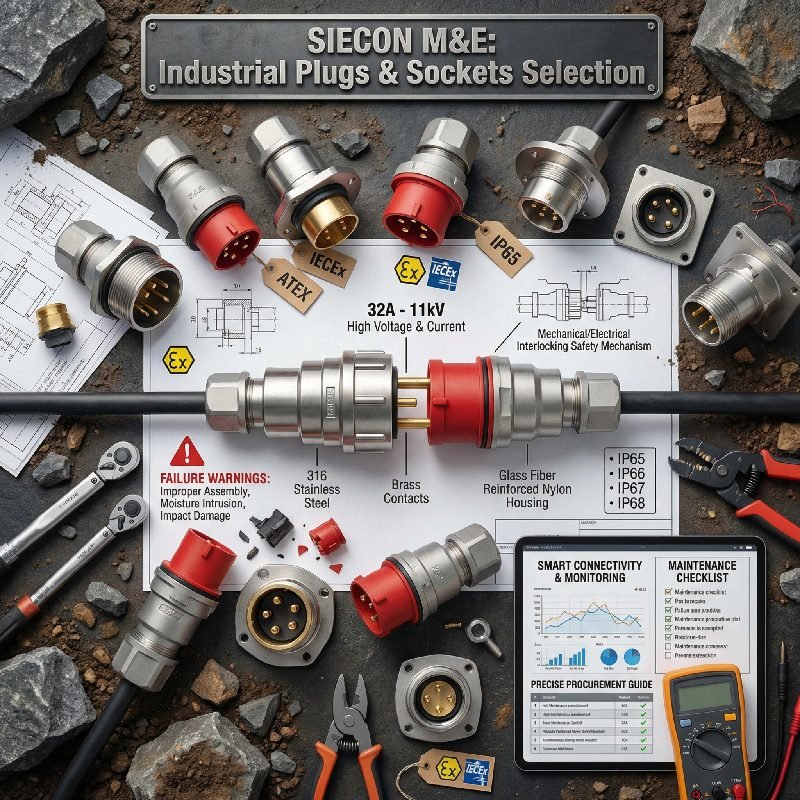
What exactly makes a connector “heavy-duty” for mining? Mining industry electrical plugs heavy-duty requirements start with material science. These components must withstand abrasive dust, flooding, and rock falls. High-grade polycarbonate or glass-filled nylon housings provide exceptional impact resistance -1. Internally, contacts are typically machined from brass or plated silver to ensure conductivity. Stainless steel components, particularly Grade 316, resist corrosion from acidic mine water -1. The mechanical design must also handle extreme vibration without loosening. Secure locking mechanisms, such as threaded rings or twist-lock designs, prevent accidental disconnection -1. Furthermore, the physical bulk of these connectors is a necessary trade-off for durability. They require more installation space but deliver protection against 400-ampere loads and high-energy impacts.
1.2 Ingress Protection and Sealing Standards
Water and dust are the primary enemies of electrical safety underground. Therefore, ingress protection (IP) ratings are a cornerstone of mining industry electrical plugs heavy-duty requirements. Standard industrial sockets are insufficient for areas with slurry or water jets. For surface mining exposed to rain, an IP65 rating is the minimum acceptable standard -1. However, for underground workings prone to flooding, IP67-rated devices are mandatory. These can withstand temporary immersion in water. For the most severe applications, such as submersible pumps, IP68 certification is required for continuous submersion -1. This protection is achieved through precision-molded silicone gaskets. These seals must remain flexible across wide temperature ranges and resist ozone degradation. A failed seal leads to moisture ingress, which causes short circuits, arcing, and equipment destruction.
Section 2: Regulatory Landscape and Safety Standards
2.1 Global Certification Requirements
Navigating the world of certifications is essential for compliance. Mining industry electrical plugs heavy-duty requirements are governed by a complex web of international and regional standards. In the United States, Title 30 of the Code of Federal Regulations (30 CFR) governs mining safety. Specifically, §18.41 mandates that connectors inby the last open crosscut must prevent incendive arcing during insertion or withdrawal -2. This often requires interlocking mechanisms that de-energize the circuit before the plug can be removed. For international operations, the IECEx and ATEX directives are the gold standards for explosive atmospheres. In Australia, AS/NZS 1299 governs explosion-protected three-phase devices up to 11 kV -6. Canadian standards, such as CSA C22.2 No. 159, cover devices for gaseous mines and coal dust environments -8. Using non-certified components in these zones is not only illegal but exponentially increases the risk of disaster.
2.2 Voltage and Current Ratings
The electrical capacity of mining plugs far exceeds typical industrial gear. Low-voltage applications might utilize single-phase sockets for hand tools and lighting -1. However, the backbone of mine power is three-phase distribution. Three-phase sockets typically operate between 380V and 690V for medium-voltage equipment. They can handle current ratings from 32 amps to well over 125 amps for primary machinery -1. For high-voltage longwall systems, restrained and bolted devices are rated up to 11 kV -6. These high-voltage couplers often incorporate pilot contacts and earthed phase barriers. These safety features ensure that the connector cannot be energized unless properly engaged. They also protect against phase-to-phase faults, which can cause explosive arcing events.
Section 3: Material Science and Durability Engineering
3.1 Corrosion Resistance and Contact Metallurgy
The chemistry of mine water varies drastically by region. Mining industry electrical plugs heavy-duty requirements must account for this variability. Corrosion is a silent killer of electrical conductivity. Brass remains a popular choice for contacts due to its natural corrosion resistance and excellent conductivity -1. For structural components exposed to severe chemical runoff, stainless steel is preferred. Grade 316 stainless steel, in particular, offers superior protection in chloride-rich environments -1. However, metallurgy alone is not enough. Engineering plastics like UV-stabilized polycarbonate are used for non-conductive parts. These polymers prevent electrochemical degradation between dissimilar metals. They also maintain dimensional stability, ensuring that housings do not warp and break seals over time.
3.2 Impact Resistance and Thermal Stability
Underground, equipment is subject to constant abuse. Mining industry electrical plugs heavy-duty requirements demand that housings survive drops and rock impacts. Reinforced thermoplastics, such as glass-filled nylon, provide the necessary toughness. These materials resist deformation under mechanical stress and maintain integrity at high temperatures -1. Thermal stability is crucial because high-current loads generate significant heat. If the housing material degrades, it can release conductive carbon paths or lose its flameproof properties. Therefore, manufacturers must verify material performance under continuous load and fault conditions. The goal is to prevent the housing from becoming a source of ignition itself.
Section 4: Case Study Analysis—Learning from Catastrophic Failures
4.1 Incident 1: The Expelled 3.3kV Plug
Theory is important, but field failures teach the harshest lessons. In one Australian underground coal mine, a longwall face conveyor stopped abruptly. When operators attempted a restart, a massive arc occurred. The 3.3kV trailing cable was violently expelled from the back of a restrained plug. Fortunately, the maintenance fitter standing nearby was uninjured. The subsequent investigation revealed a cascade of errors. The cable had suffered a bending force that put tension on the retaining screws. These 6mm screws eventually failed, causing the internal phase contacts to separate . Arcing began inside the moulding, leading to a short circuit fault that blew the cable out. This highlights how mechanical stress on a cable translates directly to electrical risk.
4.2 Incident 2: The Mismatched Components and Incorrect Assembly
A separate catastrophe occurred at another mine during startup. As a crusher motor attempted to start, the 3.3kV receptacle failed catastrophically. The plug was blown out, endangering nearby workers. Investigators found that the interior moulding inside the receptacle did not meet certification requirements. It was an incorrect part manufactured sixteen years prior, yet it fit perfectly . Furthermore, the critical plug-to-receptacle seal was missing. This allowed moisture and contaminants to enter, degrading insulation. Additionally, the retaining ring screws were tensioned to only 10Nm, far below the required 30Nm . These failures demonstrate a clear theme: mining industry electrical plugs heavy-duty requirements are useless if assembly instructions are ignored. Proper torque specifications, certified parts, and meticulous assembly are non-negotiable.
4.3 The Role of Moisture and Partial Discharge
Beyond assembly errors, environmental factors play a massive role. A major ACARP research project investigated numerous 11kV plug failures. The study found a strong correlation between failure and moisture. High relative humidity or free groundwater ingress led to partial discharge activity. Partial discharge is essentially small, persistent sparking that degrades insulation over time. The research also highlighted issues with testing techniques and a lack of high-voltage awareness. It was discovered that fully assembled units were susceptible to discharge sources, even if individual components passed tests. This led to recommendations for better training and adoption of Australian and International Standards. The industry learned that innovative designs with better phase barriers and component fit could significantly reduce failure rates.
Section 5: Technological Innovations and Smart Connectors
5.1 Interlocking Mechanisms and Safety
Preventing arcing is the primary function of a mining connector. Mining industry electrical plugs heavy-duty requirements often mandate mechanical or electrical interlocks. Mechanically interlocked connectors ensure the plug cannot be withdrawn while the circuit is live. Electrically interlocked versions use a pilot circuit to remove the load before disconnection. This pilot circuit itself must be intrinsically safe to prevent it from becoming an ignition source. For mobile battery-powered machines, regulations allow padlocked connectors as an alternative. These must have visible warning tags stating “DO NOT DISENGAGE UNDER LOAD.” These layers of protection are designed to account for human error and equipment malfunction.
5.2 Integration of Digital and USB Capabilities
The digital transformation of mining is reaching the connector level. Modern operations now utilize USB-integrated sockets within control panels -1. These provide 5V DC output for charging handheld communication devices, data loggers, and gas detectors. This supports real-time data transfer and IoT implementation. Miners can now upload data from diagnostic tools directly at the worksite, improving efficiency. Smart sockets with embedded diagnostics are also emerging. These can monitor temperature, track connection cycles, and predict maintenance needs. By identifying hot spots or degradation early, mines can prevent unplanned downtime.
Section 6: Maintenance Strategies for Longevity
6.1 Inspection Protocols and Frequency
Even the best equipment requires diligent upkeep. Mining industry electrical plugs heavy-duty requirements extend into the maintenance phase. Regulations mandate frequent examination of electrical equipment by qualified personnel. These examinations must identify potentially dangerous conditions. This includes exposed conductors, cracked housings, defective monitoring circuits, and inadequate grounding. Records of these examinations must be kept and signed by a qualified electrician. Thermography is a powerful tool for detecting overheated connections inside assembled plugs. A proactive approach involves checking for paint migration or marks that indicate cable movement within the gland. If the cable moves, the internal connections are stressed.
6.2 Proper Handling and Storage
Human interaction significantly impacts connector lifespan. Personnel must be trained to avoid dropping connectors or forcing connections. Alignment guides should be used to prevent bending pins . When not in use, plugs and sockets should be stored in dry, clean containers. This prevents contamination of contact surfaces and seal degradation. Cleaning protocols should avoid solvents that harm plastic housings or rubber seals. A simple dry or slightly damp cloth is usually sufficient. Furthermore, understanding the certification limits of components is vital. Using a grommet size not listed on the certified drawing, as seen in the case study, voids the flameproof rating. Always verify that replacement parts match the original certification.
Section 7: Selection Criteria for Procurement
7.1 Matching the Connector to the Hazard Zone
Procurement decisions must start with a thorough environmental assessment. Mining industry electrical plugs heavy-duty requirements vary depending on the classification of the area. In coal mines with methane gas, explosion-proof connectors with ATEX or IECEx certification are mandatory -1. For surface quarries with dust but minimal gas, weatherproof IP67-rated devices may suffice. It is essential to distinguish between single-phase and three-phase needs. High-torque motors require three-phase systems for efficiency and smooth operation. Voltage discrimination features prevent accidental insertion of a low-voltage plug into a high-voltage socket. This physical incompatibility is a critical safety feature.
7.2 Supplier Documentation and Traceability
Modern procurement demands transparency. Suppliers must provide comprehensive technical documentation. This includes cable gauge compatibility, environmental classifications, and installation methodologies. Component traceability is increasingly important. Procurement teams should verify that materials are lead-free and recyclable to meet sustainability goals. Detailed product specifications, including 3D models and wiring schematics, enable precise planning. Independent verification reports and certification records should be readily available. A supplier who cannot provide certified drawings for their components—like the incorrect moulding in the case study—should be avoided. The initial cost savings are never worth the safety risk.
Conclusion: The Imperative of Excellence
Mining industry electrical plugs heavy-duty requirements exist to protect human life and ensure productivity. We have explored the robust materials, stringent standards, and complex technologies involved. Real-world case studies remind us that even certified equipment fails when improperly assembled or maintained. Moisture, incorrect torque, and mismatched parts are recurring themes in disaster investigations. As mines delve deeper and conditions become more extreme, the demand for reliable connectors will only grow. Smart technologies and advanced materials offer a path forward. However, they must be supported by rigorous training and a culture of safety. The humble plug and socket are not just components; they are critical safety barriers. Treating them with the respect they deserve is the mark of a world-class mining operation.