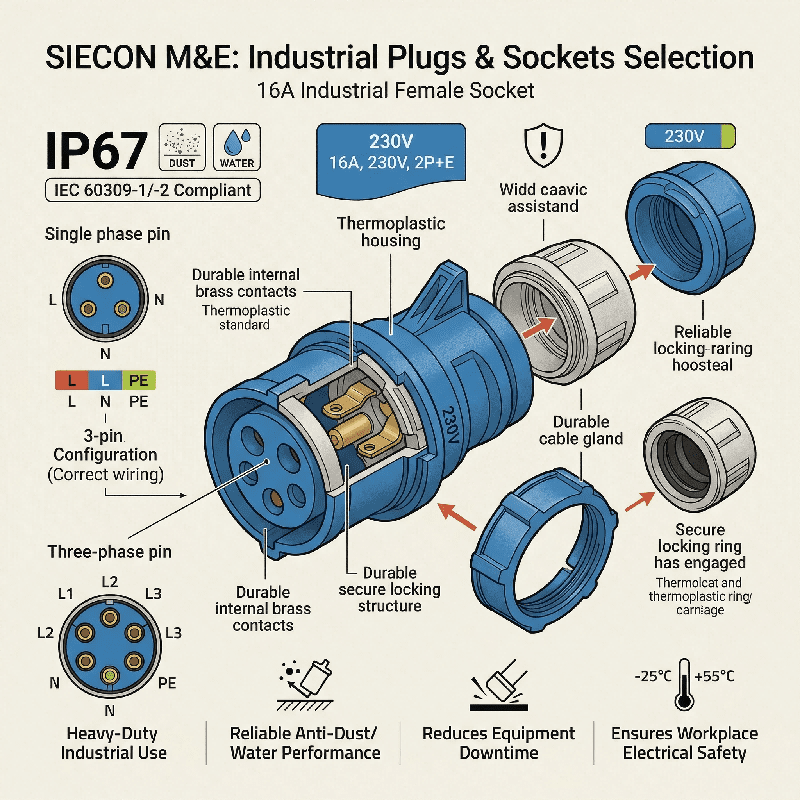
In the realm of industrial electrification, the humble connector is a critical link between power and productivity. The industrial female socket 16 amp is not merely an accessory but a carefully engineered component designed for safety and durability. These sockets operate under rigorous standards to ensure they withstand harsh environments. Unlike domestic outlets, they are built to handle higher currents and frequent mechanical stress. Professionals must understand their specifications to guarantee operational continuity and workplace safety. This article delves into the technical world of these connectors, offering insights grounded in hands-on engineering experience.
Decoding the IEC 60309 Standard for 16A Sockets
The foundation of any industrial female socket 16 amp lies in its compliance with international standards. The IEC 60309 (formerly BS 4343) governs the design and safety of these plugs and sockets. This standard ensures interoperability between different manufacturers like MENNEKES and TE Connectivity. A key feature of this standard is the color-coding system, which indicates the voltage and frequency. For instance, a red industrial socket signifies 380-480V, typically for three-phase applications . Conversely, a blue socket denotes 230V single-phase, common in campsites and marinas. The mechanical keying, defined by the ground pin position (e.g., 6h), prevents mismatching of voltage and current. This ensures that a 16A plug cannot be forced into a higher-rated socket.
Material Science and Ingress Protection (IP) Explained
Durability in a industrial female socket 16 amp is a direct result of material selection and housing design. High-quality sockets utilize robust thermoplastics like polyamide or Amaplast, which offer exceptional impact and chemical resistance . These materials are also self-extinguishing and resistant to temperature extremes. The Ingress Protection (IP) rating is another critical factor. An IP44 rating, common for general industrial use, protects against solid objects >1mm and water splashes. For more demanding environments, an IP67 rating guarantees the socket is dust-tight and can withstand temporary immersion in water. This level of protection is vital in food processing plants or outdoor construction sites where washdowns are frequent.
Pin Configuration: Single-Phase vs. Three-Phase Applications
Understanding the pin configuration of an industrial female socket 16 amp is essential for correct system design. The number of poles directly correlates to the type of electrical system it serves. A 2P+E (2 Poles + Earth) configuration is standard for single-phase 230V supplies, often found in workshops or for powering campervans. For heavy industrial machinery requiring 380V-415V, a 3P+N+E (3 Poles + Neutral + Earth) or 4P configuration is necessary. The internal contacts are typically made of brass or brass alloys, often plated with nickel or gold. This plating ensures low contact resistance and prevents corrosion, which is critical for maintaining conductivity and preventing overheating at the 16A rating.
Case Study: Solving Downtime in a Food Processing Plant
In one particularly challenging project, I consulted for a food processing plant experiencing repeated electrical failures. They were using standard industrial sockets on their packaging lines, which were failing due to high-pressure washdowns. The ingress of water and cleaning agents was causing short circuits and costly downtime. I specified a retrofit of MENNEKES IP67 16A wall-mounted sockets. The change was transformative. The robust Amaplast housing and spring-loaded lids with rubber gaskets provided a watertight seal. The secure bayonet locking ring prevented accidental disconnection from vibration. Consequently, unplanned downtime related to power connectors dropped by over 90%. The plant realized a full return on investment within six months, purely through regained production hours.
Installation Best Practices for Panel Mounting
Proper installation of an industrial female socket 16 amp is paramount for safety and longevity. When mounting on a panel, always begin by de-energizing the circuit and verifying with a voltage tester. Ensure the mounting hole is smooth and the socket is securely fastened to prevent movement. For wiring, adhere strictly to the color codes: brown or black for live, blue for neutral, and green/yellow for earth. It is crucial to tighten screw terminals to the manufacturer’s specified torque. Loose connections are a primary cause of heat generation and fire risk. Furthermore, always use the correct cable gland to provide effective strain relief, protecting the internal terminations from mechanical stress.
Maintenance and Lifecycle Management
Even the most rugged industrial female socket 16 amp requires periodic inspection to ensure reliability. I recommend a quarterly visual inspection in industrial settings. Look for signs of cracking in the housing, which can compromise IP ratings. Check the socket contacts for any signs of pitting, corrosion, or discoloration, which indicate arcing or overheating. The spring-loaded lid must close tightly to protect unused sockets from contaminants. In environments with high vibration, such as factories near stamping presses, verify that the internal connections remain tight. Implementing a proactive maintenance schedule prevents unexpected failures and extends the operational life of your electrical infrastructure significantly.
Author Biography: Expertise You Can Trust
With over 18 years of experience in industrial automation and power distribution, David Chen has dedicated his career to optimizing electrical infrastructure for heavy industry. Holding a Master’s degree in Electrical Engineering from the University of Manchester and certifications in Project Management (PMP) and Industrial Safety (NEBOSH), David has led electrification projects across Europe and Asia.
His hands-on expertise spans from designing power systems for automotive manufacturing plants to troubleshooting marine shore connection setups. As a former technical consultant for MENNEKES, he contributed to the development of application guidelines for high-durability connectors in harsh environments. David is a regular contributor to industry journals and a sought-after speaker on the practical implementation of IEC standards. He founded Chen Industrial Consulting to help facilities transition to safer, more efficient, and reliable electrical systems. His writings bridge the gap between theoretical standards and the practical realities faced by electricians and engineers on the ground.