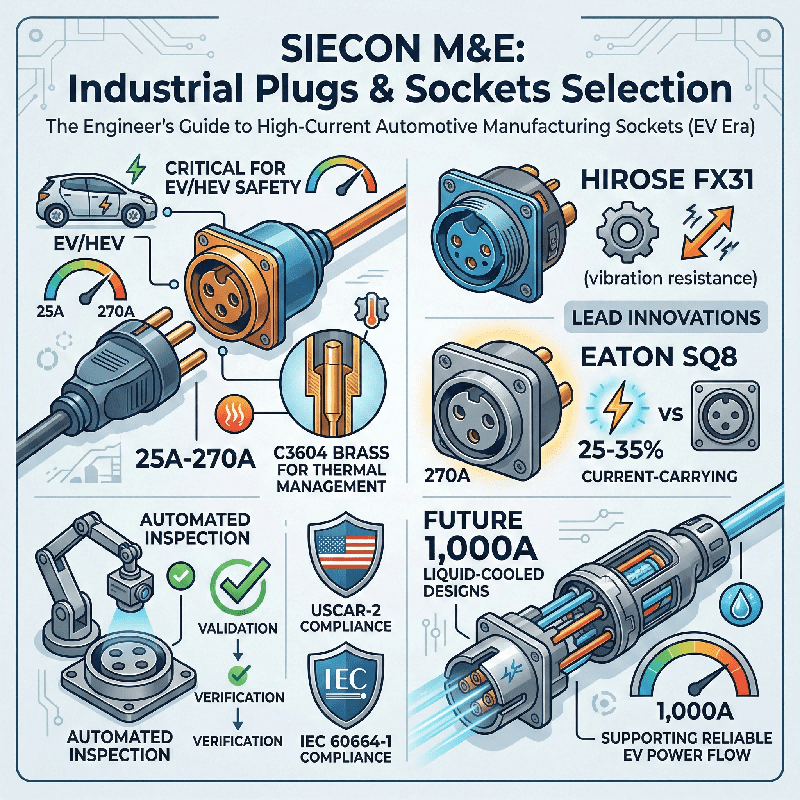
The shift towards electrification has fundamentally redefined automotive interconnection requirements. Modern electric vehicles (EVs) and hybrid electric vehicles (HEVs) demand robust power distribution solutions. High-current automotive manufacturing sockets are no longer just passive components anymore. They have become critical enablers of vehicle performance and safety systems. These specialized sockets must reliably carry currents from 25 to 270 amperes. They must also withstand the harsh realities of the automotive environment. Unlike standard electronic connectors, these variants must manage extreme heat. Constant vibration and mechanical stress are also factors over the vehicle’s lifetime. This article provides a deep technical dive into engineering challenges. We explore innovative solutions defining the current state of high-current connectivity.
The Engineering Imperative for High-Current Capacity
Traditional automotive connectors were designed for low-power sensors and modules. However, electric powertrains and battery management systems have shifted the paradigm. A modern electric vehicle may utilize 800 to 1,000 individual connectors. These connectors manage its complex electrical architecture efficiently and safely. The demand for miniaturization further complicates the design process significantly. Engineers must push higher current through increasingly smaller form factors. This creates a significant thermal management crisis requiring immediate attention. Excessive heat can degrade materials and increase contact resistance steadily. This leads to a feedback loop of further heat generation. Therefore, modern high-current automotive manufacturing sockets require careful engineering consideration. They must be designed from the ground up with thermal dissipation. Advanced material science plays a pivotal role in this process. Terminals often utilize high-performance brass alloys like C3604. Phosphor bronze is another common choice for these applications. These materials are paired with tin or selective plating. This ensures excellent corrosion resistance and maintains high conductivity levels. The goal is achieving the lowest possible contact resistance consistently. This directly minimizes heat generation under continuous electrical load.
Case Study: Vibration Resistance in Powertrain Applications
One significant engineering hurdle for high-current sockets is powertrain deployment. These areas are subjected to constant, high-frequency vibration daily. This can cause mechanical relaxation in traditional copper terminals. A standard copper contact relies on its own spring tension. It can gradually lose clamping force over operational time. This leads to increased resistance and potential arcing risks. A prime example solving this challenge is Hirose Electric’s FX31 Series connector. Recognized as a breakthrough in board-to-board power connections, this series was designed specifically to withstand demanding automotive ECU conditions. The key innovation lies in its “floating contact structure” design. This design allows for displacement absorption of ±0.5 mm. It provides this absorption in the XY direction effectively. It also provides ±1.5 mm in the Z direction. By decoupling the rigid mounting points from contacts, the FX31 connector significantly reduces mechanical stress on solder joints. This protection works during vibration or thermal expansion events. This “floating” mechanism prevents cracks and buckling failures. It ensures the connection remains physically and electrically stable. It performs reliably even in severe operating conditions up to 125°C. This innovation proves mechanical compliance equals electrical conductivity importance.
Case Study: Reinventing Terminal Contact Physics
Moving beyond traditional spring contacts, Eaton’s Mobility Group has innovated. They re-engineered the fundamental physics of the terminal connection. Their High-Power Lock Box (HPLB) SQ8 connector system leads. Selected by a major global OEM for a new plug-in hybrid platform, the SQ8 addresses the inherent flaw in all-copper terminals. That flaw is the material’s tendency to relax under heat. Vibration exacerbates this relaxation problem significantly over time. Eaton’s patented design separates the conductor from the spring function. In this architecture, a robust stainless-steel spring maintains contact force. Simultaneously, a high-purity copper current carrier handles the electrical load. This approach delivers a 25 to 35 percent improvement. It achieves better current-carrying capability for a given wire size. Furthermore, the SQ8 system can handle up to 270 amps. It achieves this with minimal resistive loss during operation. It utilizes eight spring-loaded contact points for even current distribution. This case study highlights critical applications like battery disconnect units. For high-voltage heaters, the socket choice directly influences vehicle weight. It also provides more power per unit of volume.
The Role of Automated Manufacturing and Quality Assurance
The reliability of high-current automotive manufacturing sockets relies on design. It is also a product of precision manufacturing processes. As connectors become smaller and more complex, assembly margins shrink. Defects such as terminal partial insertion can cause failures. Poor crimping or internal cracks lead to catastrophic high-voltage system failures. To combat this, manufacturers use advanced automated inspection systems. For instance, Six Sigma methodologies are enforced using machine vision. A relevant example involves a high-volume production line. This line can produce 75,000 connectors every single day. To ensure quality, a sophisticated 2D and 3D vision system was used. This system was synchronized with the production line seamlessly. It performs fourteen different control measurements on each connector. And it accomplishes this in under one second per unit. It detects microscopic defects or contamination effectively. These are defects that the human eye would certainly miss. This level of automated quality control ensures critical standards. It ensures installed sockets meet stringent automotive reliability demands.
Standards, Safety, and Future-Proofing Designs
Compliance with industry standards is non-negotiable for automotive sockets. Engineers must select components meeting or exceeding USCAR-2 specifications. USCAR-2 governs vibration, temperature shock, and durability testing. Additionally, with the shift towards higher voltage architectures, creepage distances become critical. Clearance distances are also critical safety factors requiring attention. Connectors like the JAE Electronics MX81D series are designed for compliance. They comply with IEC 60664-1 safety standards rigorously. This ensures they withstand potential differences up to 320V AC/DC. They perform reliably even at high altitudes without arcing. Looking ahead, the industry prepares for the next leap. Megawatt-class charging systems for commercial vehicles are developing rapidly. Collaborations, such as Autel Energy and Phoenix Contact partnership, are integrating liquid-cooled CCS2 connectors. These are capable of handling 1,000 amps in boost mode. While this represents a high-power charging standard, the underlying principles remain. Thermal management, contact integrity, and system-level compatibility are key. These principles trickle down into every high-current socket design. They apply to every socket within the modern vehicle.
Conclusion
The evolution of the automobile into an electrically-driven machine continues. It places unprecedented demands on its foundational hardware components. High-current automotive manufacturing sockets are critical components for power flow. They ensure the safe and efficient flow of electrical energy. As we have seen through innovations from industry leaders, success lies in advanced mechanical design, novel material application, and rigorous manufacturing processes. For the design engineer, selecting the right socket requires holistic thinking. It requires a view of the vehicle’s entire environment. This includes vibration of the powertrain and thermal load. It also includes the demands of a fast-charging cycle. By prioritizing EEAT principles and drawing on proven engineering data, we can build a future of mobility that is not only powerful but also profoundly reliable.