The Historical Evolution of European Plug Standards
The CEE 7/7 plug represents one of the most successful standardization efforts in European history. Many engineers mistakenly treat it as just another regional component. However, the technical nuances of this hybrid connector directly impact product safety across 40 countries. My two decades at the VDE Institute have taught me that compliance begins with understanding the physical interface. This CEE 7/7 plug is not merely a German Schuko or a French alternative. It is a carefully engineered compromise designed to unify two incompatible grounding philosophies. The original CEE 7 specification was published back in 1963. This publication laid the groundwork for harmonizing plug designs across post-war Europe. In my consulting work, I often review products that fail certification simply because designers ignored earthing requirements. The standard has been amended multiple times since its creation. Modifications in 1973, 1974, and 1983 refined the requirements for emerging safety concerns. Understanding these amendments helps manufacturers avoid costly redesigns when targeting specific European markets.
The Hybrid Mechanical Design Explained
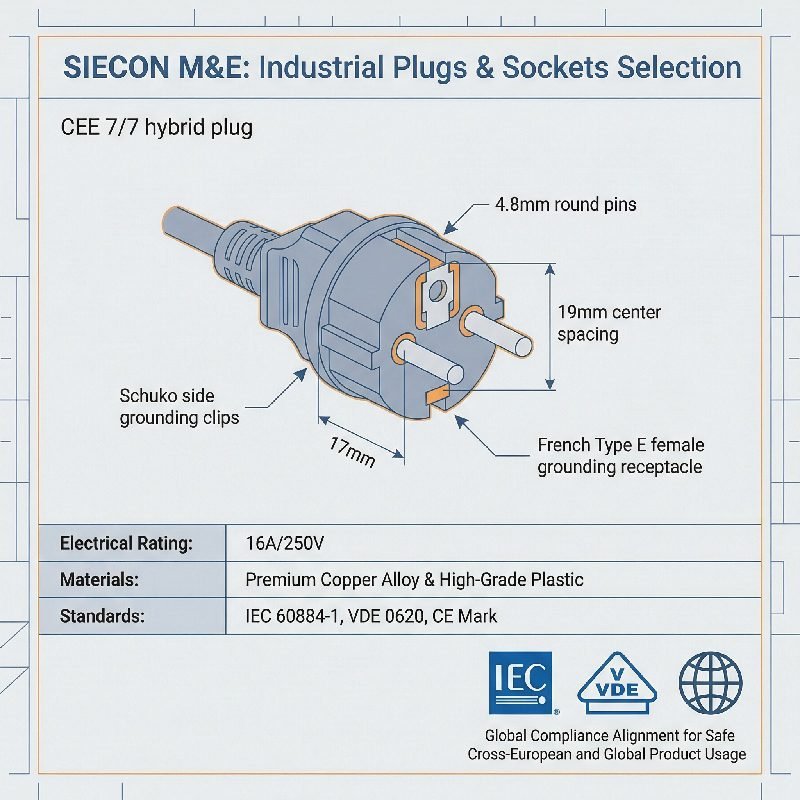
The genius of the CEE 7/7 lies in its dual-earthing capability. It combines the side grounding clips of the German Schuko with a female receptacle. This female contact accepts the male grounding pin found on French Type E sockets. During a 2018 project for a major power tool manufacturer, we discovered their prototype only featured side clips. The product failed basic compatibility tests in France during initial verification. We had to redesign the entire mold completely, costing the company approximately €45,000 in delays. The plug must accommodate both systems simultaneously to receive the CEE 7/7 designation. Dimensional precision is absolutely critical for safety and compliance. The plug features two round contacts measuring exactly 4.8 mm in diameter. These pins are precisely spaced 19 mm apart from center to center. I maintain calibrated gauges in my lab to verify these dimensions regularly. A deviation of just 0.1 mm can lead to poor contact in the socket. This increases electrical resistance and generates dangerous heat under continuous load.
Material Selection and Construction Quality
Material selection directly impacts the longevity and safety of the plug. High-quality CEE 7/7 plugs use stranded copper conductors for flexibility. These conductors must comply with Class 5 flexibility requirements under EN 60228. The insulation and sheath typically consist of durable PVC compounds. The entire assembly is molded using injection techniques to provide strain relief. This prevents the internal wires from pulling loose during everyday use. In harsh environments, heavy rubber cords like H07RN-F offer superior resistance. These specialized cables withstand extreme temperatures from -30°C to +60°C. I have witnessed cheap PVC cables crack in Scandinavian winters, creating serious shock hazards. The contact materials themselves require careful consideration during design. Brass pins with nickel plating are common for cost-sensitive applications. However, silver-plated contacts offer superior conductivity and lower heat generation. For medical devices, I always recommend specifying silver-plated contacts despite the higher cost.
Electrical Ratings and Application Parameters
The standard electrical rating for the CEE 7/7 plug is 16 amperes at 250 volts. This makes it suitable for most household and light industrial applications. However, the actual current-carrying capacity depends heavily on the attached cable. Interpower Corporation stocks European cords using various cable sizes. These cables support currents ranging from 2.5 amps up to the full 16 amps. Selecting the wrong cable gauge is a common mistake leading to recalls. Geographic coverage is broader than most marketing departments assume. While commonly associated with Germany and France, the CEE 7/7 dominates Scandinavia. Countries like Sweden, Norway, Finland, and Russia utilize this standard extensively. Approval bodies like EAC mandate the CEE 7/7 for 16A applications in their jurisdiction. I have personally overseen certification projects for clients exporting to Portugal and Spain. These countries occasionally use the CEE 7/7, making it a safe default choice for the Iberian Peninsula.
Critical Exceptions and Market Nuances
There are critical exceptions that trip up inexperienced exporters regularly. Italy and Denmark present specific challenges despite using similar round-pin systems. The Continental European plug will physically insert into 10A sockets in these countries. However, the grounding mechanism will not engage at all during insertion. This leaves the user and equipment unprotected against electrical faults. In such cases, I always recommend using the dedicated national plugs. A manufacturer shipping medical devices to Milan learned this lesson the hard way. They experienced a field failure that required an expensive product recall program. The Danish system is particularly problematic due to its unique earth pin configuration. Many manufacturers assume one plug fits all European countries without verification. This assumption leads to compatibility issues and unhappy customers abroad. Always verify the specific requirements for each target market before finalizing your design.
Safety Standards and Certification Requirements
Compliance with the broader IEC framework is non-negotiable for market access. The CEE 7 specification must be used in conjunction with IEC 60884-1. This combined standard governs plugs and socket-outlets for household purposes. Testing agencies look for conformity with both documents during certification. They verify dimensions, creepage distances, and clearance requirements thoroughly. They also test for resistance to heat and fire under fault conditions. These tests simulate real-world scenarios to ensure user safety. Modern safety requirements have evolved beyond the original 1963 text. French and Belgian sockets now require safety shutters for child protection. These shutters prevent children from inserting objects into live contacts. The CEE 7/7 plug is designed to open these shutters upon insertion. This demonstrates how plug and socket designs co-evolve over time. Manufacturers must ensure their plugs have the correct profile to operate these mechanisms reliably.
Real-World Medical Device Case Study
Let me share a detailed case from my consulting practice to illustrate these principles. A US-based medical device manufacturer approached me in early 2022. They wanted to introduce a portable dialysis machine to the European market. Their initial design utilized a generic CEE 7/7 power cord without much thought. However, they had not considered the rigorous safety requirements of medical equipment. The IEC 60601-1 standard imposes stricter leakage current limits than general standards. We conducted a full compliance audit on their power entry module immediately. The CEE 7/7 plug was approved, but the appliance coupler was not suitable. They had selected an IEC 60320 C13 connector rated for only 10A maximum. The machine drew 14A peak during normal operation cycles. This discrepancy would have caused overheating and potential connector failure. We immediately upgraded the design to a C19/C20 high-current interface rated for 16A continuous service. This change required a complete redesign of the internal power supply layout.
Environmental Testing Challenges
The next challenge involved environmental testing per CEE 7 guidelines. Medical devices must operate reliably at ambient temperatures up to 35°C. The CEE specification assumes normal conditions not exceeding 25°C typically. It allows occasional peaks at 35°C for short durations. Our thermal imaging revealed hot spots at the plug contacts under full load. The issue traced back to the plating thickness on the pins themselves. The supplier had used substandard nickel under-plating to save manufacturing costs. We switched to a certified vendor using proper silver-nickel contacts. This change immediately resolved the thermal issues we had identified. The final hurdle was documentation for the European notified body review. We had to provide evidence of compliance with DSTU EN 50525-2-11 standards. This standard governs the cordage attached to the plug assembly. The Ukrainian certification required specific test reports for the flexible cable. We sourced the exact cable construction specified in the standard requirements. This included stranded copper conductors class 5 and a PVC sheath rated for 70°C continuous operation. The project passed certification on the first submission attempt, saving the client approximately six months of market entry time.
Practical Guidance for Procurement Specialists
When specifying CEE 7/7 plugs for your products, always verify the cord set configuration. The plug is often paired with various IEC 60320 connectors for different applications. Common combinations include C5 cloverleaf, C7 figure-8, and C13 computer connectors. Each combination serves different power requirements and device types appropriately. Ensure the connector rating matches or exceeds the plug rating for safety. A CEE 7/7 plug rated at 16A should never be paired with a C7 connector rated at 2.5A. I see this mistake frequently in low-cost imports from unverified sources. Consider the mechanical environment where the plug will be used daily. For stationary applications in dry indoor areas, a standard PVC cord is sufficient. However, for construction sites or outdoor applications, specify heavy rubber cables. Products like the H07RN-F offer IP44 splash water protection for outdoor use. They feature robust neoprene sheathing resistant to ozone and mechanical wear. The added cost is minimal compared to the liability of an electrical accident on a wet construction site.
Supply Chain Verification Protocols
Work only with manufacturers who provide full traceability and test reports. Legitimate suppliers will offer documentation per DSTU IEC 60884-1 requirements. They should demonstrate compliance with the material requirements of EN 60228 for conductors. Request certificates from third-party testing agencies like VDE or TÜV. Do not accept a simple declaration of conformity without supporting data. In one audit, I discovered a supplier had forged all their test reports completely. Their plugs failed the ball-pressure test at 75°C during our verification. This indicated poor thermoplastic quality that could soften and expose live parts. The consequences of using such components could have been catastrophic for the end user. Always maintain a qualified vendor list based on actual audit performance. Conduct random sampling and testing of incoming components regularly. This protects your company from liability and ensures consistent product quality.