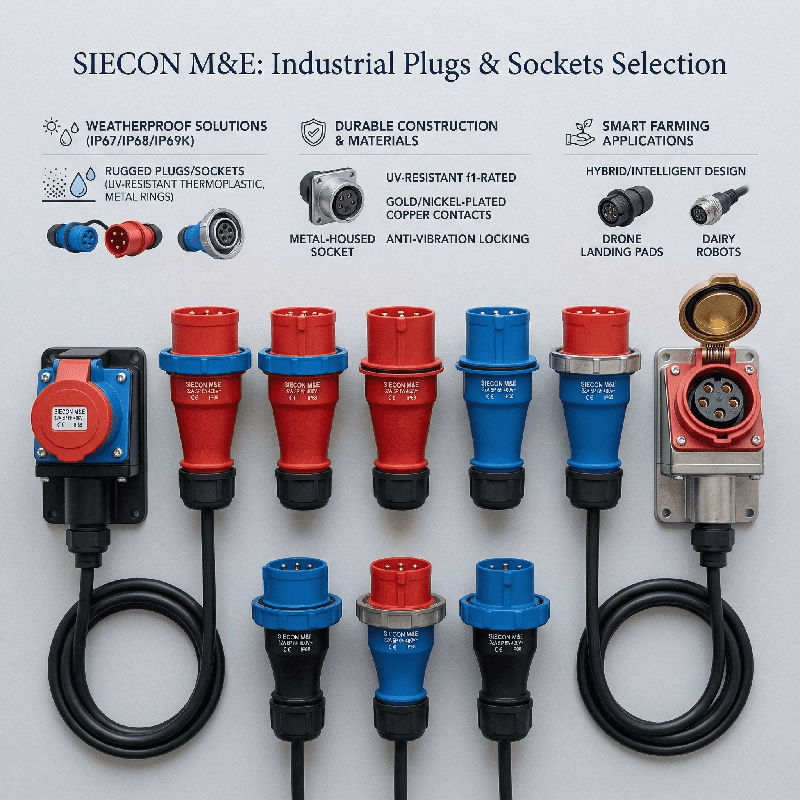
Modern agriculture has undergone a technological revolution. Farms today are data-driven, relying on autonomous tractors, smart irrigation, and aerial drones. However, the backbone of this evolution lies in a often-overlooked component: the agricultural industrial socket. These devices must transmit power and data reliably while buried in mud, soaked by irrigation, or vibrating on heavy machinery. Unlike standard electrical outlets, agricultural industrial sockets are engineered to be both weatherproof and dust-resistant. They serve as the critical interface between the farm\u2019s electronic brain and its mechanical muscles. In my two decades designing interconnection systems for off-road vehicles, I have witnessed how a single connector failure can halt a harvest. Therefore, understanding the nuances of these robust sockets is paramount for farm operators and OEMs alike.
The Harsh Realities of the Agricultural Environment
Agricultural environments present a unique combination of destructive elements. Equipment operates in open fields exposed to UV radiation, temperature extremes, and chemical fertilizers. Dust is not just a nuisance; it is an electrically conductive contaminant when combined with moisture. Irrigation systems and pressure washing create scenarios where water ingress is inevitable. Furthermore, modern farming involves constant vibration, which can cause standard connectors to loosen and fail. This is where the specific engineering of agricultural industrial sockets becomes non-negotiable. They must maintain a galvanic barrier against corrosion while withstanding mechanical stress. The goal is to ensure that a tractor\u2019s GPS guidance or a planter\u2019s seed monitor never loses signal.
Decoding IP Ratings: IP67, IP68, and IP69K
To specify the right agricultural industrial socket, one must understand Ingress Protection (IP) ratings. The first digit indicates protection against solid objects like dust. A rating of “6” signifies it is dust-tight, offering complete protection against particulate ingress. The second digit represents protection against water, ranging from rain to submersion. For agriculture, the highest standards are often IP67, IP68, and IP69K. IP67 ensures the socket survives temporary immersion in water, typically up to one meter. IP68 denotes protection against continuous submersion beyond one meter, as specified by the manufacturer. However, the gold standard for farming is IP69K, which specifically tests against high-pressure, high-temperature washdowns. This rating is crucial because modern farm equipment is frequently cleaned with pressure washers. A truly weatherproof agricultural industrial socket must hold this seal whether mated or, in many designs, with protective caps in place.
Material Science: The First Line of Defense
The durability of a weatherproof socket begins with its housing materials. High-performance thermoplastics and corrosion-resistant metal alloys dominate this sector. For instance, heavy-duty metal shells, often zinc alloy or stainless steel, provide impact resistance for applications like soil tillage. Conversely, lightweight, high-impact thermoplastics offer excellent UV resistance and chemical stability. These plastic variants often carry an “f1” rating, signifying they can withstand prolonged outdoor exposure. Inside, the contact technology is equally critical. Contacts are typically copper alloys with nickel or gold plating to minimize resistance and prevent oxidation. This plating ensures that low-voltage data signals, as well as high-current power, transmit without degradation. In essence, the socket acts as a fortress, with the housing as the wall and the plated contacts as the secure gateway.
Case Study: Enabling the “Smart Field” Inspection Drone
A practical example of high-level engineering comes from a recent “Smart Field” project in Asia, which gained attention for its use of automated drone停机坪 (landing pads). In this application, agricultural industrial sockets were deployed to power intelligent landing pads located directly in crop fields. The environment presented challenges: high humidity, pesticide drift, and significant day-night temperature swings. Standard commercial connectors failed within weeks due to contact corrosion. The solution utilized a specialized circular connector series featuring IP68 and IPX9K waterproofing. These sockets, made from anti-UV f1-grade plastic, endured continuous sunlight without becoming brittle. The bayonet locking mechanism ensured the drone\u2019s charging cable remained firmly connected despite the downdraft from rotors. As a result, the “Smart Field” project achieved 99.9% connectivity uptime, proving that robust connector selection is vital for autonomous agriculture.
Case Study: High-Pressure Washdowns in Dairy Operations
In another instance involving stationary agricultural equipment, a large-scale dairy farm faced recurring downtime with their milking parlor robots. The sensors and motors required frequent high-pressure washing to meet sanitation standards. Initially, the facility used industrial sockets rated only to IP67. Over six months, the constant thermal shock and high-pressure spray caused micro-fractures in the housing seals, leading to internal short circuits. The facility then retrofitted the system with Amphenol AHDM series connectors, which are specifically designed for off-road and agricultural use. These sockets feature silicone seals that resist hydraulic fluids and fossil fuels found around farm machinery. Rated for IP69K, they withstood the direct spray without failure. This upgrade reduced maintenance costs by an estimated 40% annually, demonstrating the long-term value of selecting the correct weatherproof socket.
Vibration Resistance and Locking Mechanisms
A dust-resistant socket is useless if it vibrates apart. Agricultural machinery generates low-frequency, high-amplitude vibration that can cause threaded couplings to back off. To combat this, engineers have developed specialized locking mechanisms. The bayonet quick-locking system is a popular choice, allowing for a secure connection with a simple push-and-twist motion. This design not only saves installation time but also provides audible or tactile feedback confirming a full mate. Other systems utilize secondary locking features like TPAs (Terminal Position Assurance) to ensure contacts stay seated. For the harshest environments, compression-fit backshells and ring adapters add another layer of strain relief. These mechanisms ensure that data lines for ISOBUS protocols, which connect tractors to implements, remain uninterrupted even when bouncing through a field.
The Rise of Hybrid and Intelligent Connectors
As farming embraces the Internet of Things (IoT), agricultural industrial sockets are evolving to carry more than just power. Hybrid connectors integrate power pins and signal contacts within a single housing. This allows for compact designs on space-constrained equipment like robotic arms. Furthermore, the concept of the “intelligent connector” has emerged. Companies like Bulgin have developed connectors with embedded PCBs and EEPROM chips . In a trial for AgTech Industries, these smart connectors allowed for automatic sensor identification. When a sensor is plugged in, the system immediately recognizes its calibration data and type. This simplifies setup for variable-rate irrigation or fertilization, reducing user error. The connector itself becomes a data node, ensuring that the signal integrity is maintained right up to the control system.
Market Trends and Future Outlook
The demand for reliable agricultural connectors is growing rapidly. The global market for modern agriculture connectors is projected to reach nearly $5 billion by 2031, growing at a CAGR of over 10% . This growth is fueled by precision agriculture and robotics. We are seeing a shift towards miniaturization, where smaller, high-density connectors save space on compact drones . Additionally, the adoption of Power over Ethernet (PoE) in vertical farming requires connectors that can deliver both data and power in humid indoor environments . Companies like Samtec are partnering with vertical farming innovators to ensure connectivity in these totally controlled environments . For the specifier, this means a wider array of options than ever before, from heavy-duty circular connectors to lightweight rectangular solutions.
Selection Criteria for Engineers and Farmers
Choosing the right agricultural industrial socket requires a holistic assessment. First, define the environmental hazards: is the primary threat dust, pressure washing, or chemical exposure? Second, calculate the electrical load, considering both inrush currents for motors and steady-state power draw. Third, consider the mating cycle frequency; a connector for a seasonal implement may only need 500 cycles, while a permanent robot connection may need over 1000 -1. Fourth, verify certifications like UL or VDE, which validate the manufacturer’s safety claims . Finally, evaluate the total cost of ownership. A cheaper, non-weatherproof socket might fail in one season, while a quality IP69K-rated component can last for years. By prioritizing engineering data over upfront cost, you ensure the reliability of your entire agricultural operation.
In conclusion, as agriculture becomes increasingly high-tech, the humility of the industrial socket belies its critical importance. These components are the unsung heroes of the smart farm, standing resilient against dust, water, and vibration.