Introduction
Industrial power conversion forms the backbone of modern automation systems. The 24V DC rail remains the standard for factory floors worldwide. Mastering 24V AC-DC conversion industrial design requires deep expertise in topologies and thermal management. Engineers must balance efficiency, cost, and reliability in harsh environments. This article provides advanced strategies from an industry veteran. We will explore digital control, PFC stages, and resonant converter topologies. Specific reference designs and real-world case studies validate these approaches. The goal is optimizing performance for 24/7 industrial operation. We will leverage over a decade of power supply engineering experience. Let us begin by examining the core challenges in this domain.
The Critical Role of the 24V Industrial Rail
Industrial control systems rely on stable 24V power for operation. Programmable logic controllers (PLCs) and sensors demand this voltage. Motor drives and automated production lines also depend on it. These applications require continuous operation without interruption. Power supplies must endure wide temperature ranges and transients. The conversion from AC mains to stable DC is therefore critical. Efficiency directly impacts operational costs and cooling requirements. Reliability ensures minimal downtime in production processes. Consequently, mastering this conversion is a strategic advantage. Modern designs must also meet strict EMC standards . This foundation sets the stage for advanced design techniques.
Advanced Topologies for High-Performance Conversion
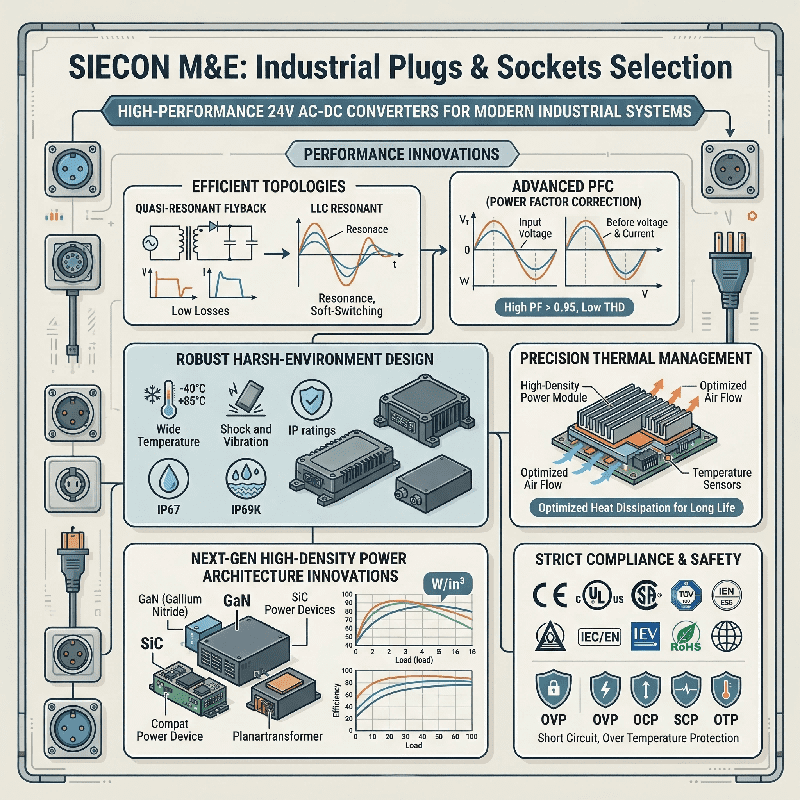
Selecting the right topology is the first major design decision. Traditional solutions often fall short on efficiency today. Advanced designs leverage two-stage conversion architectures effectively. A power factor correction (PFC) stage typically handles the front-end. This stage ensures compliance with harmonic current regulations. Following PFC, a DC-DC stage provides isolation and regulation. The LLC resonant converter is a top choice for the DC-DC stage. It enables soft switching, which drastically reduces losses. This topology also supports wide input voltage ranges efficiently. For instance, a 280W design used PFC with an LLC converter. This combination maintained high performance from 85V to 550VAC. Such robustness is essential for global industrial equipment.
Power Factor Correction Strategies
Power Factor Correction is non-negotiable in modern industrial supplies. It shapes input current to reduce harmonic pollution. Standards like IEC 61000-3-2 mandate this performance level. Bridgeless PFC topologies offer significant efficiency improvements. They reduce conduction losses by eliminating the input diode bridge. Interleaved PFC stages are another powerful technique. A 500W design utilized two-phase interleaved transition mode PFC. This approach minimizes inductor size and reduces EMI filter requirements. Achieving a power factor over 0.99 is possible with proper design. This ensures clean utilization of the AC mains supply.
The LLC Resonant Converter Advantage
The LLC resonant converter excels in medium to high power levels. It efficiently handles the DC-DC conversion from the PFC bus. A key benefit is zero voltage switching (ZVS) for primary FETs. This dramatically reduces switching losses at high frequencies. Furthermore, it enables zero current switching (ZCS) for output diodes. However, careful design is required to avoid ZCS loss. Modern controllers like the UCC256301 include ZCS avoidance features. This protects the system during overload or startup conditions. A 480W nominal design using this IC achieved >93.5% efficiency. It also delivered 720W peak power for demanding loads. Such performance proves the viability of this topology.
Digital Control Implementation
Analog control has been the traditional method for decades. However, digital control offers compelling advantages for complex supplies. A digital controller can manage multiple functionalities in one microcontroller. This consolidation reduces component count and overall cost. Additionally, it enhances reliability and can shrink physical size. A notable 280W design replaced an entire analog stage digitally. It controlled both a fixed-frequency PFC and a variable-frequency LLC. This flexibility is difficult to achieve with pure analog circuits. Digital control also allows for advanced monitoring and protection. Engineers can adapt algorithms without changing hardware. This adaptability is key for optimizing over wide input ranges.
Synchronous Rectification and Efficiency Optimization
Efficiency is paramount for reducing heat sink requirements. At the secondary side, diode rectifiers cause significant losses. Synchronous rectification (SR) replaces diodes with MOSFETs. These MOSFETs have much lower voltage drops when conducting. Implementing SR in an LLC converter requires precise timing. Controllers like the UCC24612 optimize gate drive and dead time . This minimizes body diode conduction and prevents shoot-through . A 500W reference design achieved 94.5% efficiency using these techniques. Peak efficiency exceeded 95% under optimal conditions. This allows for up to 330W operation without forced cooling. Such high efficiency directly improves system reliability and lifetime.
Case Study: 500W High-Density Industrial Supply
Let us analyze a specific high-performance reference design in detail. The TIDA-010015 is a compact 500W industrial power supply. It accepts a universal input of 85-265VAC. The output is a regulated 24VDC at up to 21A. This design achieves an impressive overall efficiency of 94.5%. The front end uses a two-phase interleaved TM PFC controller. This minimizes the size of magnetic components significantly. The DC-DC stage is an HB-LLC resonant converter. It utilizes the UCC256301 for robust resonant control. Synchronous rectification on the secondary side uses the UCC24612. The total PCB form factor is only 160mm x 80mm. This high power density is ideal for space-constrained industrial panels.
Performance Metrics and Compliance
Performance validation is crucial for industrial acceptance. This 500W design meets stringent regulatory standards effortlessly. It achieves a power factor greater than 0.99. Total harmonic distortion (THD) complies with IEC 61000-3-2 Class A. Conducted emissions meet the EN55011 Class B standard. Protection features include overcurrent, short circuit, and overvoltage. The LLC controller”s ZCS avoidance feature enhances robustness. These metrics confirm the design”s suitability for industrial environments. It demonstrates that high efficiency and compliance are simultaneously achievable.
Case Study: PCBA for Industrial Automation
Beyond reference designs, real-world manufacturing matters. A European automation customer needed a reliable power module. The application involved PLCs and motor drives running 24/7. The required specifications were demanding and specific. Input voltage needed to handle 90-264VAC globally. Output was 24VDC at 2.5A, totaling 60W. Efficiency had to be 88% typical with natural cooling. Crucially, EMC compliance to EN55032 Class B was mandatory. The chosen PCBA partner, KKPCB, optimized the design for manufacturability. They used reinforced copper and multi-layer PCBs for safety. This meticulous approach led to exceptional results in testing.
Manufacturing Outcomes
The partnership yielded significant improvements in production. First-pass EMC compliance was achieved in just three days. Typical timelines for such compliance are often two weeks. The production yield soared to over 99.8% after optimization. Delivery time for PCBA boards was reduced from six to four weeks. The power supply performed flawlessly in temperature and humidity tests. Mean time between failures (MTBF) exceeded customer expectations. This case proves that design and manufacturing must align. Advanced topologies require equally advanced assembly processes.
Addressing High Input Voltage Challenges
Industrial environments often feature widely varying AC mains. Three-phase connections can present up to 420VAC or more. Rectifying this voltage creates a DC bus near 600V. This stresses input capacitors and primary FETs considerably. Component cost and availability become major concerns at these voltages . A smart solution involves stacking lower voltage components. For example, using two FETs in series spreads the voltage stress. Similarly, stacking capacitors can achieve the required bus voltage. This technique maintains low cost while ensuring reliable operation. A 12W smart meter design successfully used this approach. It handled a 110VAC to 420VAC input range effectively.
Managing Multiple Outputs and Loads
Some industrial systems require more than just a single 24V rail. Sensors may need 5V, while communication modules use 12V. Generating these from one transformer is efficient and compact. Multiple secondary windings can provide isolated outputs. However, cross-regulation between windings is a challenge. Adding post-regulators like LDOs or bucks solves this issue . Feedback is typically taken from the highest power output. Pre-loads may be necessary on unregulated outputs. This prevents voltages from drifting during light load conditions. Zener diodes can also clamp voltages for basic protection. Such strategies ensure all rails stay within specification.
Thermal Management and Reliability
Heat is the enemy of electrolytic capacitors and semiconductor life. High-efficiency designs inherently reduce heat generation. However, proper thermal management remains essential. Conduction losses in magnetics and PCB traces must be minimized. Using components with low DCR is a primary strategy. Synchronous rectification also reduces heat in the secondary. For a 480W design, >93.5% efficiency allows compact cooling. Some designs can operate without forced cooling up to 330W. Component derating is crucial for operating at high ambient temperatures. Industrial grades often require -40°C to +70°C or wider ranges. Selecting components with proven MTBF data ensures long-term reliability. A 10W module boasted over 1,000,000 hours MTBF. This level of reliability is the ultimate goal of industrial design.
Compliance and Certification Standards
Selling industrial equipment globally requires certifications. Safety standards like UL/cUL/EN62368-1 are fundamental. These ensure protection against electrical shock and fire. Medical applications may require even stricter isolation. The Murata BAC05 series, for instance, targets 1 MOPP compliance. EMC standards dictate allowable conducted and radiated emissions . EN55011 and EN55032 Class B are common targets for industrial gear . Immunity standards are equally important for noisy factory floors. Designing for compliance from the start reduces certification delays. Using approved reference designs can accelerate this process significantly.
Conclusion
Mastering 24V AC-DC conversion industrial design demands a holistic engineering approach. We have explored advanced topologies like interleaved PFC and LLC resonant converters. Digital control implementation offers cost and performance benefits. Synchronous rectification is essential for achieving >94% efficiency. Real-world case studies validate these strategies in production environments. Addressing high voltage and multiple outputs requires creative circuit design. Thermal management and adherence to safety standards ensure long life. By applying these advanced strategies, engineers can optimize power supplies for the harshest conditions. The industry will continue pushing for higher density and efficiency. Staying abreast of these techniques is vital for professional success.