In the high-stakes world of data centers, power is everything. Modern facilities demand absolute reliability from every component, and people often overlook the industrial socket systems that form the critical backbone of the entire operation. These components must handle massive loads without failure and run 24/7 in environments with fluctuating temperatures. A single faulty connection can lead to catastrophic downtime, so selecting the right socket system is paramount. We must examine the technology that ensures continuous operations, so let’s explore the engineering behind these robust power interfaces.
The Critical Role of Industrial Connectors
Data center infrastructure demands zero-compromise reliability at all levels. Industrial plugs and sockets are not merely accessories but critical enablers. They efficiently distribute power to high-density server racks and cabinets. Standardized connector types meet the high power requirements of modern IT. These systems ensure a reliable power supply for mission-critical servers. They must also endure the mechanical stress of repeated connections. Connectors operate in environments ranging from cool to hot data center aisles. This choice directly impacts your facility’s overall operational uptime. Understanding their specifications is a technical necessity. We must view them as integral to power distribution strategies.
Understanding Socket System Types and Materials
High-Power IEC Connectors (C19 & C20)
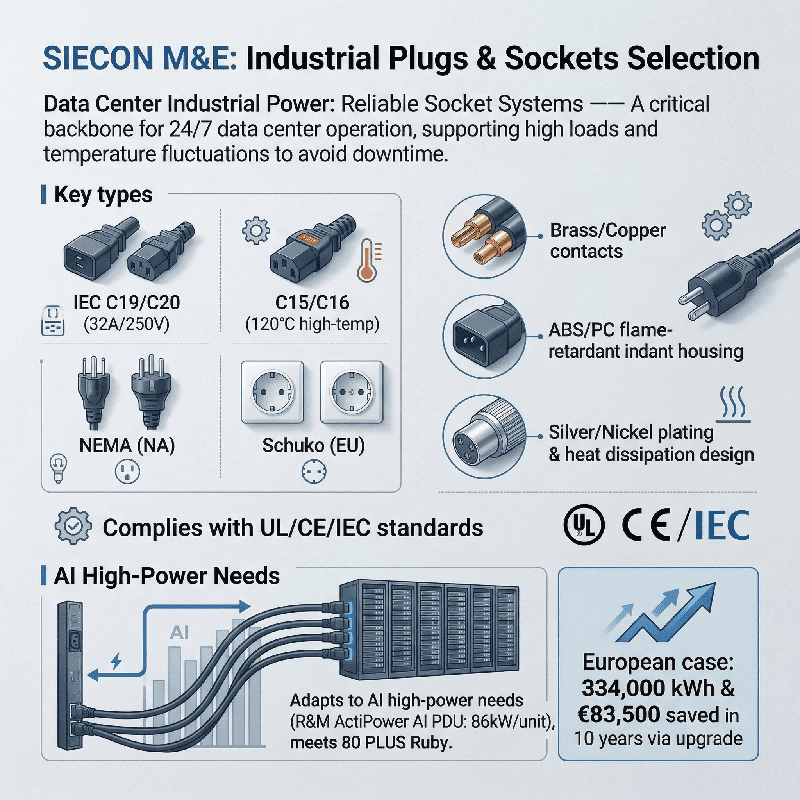
For high-power servers, the IEC C19 connector is the industry standard and it supports high current levels, typically up to 32A at 250V while its rectangular shape prevents incorrect mating with lower-rated C13/14 devices and this connector is essential for high-density server racks and UPS systems as the corresponding C20 inlet is designed to match this robust interface and these components feature high-conductivity brass or copper contacts which ensure minimal energy loss during power transmission and they are built to handle the continuous loads of blade servers while using them correctly reduces heat buildup caused by resistance.
Specialized High-Temperature Variants (C15 & C16)
Certain applications generate significantly more heat than others and the Type C16 connector addresses this with higher thermal tolerance as it is commonly used in equipment requiring operation up to 120°C which makes it ideal for servers and high-performance computing tasks while the connector maintains integrity where standard versions might fail and it offers reverse compatibility with C13 plugs for flexibility but its robust design means a slightly larger physical footprint and engineers must specify these for high-ambient-temperature zones as this choice prevents degradation of the contact interface over time and it is a simple upgrade for enhanced long-term reliability.
Regional Standards: NEMA and Schuko
Data centers operate globally and must adhere to regional norms and in North America, the NEMA 5-15R is ubiquitous for standard loads as it handles 15A at 120V for office servers and networking gear while for higher efficiency, NEMA 6-15R supports 240V applications and European facilities rely heavily on the Schuko socket which supports up to 16A at 230V with a robust grounding system while using the wrong regional type creates safety hazards and inefficiency and compliance with local codes is non-negotiable for safety certification as these standards dictate the physical interface for facility power and matching the connector to the grid is the first safety rule.
Advanced Design and Safety Features
Material Science in Connector Housing
The outer housing is the first line of defense against failure and high-grade thermoplastics like ABS/PC alloy provide excellent impact resistance while these materials offer superior thermal insulation and flame retardancy and they typically meet stringent UL94 V-0 flammability standards which is critical for fire safety in enclosed server racks and the housing also acts as a barrier against dust and moisture while in industrial settings, this protection extends the connector’s lifespan and Amphenol uses PBT noted for its strength and chemical resistance as such materials maintain dimensional stability under continuous stress and they ensure the internal components remain perfectly aligned.
Contact Technology and Thermal Management
At the heart of these sockets are the electrical contacts and these are typically made from brass or copper alloys while copper offers the highest conductivity, reducing energy loss and contact surfaces are often plated with silver or nickel as silver-nickel contacts provide ultra-low resistance for efficiency and Marechal Electric uses spring-loaded terminals to maintain pressure which compensates for copper deformation from thermal cycles while effective heat dissipation is crucial for connector integrity and some designs integrate heat sinks or thermal vents as these features manage temperature rise under continuous high loads.
Safety Compliance and Ergonomics
Safety features are engineered into every level of the design and polarized contacts and keying systems prevent incorrect mating while shrouded terminals protect personnel from accidental contact and the IEC 60309 standard uses a clock system for voltage rating as the ground pin location codifies the connector’s specific configuration and ergonomic designs include color-coded ports and tactile guides which minimize human error during installation and tool-less mounting options streamline large-scale deployments while in mission-critical environments, these details prevent costly mistakes and compliance with UL, CE, and IEC standards builds trust in safety.
Meeting the Demands of High-Density and AI
The Shift Toward Higher Currents
AI workloads are driving unprecedented power densities in racks and traditional socket systems are being pushed to their limits as R&M’s ActiPower AI PDU addresses this with high-power applications and it provides up to 3x125A, delivering an impressive 86kW per unit which is 4-8 times higher than current standard DC PDUs and to achieve this, the IEXv2 socket accepts C14, C16, C20, and C22 plugs ensuring seamless compatibility across different equipment types while the connectors must operate reliably up to 60°C requiring advanced materials and precision manufacturing and the industry is moving toward 400A power connectors for next-gen densities so operators need solutions that handle these massive loads safely.
The Importance of Efficiency (80 PLUS Ruby)
Energy efficiency is directly tied to connector performance and poor connections create heat, increasing cooling loads significantly while up to 40% of a data center’s energy can go to cooling systems and minimizing losses at the connection point improves PUE as the new 80 PLUS Ruby standard highlights this need and it requires 96.5% efficiency at 50% load for power supplies while this standard targets PSUs, the principle applies to all connections and every interconnect in the chain must support this efficiency as low-loss connection technology delivers measurable savings and it reduces the kWh consumed by the facility year after year.
Case Study: Measurable Savings via Connector Upgrade
Let us examine a real‑world application to quantify the impact. A European colocation facility faced high cooling costs because it used 500 standard industrial 32 A connectors with typical resistance levels in its power chain. The facility chose to retrofit with advanced low‑loss connectors to reduce Joule‑effect heating at the contact points. It selected Marechal Electric’s technology for its silver‑nickel contacts, which greatly lowered circuit resistance. The reduced heat output directly cut the facility’s cooling demand. Over a 10‑year period, the savings proved substantial and verified: the facility saved 334,000 kWh of energy. At an average cost of €0.25 per kWh, this translated to €83,500 in savings. This example shows that connectors represent a fast‑ROI investment. The upgrade covered its own cost entirely through improved energy efficiency. It also boosted safety and lowered maintenance requirements.
Best Practices for Selection and Implementation
Selecting the right socket system requires a systematic approach and engineers must first verify the voltage and current requirements as mismatched connectors lead to overheating and fire hazards and consider the environment whether it is dry and cool or humid and hot while determining if you need single-phase or three-phase configurations and three-phase Wye requires conductors for phase, neutral, and ground while always check the IP rating required for the installation zone and for areas near cooling units, IP67 protection may be necessary as you look for integrated protection like surge suppression and ensure the connector materials meet UL94 V-0 flammability ratings while finally consulting local electrical codes and equipment specifications and following these steps ensures a safe, efficient power distribution system.
Conclusion
Reliable socket systems are the unsung heroes of data center operations and they ensure that power flows safely from the grid to the server while advanced materials and smart design prevent costly downtime and as AI increases rack densities, connector technology must evolve while investing in high-quality industrial power connectors is a strategic move and it delivers immediate savings through reduced energy losses while it enhances safety for personnel performing maintenance and it future-proofs the facility for next-generation hardware demands so by prioritizing these components, operators protect their critical infrastructure and the connection point is where reliability truly begins.