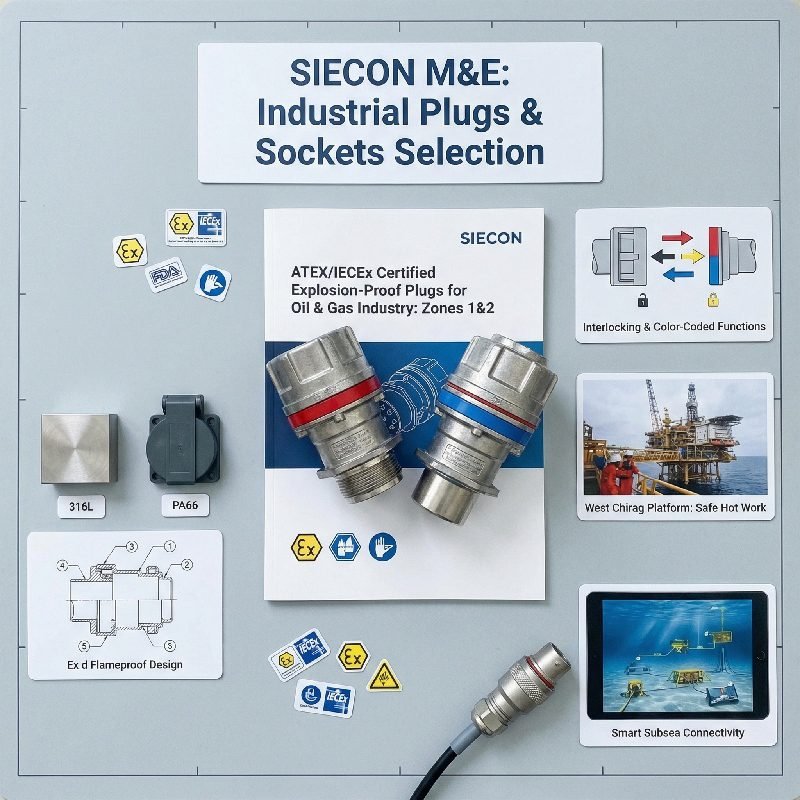
Oil & Gas Industry Plugs: Explosion-Proof Solutions
By Isaac Noble, European Product Manager, PEI-Genesis
Explosion-proof plugs are the first line of defense in volatile oil and gas environments. The global demand for energy continues to rise. Consequently, operators are pushing into extreme locations. From the scorching deserts of the Middle East to deep waters off South America, hazards are everywhere. In these volatile settings, the slightest electrical spark can trigger a catastrophe. Therefore, the humble electrical plug becomes a critical safety device. This article explores the engineering, standards, and real-world applications of these essential components.
Understanding the Hazardous Environment
Offshore platforms and refineries are classified as hazardous areas. This means atmospheres contain flammable gases, vapors, or dusts . Equipment used here must not ignite these substances. We must understand the “Zone” classification system before selecting connectors. Zone 0 indicates a continuous explosive atmosphere, which is very rare. And Zone 1 means the atmosphere is likely to occur during normal operation . Zone 2 suggests it is unlikely to occur, and if it does, it will only persist for a short time. Most high-power plugs are rated for Zones 1 and 2. The primary risk is arcing during connection or disconnection under load .
The Core Protection Strategies
Explosion-proof protection is governed by the “Ex d” standard. This method contains an internal explosion without igniting the external atmosphere . The plug and socket housings are built to withstand high pressures. They feature precisely machined flame paths. These gaps cool expanding gases before they escape, quenching any flame . In contrast, “Increased Safety” (Ex e) prevents arcs or sparks from occurring in the first place .
Case Study: The West Chirag Oil Platform
Theory becomes reality in projects like the West Chirag Oil Platform in the Caspian Sea. This project required robust solutions for wellhead control panels . Cooper Crouse-Hinds supplied 240 eXLink explosion-protected connectors for this platform . These connectors were fitted to solenoid valves within the control panels. The key requirement was the ability to perform “hot” work without a permit.
The eXLink connectors allowed engineers to disconnect and connect drawer modules rapidly. Crucially, this was achieved without isolating the apparatus from the mains . This capability drastically reduced downtime during maintenance. It also eliminated the need for complex administrative procedures like hot work permits. This case proves that proper connector selection directly impacts operational efficiency. It ensures safety without sacrificing productivity in gas atmospheres .
Material Science and Durability
Materials must withstand corrosive marine environments and mechanical stress. Marine-grade stainless steel offers long-term resistance to saltwater corrosion . Anodized aluminum provides a lightweight yet durable housing option .We use specialized polymers and nylon for the harshest chemical environments. We often glass-fill these materials to enhance strength and UV resistance.
High-strength plastics also offer excellent electrical insulation. They prevent short circuits and resist degradation from oils and solvents . Internally, contacts are typically made from copper alloys. These are often plated with silver or tin to maintain conductivity and prevent oxidation . Ceramic components are sometimes used for their thermal stability and insulating properties .
Advanced Features in Modern Connectors
Modern explosion-proof plugs incorporate sophisticated design features. Reliable interlocking functions are critical for safety. For example, the plug cannot be withdrawn unless the switch is “off” . Conversely, the switch cannot be turned “on” unless the plug is fully inserted . This mechanism prevents arcing during make-and-break operations. Another feature is the use of color-coded voltage bands. Different working voltages are assigned different colors to prevent mismatching . This is vital in complex installations with multiple power requirements.
Contact design has also evolved significantly. Some manufacturers utilize “shutter spring sleeves” for the socket contacts . These sleeves ensure the plug pins are self-cleaning upon insertion. They also maintain low contact resistance and minimize temperature rise . This design reduces the force required for insertion and extraction. It ensures long-term mechanical reliability even after thousands of cycles .
Certification and Compliance
No connector reaches the field without rigorous testing. ATEX and IECEx certifications govern the entire manufacturing process . These standards require testing for pressure resistance and flame containment. Ingress Protection ratings, such as IP66 or IP67, are mandatory . IP66 denotes protection against powerful water jets, while IP67 allows for temporary immersion .
Temperature class is another critical certification parameter. This rating indicates the maximum surface temperature of the equipment. For instance, a T4 rating is required for hydrogen environments . The T-rating must be lower than the ignition temperature of the surrounding gases. Certificates must be traceable to the individual product batch .
Installation and Maintenance Best Practices
Even the best equipment fails if installed poorly. Cable glands must be correctly selected and fitted to maintain integrity. For instance, the VORTEx injection resin barrier gland seals cable interstices . This prevents gas migration through the cable itself into the enclosure . During installation, verify that all threads are properly engaged. Use thread sealant where required to maintain the flameproof path .
Maintenance routines are equally important. Inspect plugs and sockets for damaged threads or worn gaskets . Look for signs of corrosion or overheating, which indicate underlying issues . For purge and pressurized systems, ensure a constant supply of clean air or inert gas . Regular inspection of seals in stop plugs is also crucial . These practices ensure the longevity of the safety solution.
The Future: Smart and Subsea Connectivity
The industry is moving toward smarter, more connected equipment. Manufacturers are now embedding diagnostics into explosion-proof housings . These “smart” connectors can detect moisture ingress or thermal buildup. They monitor contact degradation long before failure occurs . This real-time data allows for predictive maintenance scheduling.
Subsea expansion is also driving innovation. Projects like the Saudi Aramco Zuluf field require extreme durability . Connectors and glands must perform at depths with immense pressure. They must resist corrosive saltwater for the design life of the field—often 30 years . IP68 ratings, allowing for continuous submersion, are becoming more common . Hybrid connectors that carry both power and data are also gaining traction . These reduce the number of penetration points in enclosures, simplifying design.
Conclusion
Explosion-proof plugs are far more than simple electrical components. They are precision-engineered safety barriers in the world’s most hazardous industries. As we have seen with the West Chirag platform, the right connector enables safe and efficient operations . By containing internal explosions, utilizing advanced materials, and adhering to strict ATEX/IECEx standards, these devices protect both personnel and assets . For engineers specifying equipment for Zone 1 or Zone 2 areas, understanding these technologies is not just a matter of compliance—it is a matter of ensuring everyone goes home safely at the end of the day.