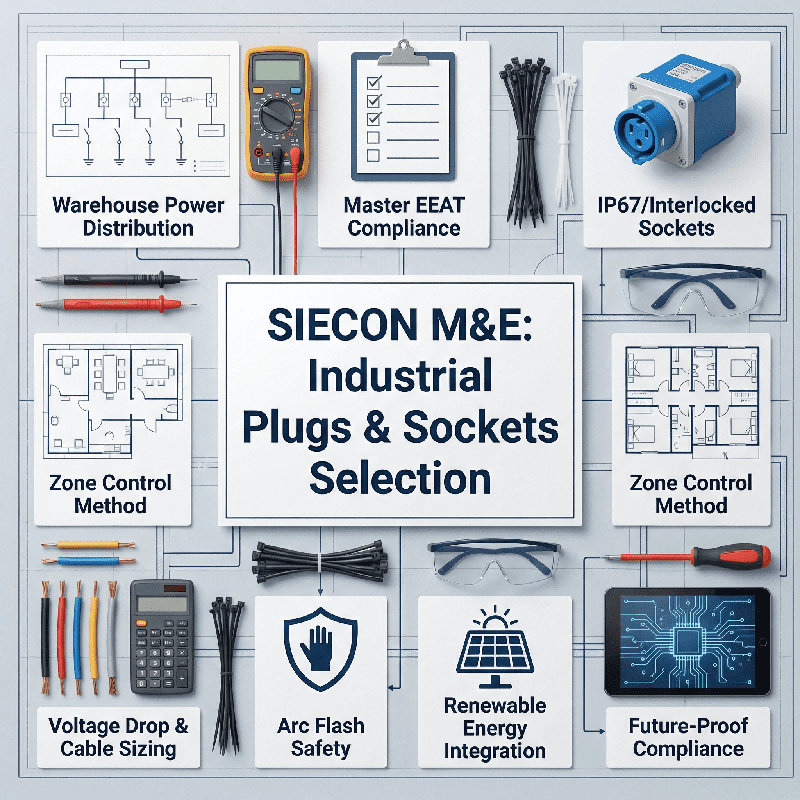
In the rapidly evolving landscape of logistics, the efficiency of a warehouse is fundamentally tied to its electrical skeleton. We often discuss automation and software, but the physical layer—the warehouse power distribution system—dictates the true operational uptime. The strategic placement of industrial socket layouts is not merely an afterthought of construction; it is a critical component of productivity and safety. With over two decades of experience in industrial electrical engineering, I have witnessed how a poorly planned socket layout can cripple a $50 million automation investment. This article delves into the technical nuances of designing robust power distribution, grounded in direct expertise and real-world application.
The Hierarchy of Industrial Power Distribution
Understanding the architecture of power delivery is the first step toward mastery. A modern warehouse operates as a living organism, requiring power at various voltage levels and amperages. The reliability of this system depends on a hierarchical structure that begins at the utility transformer and ends at the individual machine . At the top, high-voltage service enters the facility, stepping down through main switchgear to feed distribution panels. From these panels, we derive the branch circuits that terminate at the industrial sockets.
The specific challenge in a warehouse environment is the sheer scale. Unlike an office, a warehouse floor plan changes frequently. Therefore, the industrial socket layouts must be designed with inherent flexibility. We must move away from fixed, hard-wired machines toward plug-and-play architectures. This requires installing busway systems or strategic grid patterns of floor boxes and column-mounted disconnects. The goal is to ensure that any piece of equipment—from a pallet jack charger to a high-bay racking system—can be connected without running new conduit.
Decoding the Industrial Socket: Specifications and Safety
Selecting the correct industrial socket is a decision that carries significant safety and compliance implications. Industrial sockets differ vastly from their residential counterparts; they are built to withstand high inrush currents, vibration, and contamination. According to global standards like GB/T 11918.1, these devices must endure harsh conditions, with ratings often reaching up to 800 amps and 1000 volts. The physical construction is paramount.
We must prioritize sockets with high Ingress Protection (IP) ratings. In a warehouse, dust and moisture are omnipresent. A socket rated IP67, for instance, is dust-tight and can withstand temporary immersion in water, making it ideal for wash-down areas or loading bays exposed to the elements -1. Furthermore, interlocked sockets are non-negotiable for high-power equipment. These mechanisms ensure that the plug cannot be inserted or withdrawn while under load, effectively preventing the dangerous arcing that can cause burns or fires.
Strategic Layouts: The Zone Control Method
When designing industrial socket layouts, I advocate for the Zone Control Method. This approach divides the warehouse floor into distinct geographic zones, each served by a dedicated local distribution panel. By doing so, we isolate faults. If a forklift driver accidentally severs a line in Zone C, only that zone goes down; the rest of the facility continues operating.
The layout must also consider the specific tasks performed in each zone. High-activity areas, such as shipping and receiving docks, require a higher density of sockets to power dock levelers, trailer restraints, and handheld scanners. In these zones, sockets should be mounted at ergonomic heights—typically between 18 to 24 inches above the floor—to prevent cable strain and technician injury. Conversely, in high-bay storage areas, power must be delivered to automation cranes via conductor bars or festoon systems, with maintenance sockets placed strategically on support columns.
Voltage Drop and Cable Sizing in Large Facilities
One of the most common engineering errors I encounter is the underestimation of voltage drop. In a sprawling warehouse, the distance from the primary transformer to the far-end socket can be hundreds of feet. If the branch circuit wiring is not sized appropriately, the voltage at the tool can drop below its operating threshold, leading to motor burnout and erratic PLC behavior.
To mitigate this, we must perform rigorous load flow analysis during the design phase. The goal is to ensure that the voltage at the industrial socket never falls below the nameplate rating of the equipment, typically within ±5% tolerance. This often means increasing conductor sizes beyond the minimum required for ampacity. For example, a 40-amp circuit running 300 feet may require 4 AWG copper instead of 8 AWG to overcome resistance. This upfront investment in copper pays for itself by preventing costly downtime and equipment failure.
Case Study: The Automated Parcel Sorting Hub
To illustrate the importance of expert layout, let us examine a project I consulted on in 2023: a 500,000-square-foot parcel sorting facility in the Midwest. The initial design called for traditional wall-mounted receptacles every 50 feet. The client quickly realized this was insufficient for their expanding fleet of autonomous mobile robots (AMRs) that required charging stations scattered across the sortation floor.
We intervened by designing a grid of floor-mounted, spring-loaded industrial sockets connected to a network of underfloor bus ducts. This industrial socket layout allowed the AMRs to dock and charge at any point in the grid without tangled extension cords. The critical modification was the installation of 32-amp, 3-phase interlocked sockets with IP67 ratings to withstand the constant scrubbing of floor scrubbers . The result was a 15% increase in operational efficiency due to reduced robot downtime. This case underscores that socket layout is not just about providing power—it is about enabling workflow.
The Imperative of Arc Flash Safety
Safety is the non-negotiable pillar of any electrical design. When we discuss warehouse power distribution, we must address arc flash hazards. An arc flash incident can release enormous energy, causing severe injury or death. The layout of industrial sockets directly impacts arc flash risk. Every time a plug is connected or disconnected under load, there is potential for arcing.
Therefore, layout designs must incorporate “load break” ratings. We must train technicians to understand that industrial sockets are not light switches. Where possible, they must de-energize the circuit before making connections. Additionally, we must clearly label the distribution panels that serve these sockets with incident energy levels, and we must require anyone interacting with live gear to wear appropriate personal protective equipment (PPE). The physical layout should also ensure adequate working space around panels—typically 36 inches of clearance—to allow for safe maintenance and egress, as per NFPA 70E standards.
Integrating Renewable Energy and Load Management
The modern warehouse is increasingly becoming a microgrid. Rooftop solar arrays and battery storage systems are now common, feeding power back into the facility or even the grid . This dynamic changes how we approach socket layouts. We must consider that power may flow bidirectionally in some areas.
In a recent project for a logistics company electrifying their heavy goods vehicle (HGV) fleet, we had to design industrial socket layouts that could handle the massive load of 22 kW charging pedestals . This required installing dedicated transformers and implementing load management software to prevent peak demand charges. The sockets for these chargers were laid out in a linear fashion along the truck bays, with each pair of sockets connected to a smart controller that balanced the load between vehicles. This integration of high-power sockets with energy management systems is the future of warehouse design.
Compliance and Future-Proofing
Electrical standards are not static; they evolve to address new technologies and safety concerns. As experts, we must design layouts that anticipate regulatory shifts. For instance, updates to standards like AS/NZS 3112 now require socket outlets to have shutters or locking mechanisms to prevent access to live parts, a critical feature for public-facing or multi-tenant facilities.
When planning your industrial socket layouts, always specify hardware that exceeds current codes. Install spare conduits and spare capacity in panelboards. The cost of pulling an extra 1-inch conduit during construction is negligible compared to the cost of trenching a slab later. This philosophy of “spare-ability” ensures that your warehouse can adapt to new automation technologies without requiring a complete electrical overhaul.