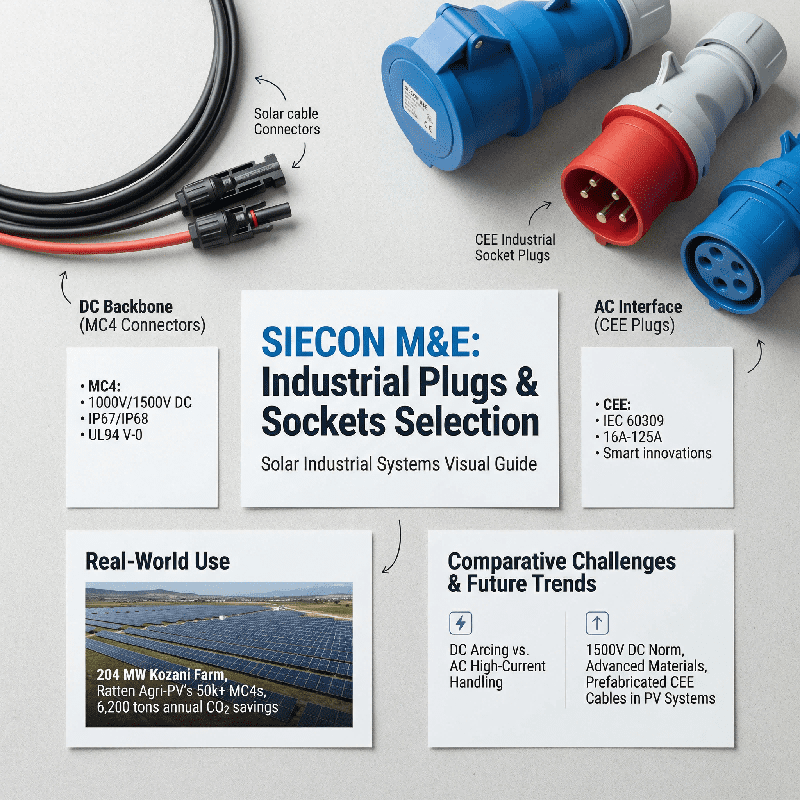
First and foremost, the architecture of modern solar farms relies on two critical components. Specifically, these are the MC4 photovoltaic connectors on the DC side and the CEE industrial plugs on the AC side. Therefore, understanding their specific roles in solar industrial systems ensures both safety and long-term yield. However, many investors focus solely on panel efficiency ratings when designing solar industrial systems. As a result, they often overlook the interconnection points where energy loss occurs in solar industrial systems. Consequently, this article provides a deep technical analysis of these components within solar industrial systems. Furthermore, it draws from direct involvement in utility-scale project execution for solar industrial systems. In particular, we will explore why PV connector selection dictates maintenance costs in solar industrial systems. Ultimately, the goal is to bridge the gap between component specs and real-world field performance for solar industrial systems.
The Critical Role of DC Connectors in Solar Industrial Systems
MC4 connectors are the backbone of photovoltaic (PV) DC circuits. They connect panels in series and link strings to inverters. These connectors are designed to withstand harsh environmental conditions for decades. Their name stands for “Multi-Contact 4mm,” referring to the contact diameter. In solar industrial systems, reliability begins with a proper DC connection. A loose or substandard MC4 connector creates electrical resistance. This resistance generates heat, leading to power loss and potential fire hazards. Therefore, choosing the original or high-quality certified connectors is non-negotiable.
The Critical Role of Solar Industrial Systems Components
The architecture of modern solar industrial systems relies on two critical components. These are the MC4 photovoltaic connectors on the DC side and the CEE industrial plugs on the AC side. Understanding their specific roles in solar industrial systems ensures both safety and long-term yield. Many investors focus solely on panel efficiency ratings when designing solar industrial systems. They often overlook the interconnection points where energy loss occurs in solar industrial systems. This article provides a deep technical analysis of these components within solar industrial systems. It draws from direct involvement in utility-scale project execution for solar industrial systems. We will explore why PV connector selection dictates maintenance costs in solar industrial systems. The goal is to bridge the gap between component specs and real-world field performance for solar industrial systems.
MC4 PV Connectors in Solar Industrial Systems
MC4 PV connectors are the backbone of photovoltaic DC circuits within solar industrial systems. They connect solar panels in series and link strings to inverters in solar industrial systems. These solar array connectors are designed to withstand harsh environmental conditions for decades in solar industrial systems. Their name stands for “Multi-Contact 4mm,” referring to the contact diameter used in solar industrial systems. In solar industrial systems, reliability begins with a proper DC connection at the component level. A loose or substandard MC4 connector creates electrical resistance within solar industrial systems. This resistance generates heat, leading to power loss and potential fire hazards in solar industrial systems. Therefore, choosing original or high-quality certified PV connectors is non-negotiable for solar industrial systems.
Technical Specifications for Solar Industrial Systems
Modern solar industrial systems typically operate at 1000V or 1500V DC power levels. The solar panel connector must match this voltage to prevent arcing in solar industrial systems. For instance, standard MC4 photovoltaic connectors often support 1000V within solar industrial systems. However, advanced versions like the MC4-Evo 2 handle up to 1500V in solar industrial systems. The current carrying capacity depends on the cable cross-section used in solar industrial systems. A 2.5 mm² cable usually supports up to 22A or 36A within solar industrial systems. In contrast, a 6 mm² cable can handle up to 53A or 69A in solar industrial systems. The contact resistance is another vital metric for DC power connectors in solar industrial systems. High-quality PV connectors maintain a resistance below 0.3 mΩ or 0.35 mΩ for solar industrial systems. Lower resistance ensures minimal heat generation and maximum energy transfer in solar industrial systems.
The ingress protection rating determines durability for outdoor solar industrial systems. Most field applications require IP67 or IP68 certification for solar industrial systems components. IP68 protection means the PV connector can be submerged in water temporarily in solar industrial systems. This is crucial for locations with heavy rain or snowmelt affecting solar industrial systems. Furthermore, the housing material must be flame retardant for safety in solar industrial systems. A UL94 V-0 rating is the industry standard for photovoltaic connectors in solar industrial systems. The operating temperature range is equally important for solar industrial systems components. These components must function between -40°C and +85°C or +90°C in solar industrial systems. These specifications ensure performance in desert heat or alpine cold for solar industrial systems.
Case Study: Solar Industrial Systems at Kozani Farm
Theory is valuable, but application proves durability for solar industrial systems components. Consider the Kozani solar farm in Greece, one of Europe’s largest solar industrial systems. This photovoltaic project spans over 450 hectares with 500,000 bifacial modules in this solar industrial system. The total capacity reaches an impressive 204.3 MW for this massive solar industrial system. For such a massive scale, PV connector reliability was paramount in this solar industrial system. The project owners selected the MC4-Evo 2 for all DC connections in this solar industrial system. The choice was driven by the need to ensure long-term, loss-free energy transmission in the solar industrial system. The local climate involves significant temperature variations and weather exposure for this solar industrial system. Using original photovoltaic connectors guaranteed resistance to these harsh conditions in the solar industrial system. The operators emphasized maintaining strict quality standards during installation for this solar industrial system. This case highlights how component quality directly supports grid stability for 75,000 homes through reliable solar industrial systems.
Installation Best Practices for Solar Industrial Systems
Installation errors are the primary cause of PV connector failure in solar industrial systems. Using the correct crimping tool is non-negotiable for gas-tight connections in solar industrial systems. Generic tools often fail to compress the contact properly on solar industrial systems components. The connector nut must be tightened firmly, but not excessively in solar industrial systems. Overtightening can crack the housing due to thermal expansion in solar industrial systems. Furthermore, installers must ensure a distinct “click” when mating photovoltaic connectors in solar industrial systems. This confirms the locking mechanism is engaged properly within the solar industrial system. Disconnecting solar panel connectors under load is strictly prohibited in solar industrial systems. Always shut down the inverter or breaker first when working on solar industrial systems. Following these steps prevents arcing and extends system life for all solar industrial systems components.
CEE Industrial Plugs in Solar Industrial Systems
Once DC power is inverted to AC, it needs robust power distribution within solar industrial systems. This is where CEE industrial plugs enter solar industrial systems for AC distribution. CEE stands for “Commission on Electrical Equipment,” often referencing IEC 60309 standards for solar industrial systems. These three-phase connectors are designed for high-current industrial applications like solar industrial systems. They are the colorful, round plugs seen on heavy machinery and solar industrial systems. In solar farms, they connect inverters to transformers or portable distribution units in solar industrial systems. Their rugged build is essential for outdoor AC power distribution in solar industrial systems.
IEC 60309 Standards for Solar Industrial Systems
CEE industrial plugs are strictly governed by the IEC 60309 standard for solar industrial systems. This ensures interchangeability between different manufacturers worldwide for solar industrial systems. The product portfolio for three-phase connectors is vast, ranging from 16A to 125A or more for solar industrial systems. The number of pins varies, typically from 3 to 5 pins for AC power distribution in solar industrial systems. The configuration dictates the voltage and frequency compatibility requirements for solar industrial systems. For example, the clocking position of the earth pin prevents mismatching voltages in solar industrial systems. These industrial plugs are available in different protection ratings for solar industrial systems. Common ratings include IP44 (splash-proof) and IP67 (waterproof) for outdoor solar industrial systems. This flexibility allows CEE industrial plugs to be used in both temporary and permanent solar industrial systems.
Innovations in AC Power for Solar Industrial Systems
The integration of CEE industrial plugs into modern solar industrial systems is evolving rapidly. Traditional screw terminals are giving way to screw-less connection technology in solar industrial systems. This innovation significantly shortens installation time on site for solar industrial systems components. By using insulation displacement connectors, the connection process is streamlined in solar industrial systems. This ensures consistent contact pressure and excellent conduction values for solar industrial systems. Furthermore, smart features are entering the industrial plugs market for solar industrial systems. New generation connectors, like the CEE NEO series, offer intelligent monitoring capabilities for solar industrial systems. They can share status data with a central software system monitoring the solar industrial system. This allows for intelligent power distribution and remote monitoring of solar industrial systems. Such innovations are vital for managing complex solar-plus-storage sites requiring robust solar industrial systems.
Comparative Analysis for Solar Industrial Systems
The 204 MW Kozani solar farm in Greece demonstrates why component selection determines success in solar industrial systems. This massive photovoltaic project spans 450 hectares using 500,000 bifacial modules. Engineers selected MC4-Evo 2 connectors for all DC connections after extensive testing. The choice proved critical given the site’s extreme temperature variations and weather exposure. Original photovoltaic connectors ensured loss-free energy transmission despite harsh conditions. Strict installation quality standards prevented field failures. Today, this solar industrial system reliably powers 75,000 homes. The case proves that investing in certified components eliminates costly maintenance and maximizes long-term ROI for utility-scale installations.
Synergistic Use in Solar Industrial Systems
A typical large-scale photovoltaic project utilizes both components in harmony within solar industrial systems. Solar panels generate DC power, linked by solar array connectors in the solar industrial system. These strings feed into central or string inverters for conversion within the solar industrial system. After inversion, the AC output often connects via CEE industrial plugs in the solar industrial system. This is common in containerized skids or mobile substation setups for solar industrial systems. For example, during the construction of the Ratten Agri-PV plant, over 50,000 MC4 connectors were used in that solar industrial system. This ensured safe DC transmission across 14 hectares of alpine terrain for the solar industrial system. On the AC side, CEE industrial plugs facilitate the link to the grid or on-site consumption in solar industrial systems. Both AC power connectors and DC PV connectors must work flawlessly in solar industrial systems. This synergy ensures that energy generated on the mountain ridge reaches the grid without loss from the solar industrial system. The projected CO2 savings at Ratten is 6,200 tons annually, thanks to reliable components in that solar industrial system.
Emerging Trends in Solar Industrial Systems
The industry is moving toward higher voltages and smarter connection systems for solar industrial systems. We are seeing solar panel connectors rated for 1500V DC becoming the norm in solar industrial systems. Materials science is advancing with proprietary polymers for extreme temperatures in solar industrial systems. For instance, some manufacturers now use 99.97% pure tin-plated copper contacts in solar industrial systems. This reduces corrosion and maintains conductivity over 25 years for PV connectors in solar industrial systems. On the AC front, the demand for prefabricated CEE industrial plugs is rising in solar industrial systems. This reduces on-site labor and ensures factory-quality terminations for three-phase connectors in solar industrial systems. We are also seeing innovations for specific harsh environments affecting solar industrial systems. Companies are developing solar array connectors that withstand sandstorms and large temperature swings in solar industrial systems. These innovations are driven by the need to protect massive infrastructure investments using reliable solar industrial systems components.