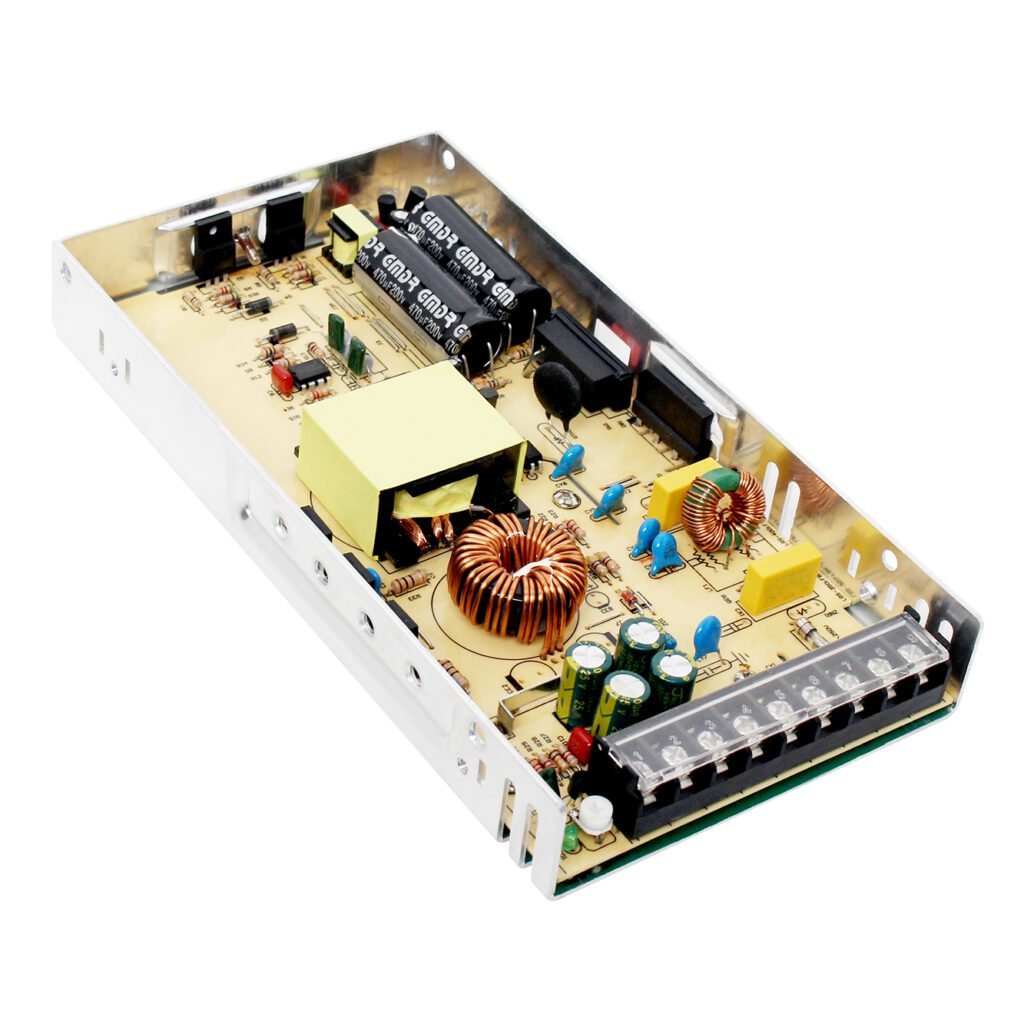
Introduction: The Fundamental Choice in Power Supply Design
When selecting between a switching power supply and linear power supply, engineers face a critical decision impacting system efficiency, size, thermal management, and overall performance. This comprehensive comparison examines both technologies across four key parameters, helping you make informed decisions for industrial, commercial, and electronic applications.
1. Efficiency Comparison: SMPS vs Linear Power Supply
Switching Power Supply Efficiency (SMPS)
Switching power supplies achieve impressive efficiency ratings through high-frequency operation:
Typical Efficiency: 70-95%
High-Efficiency Models: Up to 96% (with PFC)
Power Factor Correction: Modern SMPS often include active PFC (>0.95)
Variable Load Performance: Maintain high efficiency across wide load ranges
Example: A 24V/10A industrial switching power supply (240W) with 92% efficiency dissipates only 20W as heat, drawing approximately 261W from the mains.
Linear Power Supply Efficiency
Linear power supplies suffer from inherent efficiency limitations:
Typical Efficiency: 30-60%
Major Loss Source: Voltage drop across series regulator
Heat Generation: Significant energy wasted as thermal dissipation
Input-Output Relationship: Efficiency ≈ (Vout/Vin) × 100%
Example: A 24V linear power supply from 120VAC input achieves only 20% efficiency (240W output requires 1200W input, dissipating 960W as heat).
Efficiency Comparison Table
| Load Condition | Switching Power Supply | Linear Power Supply |
|---|---|---|
| Full Load | 85-95% | 30-50% |
| Half Load | 87-94% | 25-45% |
| Light Load | 80-90% | 15-35% |
| Standby | 75-85% | 5-20% |
Key Insight: Switching power supplies provide 2-3 times better efficiency than linear equivalents, directly reducing electricity costs and cooling requirements.
2. Size and Weight Comparison
Switching Power Supply Dimensions
Switching power supplies excel in power density:
Compact Design: High-frequency operation (20kHz-1MHz) enables smaller magnetics
Light Weight: Eliminates heavy line-frequency transformers
Modern Examples:
DIN rail power supply: 24V/5A in 30×90×100mm (270cm³)
Enclosed switching supply: 240W in 60×100×120mm
LED power supply: 150W waterproof unit in compact housing
Linear Power Supply Dimensions
Linear power supplies require substantial physical space:
Bulky Transformers: 50/60Hz operation demands large iron cores
Heatsink Requirements: Significant heat dissipation needs large aluminum heatsinks
Typical Sizes:
24V linear supply: Typically 2-3 times larger than equivalent SMPS
Industrial linear supply: Often requires separate cooling arrangements
Size Comparison: Real-World Examples
| Specification | Switching Power Supply | Linear Power Supply | Size Reduction |
|---|---|---|---|
| 24V/5A (120W) | 125×60×30mm (225cm³) | 200×100×80mm (1600cm³) | 86% smaller |
| 12V/10A (120W) | 100×50×35mm (175cm³) | 180×90×70mm (1134cm³) | 85% smaller |
| 48V/3A (144W) | 130×65×40mm (338cm³) | 220×110×85mm (2057cm³) | 84% smaller |
Design Advantage: For DIN rail mounting or space-constrained industrial cabinets, switching power supplies offer clear installation benefits.
3. Heat Dissipation and Thermal Management
Switching Power Supply Thermal Characteristics
Modern switching power supplies manage heat effectively:
Low Heat Generation: 5-30% of input power converted to heat
Distributed Heat Sources: Heat spread across multiple components
Efficient Cooling: Often convection-cooled, no fan required for <300W
Temperature Range: Typically -25°C to +70°C ambient operation
Thermal Protection: Built-in over-temperature shutdown
Industrial Application: 24V DIN rail power supplies in control cabinets often operate without additional cooling, even in dense installations.
Linear Power Supply Thermal Challenges
Linear power supplies present significant thermal challenges:
High Heat Generation: 40-70% of input power wasted as heat
Concentrated Hotspots: Series regulator becomes extremely hot
Cooling Requirements: Large heatsinks or forced-air cooling often necessary
Temperature Derating: Output current typically derated above 40°C ambient
Safety Concerns: Surface temperatures can exceed 80°C
Thermal Management Comparison
| Parameter | Switching Power Supply | Linear Power Supply |
|---|---|---|
| Heat Dissipation | 5-30% of input power | 40-70% of input power |
| Cooling Method | Natural convection | Heatsink + often fan |
| Hotspot Temperature | 60-80°C | 80-120°C |
| Ambient Limit | Up to 70°C | Typically 40-50°C |
| Enclosure Requirement | Standard IP20/IP40 | Often ventilated/enforced cooling |
Critical Consideration: In sealed industrial power supply installations, switching power supplies reduce thermal management complexity and cost.
4. Application Scenarios: When to Choose Each Technology
When to Choose Switching Power Supplies (SMPS)
1. Industrial Automation Systems
PLC power supplies: 24V DIN rail power supplies for control cabinets
Sensor networks: Distributed 24V power supplies across factory floor
Motor controllers: 48V industrial power supplies for servo drives
Example: Siecon S-DIN Series for factory automation
2. LED Lighting Applications
Commercial lighting: LED power supply 24V for office/retail lighting
Street lighting: Waterproof LED drivers with high efficiency
Architectural lighting: Dimmable LED power supplies with smooth control
Example: Siecon S-LED Series with TRIAC/0-10V dimming
3. Electronics and Communications
Network equipment: 48V switching power supplies for PoE switches
Consumer electronics: Compact AC-DC power supplies for devices
Medical equipment: Low-leakage medical power supplies
Example: Enclosed switching power supplies for telecom installations
4. Renewable Energy Systems
Solar applications: Wide-input DC-DC converters
Battery charging: Efficient battery charger power supplies
Energy storage: Dual output power supplies for monitoring systems
When to Choose Linear Power Supplies
1. Audio and RF Applications
High-fidelity audio: Ultra-low noise power for preamplifiers
Radio equipment: Clean power for sensitive RF circuits
Measurement systems: Precision analog instrumentation
2. Laboratory and Test Equipment
Bench power supplies: Low-ripple variable power supplies
Calibration standards: Stable reference voltage sources
Sensor excitation: Low-noise bias supplies
3. Low-Power, High-Precision Applications
Medical sensors: Micro-power linear regulators
Reference circuits: Voltage references with ppm stability
Low-noise analog: Signal conditioning front ends
Application Decision Matrix
| Application Type | Recommended Technology | Key Reason | Example Products |
|---|---|---|---|
| Industrial Control | Switching Power Supply | Efficiency, Size | 24V DIN Rail Power Supply |
| LED Lighting | Switching Power Supply | Efficiency, Cost | 24V LED Driver |
| Audio Amplifier | Linear Power Supply | Low Noise | Linear Regulator |
| Laboratory Instrument | Linear Power Supply | Precision | Bench Power Supply |
| Telecom Equipment | Switching Power Supply | Power Density | 48V DC Power Supply |
| Automotive Electronics | Switching Power Supply | Wide Input Range | DC-DC Converter |
5. Technical Specifications Deep Dive
Voltage and Current Ranges
Switching Power Supply Capabilities:
Input Voltage: Wide range (85-264VAC, 120-370VDC)
Output Voltage: Single (5V, 12V, 24V, 48V) or multiple outputs
Current Rating: From <1A to >100A models available
Regulation: Typically ±1% line/load regulation
Linear Power Supply Limitations:
Input Voltage: Narrow range (often fixed transformer tap)
Output Voltage: Limited adjustment range
Current Rating: Practical limit around 5-10A due to heat
Regulation: Excellent (±0.1% with good design)
Protection Features Comparison
Switching Power Supply Protections:
Overvoltage protection (OVP)
Overcurrent protection (OCP)
Short circuit protection (SCP)
Over temperature protection (OTP)
Surge and spike protection
Linear Power Supply Protections:
Current limiting (foldback or constant)
Thermal shutdown
Overvoltage crowbar (some models)
Reverse polarity protection
Cost Analysis
Initial Cost:
Low-power (<50W): Linear often cheaper
Medium-power (50-500W): Switching typically cheaper
High-power (>500W): Switching significantly cheaper
Total Cost of Ownership:
Energy cost: Switching saves 30-70% on electricity
Cooling cost: Switching reduces HVAC requirements
Space cost: Switching saves valuable enclosure space
Reliability: Both can be highly reliable when properly applied
6. Frequently Asked Questions (FAQ)
Q1: Can switching power supplies replace linear supplies in all applications?
A: While switching power supplies excel in most applications, linear power supplies remain preferable for ultra-low-noise analog circuits, certain RF applications, and specific laboratory instruments where ripple and switching noise are unacceptable.
Q2: Why do switching power supplies have higher efficiency?
A: Switching power supplies achieve high efficiency by rapidly switching transistors between fully-on and fully-off states, minimizing power dissipation. In contrast, linear power supplies continuously dissipate excess voltage as heat across a series regulator.
Q3: Are switching power supplies noisier than linear supplies?
A: Yes, switching power supplies generate high-frequency noise (20kHz-1MHz) that requires filtering. However, modern designs with proper filtering can meet stringent EMI requirements. Linear power supplies produce virtually no switching noise, making them ideal for sensitive analog applications.
Q4: Which is better for 24V industrial applications?
A: For 24V industrial power supplies, switching power supplies are overwhelmingly preferred due to their higher efficiency, smaller size, and better thermal performance. DIN rail power supplies almost exclusively use switching technology.
Q5: Can linear and switching power supplies be combined?
A: Yes, hybrid approaches are common. A switching pre-regulator can provide efficient voltage reduction, followed by a linear post-regulator for ultra-clean output. This combines efficiency with low noise.
Q6: How do I choose between them for my specific application?
A: Follow this decision flowchart:
Is ultra-low noise critical? → Choose Linear
Is efficiency or heat a concern? → Choose Switching
Is size/weight constrained? → Choose Switching
Is cost the primary driver? → Evaluate both for total cost
Industrial application? → Almost always Switching
7. Future Trends and Developments
Switching Power Supply Advancements
Higher Switching Frequencies: Moving toward MHz-range operation for further miniaturization
Wide Bandgap Semiconductors: GaN and SiC devices enabling higher efficiency (>97%)
Digital Control: Intelligent power management with adaptive algorithms
Integration: Higher levels of integration reducing component count
Linear Power Supply Niche Refinement
Ultra-Low Noise Designs: Specialized linear regulators for quantum and scientific applications
Integration: Linear regulators integrated with switching front ends
Material Science: Improved thermal interface materials for better heat dissipation
Conclusion: Making the Right Power Supply Choice
The switching power supply vs linear power supply debate has largely been resolved in favor of switching technology for most applications. With 70-95% efficiency versus 30-60%, compact size versus bulky designs, and minimal heat versus significant thermal challenges, switching power supplies deliver clear advantages for industrial, commercial, and consumer applications.
Key Recommendations:
Industrial Applications: Choose switching power supplies (DIN rail, enclosed, or modular designs)
LED Lighting: Select efficient switching LED drivers with appropriate dimming
Sensitive Analog: Consider linear power supplies or hybrid approaches
General Electronics: Switching power supplies typically offer the best balance
For 24V industrial systems, DIN rail power supplies, LED lighting installations, and most modern electronic systems, switching power supply technology provides the optimal combination of efficiency, size, reliability, and cost-effectiveness.
About Siecon Power Systems: We specialize in high-efficiency industrial switching power supplies, including DIN rail power supplies, LED drivers, and custom power solutions. Contact us for application-specific recommendations.