
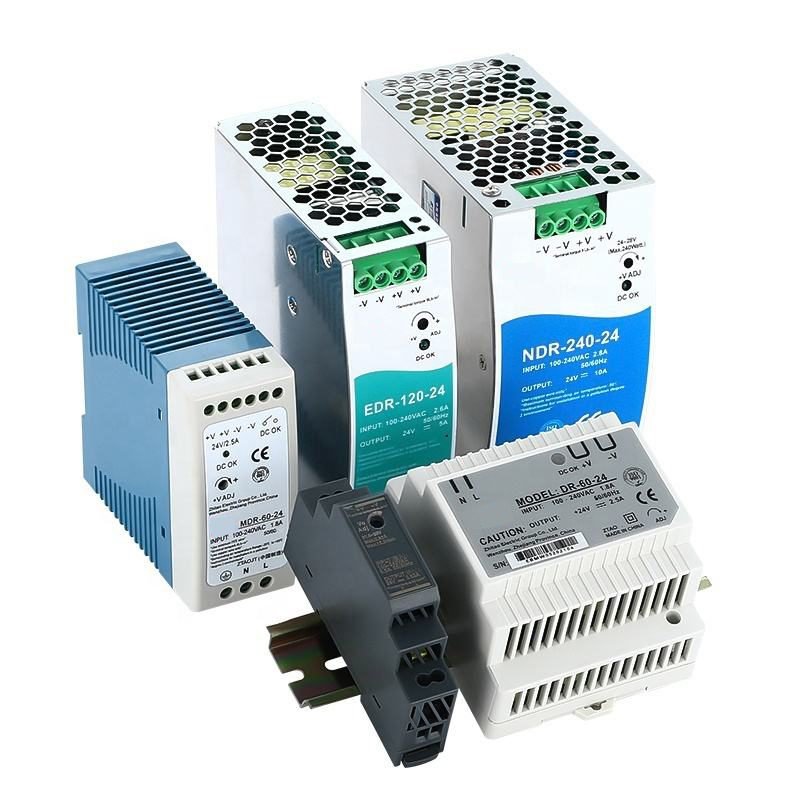
Introduction
For industrial automation, control cabinets, and electrical equipment, the 24V DIN Rail Power Supply is a critical component that ensures stable operation. However, many newcomers make costly mistakes when selecting this power supply—such as ignoring current requirements or overlooking environmental adaptability—leading to equipment failures or safety risks. This article highlights 5 key mistakes to avoid, helping you choose a reliable model.
1. Ignoring Current Margins: Don’t Just “Match” the Rated Current
A common mistake is selecting a unit with output current exactly equal to the equipment’s rated current. In practice:
- Industrial equipment often has peak current demands (e.g., during startup) that exceed the rated current by 10-20%.
- Choose one with output current 1.2-1.5 times the equipment’s maximum current (e.g., for a 5A device, select a 6-7.5A model).
- Example: A 24V 10A DIN Rail Power Supply works better for a 24V 8A motor than a 24V 8A model, as it prevents overloading and extends lifespan.
2. Overlooking Protection Functions: Essential for Industrial Safety
Many beginners skip checking protection features when buying this power supply, but these are non-negotiable for industrial use:
- Overload Protection: Shuts down the unit if load exceeds rated current, protecting both the device and connected equipment.
- Short-Circuit Protection: Critical for accidental wiring errors—prevents the unit from burning out.
- Overvoltage Protection: Stops voltage spikes from damaging sensitive components like sensors or PLCs.
3. Neglecting Efficiency Rating: Wasting Energy and Increasing Heat
Efficiency directly impacts operating costs and heat generation for this equipment:
- Prioritize models with 85%+ efficiency (88%+ for 100W+ output) to reduce energy waste and lower electricity bills.
- Higher efficiency means less heat, reducing the need for cabinet cooling systems and extending the unit’s life.
- Look for certifications like ENERGY STAR or CE Level V to confirm efficiency claims.
4. Disregarding Temperature Range: Mismatched to Industrial Environments
Industrial sites often have extreme temperatures, but many beginners choose a unit rated only for room temperature (0-40°C):
- For high-heat areas (e.g., near machinery), select a model with a -20°C to 60°C range.
- For cold environments (e.g., outdoor cabinets), ensure it can start at -30°C without issues.
- Verify temperature claims with third-party test reports—low-cost models may not perform as advertised.
5. Ignoring Industrial Certifications: Risking Non-Compliance
Certifications guarantee the unit meets safety and performance standards:
- CE (EN 61558): Mandatory for European markets, ensuring electromagnetic compatibility (EMC).
- UL 508: Critical for North America, certifying suitability for control circuits.
- IEC 60950: Prevents electric shock and fire hazards.
- Avoid uncertified models—they may violate local regulations and pose safety risks.
Conclusion
Selecting the right 24V DIN Rail Power Supply requires more than just matching voltage. By avoiding these 5 mistakes—ignoring current margins, skipping protection checks, neglecting efficiency, disregarding temperature range, and ignoring certifications—you can ensure stable equipment operation, reduce maintenance costs, and improve industrial system reliability. For specialized needs (e.g., medical or hazardous environments), consult a professional supplier for tailored solutions.